There is a moment — and if you have lived it, you will never forget it — when you are far from home, maybe in a London underground station or a mall in Houston or a supermarket in Toronto, and suddenly, from somewhere you cannot immediately locate, you hear it. That bass. That rhythm. That unmistakable bounce that does not walk, it sways. And before your brain can even process what is happening, your body has already responded. Your shoulders drop. Your head tilts. A small, involuntary smile crosses your face.
That is Afrobeats. And that moment — that involuntary, full-body recognition — is exactly why the world has stopped sleeping on African music.
But here is what the international press will not tell you: this did not happen because Africa got lucky. It did not happen because some American executive discovered us and decided we were worth promoting. It happened because a generation of young Africans — hungry, talented, stubborn, and completely unbothered by gatekeepers — refused to shrink themselves to fit into a world that was not designed to celebrate them.
This is the story of how African music stopped being a genre and became a global religion.
The Years Nobody Was Watching
Let us go back. Not to Burna Boy's Grammy. Not to Wizkid and Drake. Let us go all the way back to the years when Afrobeats was being made in small studios in Surulere and Oshodi, in rented rooms in Accra's Osu, in makeshift booths in Nairobi. The years when the music was everywhere on the continent and completely invisible to the rest of the world.
In those years, Nigerian artists were not signed to Sony or Universal. They were pressing CDs in Alaba International Market. They were selling from the boots of cars. They were performing at owambe parties and student union events and local concerts where the sound system would cut out twice before the night was over — and the crowd would not even care, because the energy in that room was its own electricity.
The music that came out of those years was not polished for export. It was not made with international audiences in mind. It was made for us — for the girl in Yaba who needed something to play while she was getting her hair done, for the boy in Kumasi who needed a soundtrack to his heartbreak, for the family in Lagos Island sitting on the balcony on a Sunday afternoon with cold drinks and warm air and nowhere else they would rather be.
That authenticity — that music made from the inside out rather than from the outside in — is exactly what eventually made the world stop and listen.
The Architects Nobody Gave Enough Credit To
Before we talk about the current kings, let us pause and pour a little for the ones who laid the foundation.
Fela Anikulapo-Kuti did not just make music. He built an entire language — a way of using rhythm and saxophone and Yoruba and Pidgin to say things that could get you arrested. His music was protest and party at the same time, which is perhaps the most African thing that has ever existed. You dance because things are hard. You dance despite things being hard. You dance because the dancing itself is an act of defiance.
Then came King Sunny Ade, whose Juju music made the guitar sound like it had always belonged in West Africa. Came Femi Kuti carrying the torch. Came 2face Idibia with African Queen — a song so honest about love and longing that it crossed every border without even trying. Came D'banj whose energy was so large it could not be contained in any single room, any single country, any single continent.
These men did not get Grammy nominations. They did not get New York Times profiles. But they built the road that every current superstar is walking on, and that road needs to be acknowledged.
When the World Finally Turned Its Head
The tipping point, if you want to name one, was probably 2016. That was the year Wizkid appeared on Drake's One Dance — a song that became the most-streamed track in Spotify history at the time. Suddenly, the conversation changed. Suddenly, A&R executives who had spent years ignoring emails from Nigerian managers were asking questions. Suddenly, "Afrobeats" was a word that people in Los Angeles were using in meetings.
But even that moment can be misread. The world did not discover Afrobeats in 2016. Afrobeats had been fully formed and thriving for years. What happened in 2016 was simply that the world's ears finally caught up with what Africa already knew.
From that point, the momentum became unstoppable. Burna Boy turned his pain and his pride into an album called African Giant — a title that was not a boast but a statement of identity — and then followed it with Twice as Tall and Love, Damini, each one bigger and more cinematic than the last. When he won the Grammy for Best Global Music Album in 2021, he stood on that stage not like someone who had been given something, but like someone who had come to collect what was already his.
Davido built a different kind of empire — louder, more communal, more intentionally pan-African. His music has always understood that joy is not a small thing. That celebration is not frivolous. That a song about dancing and loving and living fully is just as important as any other kind of song.
Tems arrived and reminded everyone that African women had been making breathtaking music all along and that the world simply had not been paying attention. Her voice — low, aching, bottomless — does something to a room that is difficult to describe in words. It settles into your chest like warm food after a long journey.
What Nobody Talks About
Here is the thing about the global Afrobeats conversation that sometimes feels incomplete: it focuses almost entirely on Nigeria. And while Nigeria's contribution is undeniable and enormous, African music is not one country.
Ghana gave us Highlife — one of the most sophisticated musical traditions on the continent, and the ancestor of much of what we now call Afrobeats. Ghana gave us Sarkodie, whose mastery of rap in Twi and English makes him one of the most complete lyricists the continent has produced. Gave us Black Sherif, whose Kwaku The Traveller felt like it was pulled from the chest of every young African who has ever felt the weight of expectations and the longing to be free.
East Africa gave us Afro-fusion sounds rooted in Benga and Taarab. Southern Africa gave us Amapiano — perhaps the most important new genre to emerge from the continent in a decade, a sound so hypnotic and joyful and communal that it has now infiltrated clubs from Johannesburg to Berlin to São Paulo.
African music is a continent, not a country. And the more the world begins to understand that geography, the richer the conversation becomes.
The Generation That Changed Everything
What makes the current moment in African music truly historic is not just the talent — Africa has always had talent in extraordinary abundance. What makes it historic is the infrastructure that has grown up around that talent.
Young African producers, managers, lawyers, and executives are building the music industry from the inside. Labels like Spaceship Entertainment, DMW, and Chocolate City are not just talent houses — they are proof that African artists do not need to sign away their power to foreign companies in order to reach the world.
Streaming has been both a blessing and a complication. On one hand, it has given African artists a direct line to global audiences that no CD distribution deal could have provided. On the other hand, the economics of streaming continue to shortchange artists who do not have the marketing budgets of major Western labels. These are conversations that the African music industry must continue to have — loudly and without apology.
What Comes Next
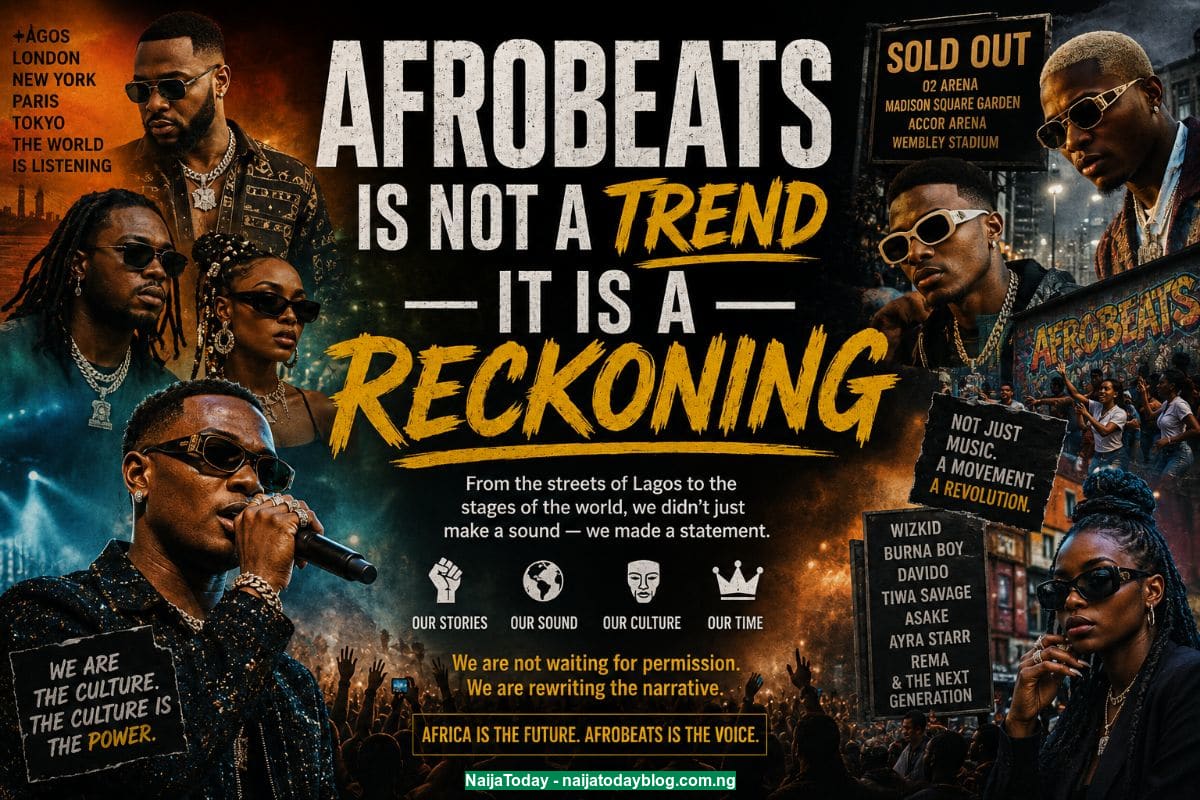
Afrobeats is not a moment. It is a movement. And movements do not peak — they evolve.
The next chapter of African music will be written by artists who are not afraid to be complicated. Artists who blend Afrobeats with jazz, with classical, with spoken word, with electronic music, with silence. Artists who use their platforms not just to entertain but to interrogate — to ask hard questions about governance, identity, mental health, gender, and what it means to be young and African in the twenty-first century.
It will be written by women who refuse to be backup singers in their own stories. By producers whose names finally get mentioned in the same breath as the artists they built. By journalists and critics on the continent who stop waiting for validation from Western publications before they decide something is important.
The world is listening now. And Africa — finally, fully, unapologetically — is speaking