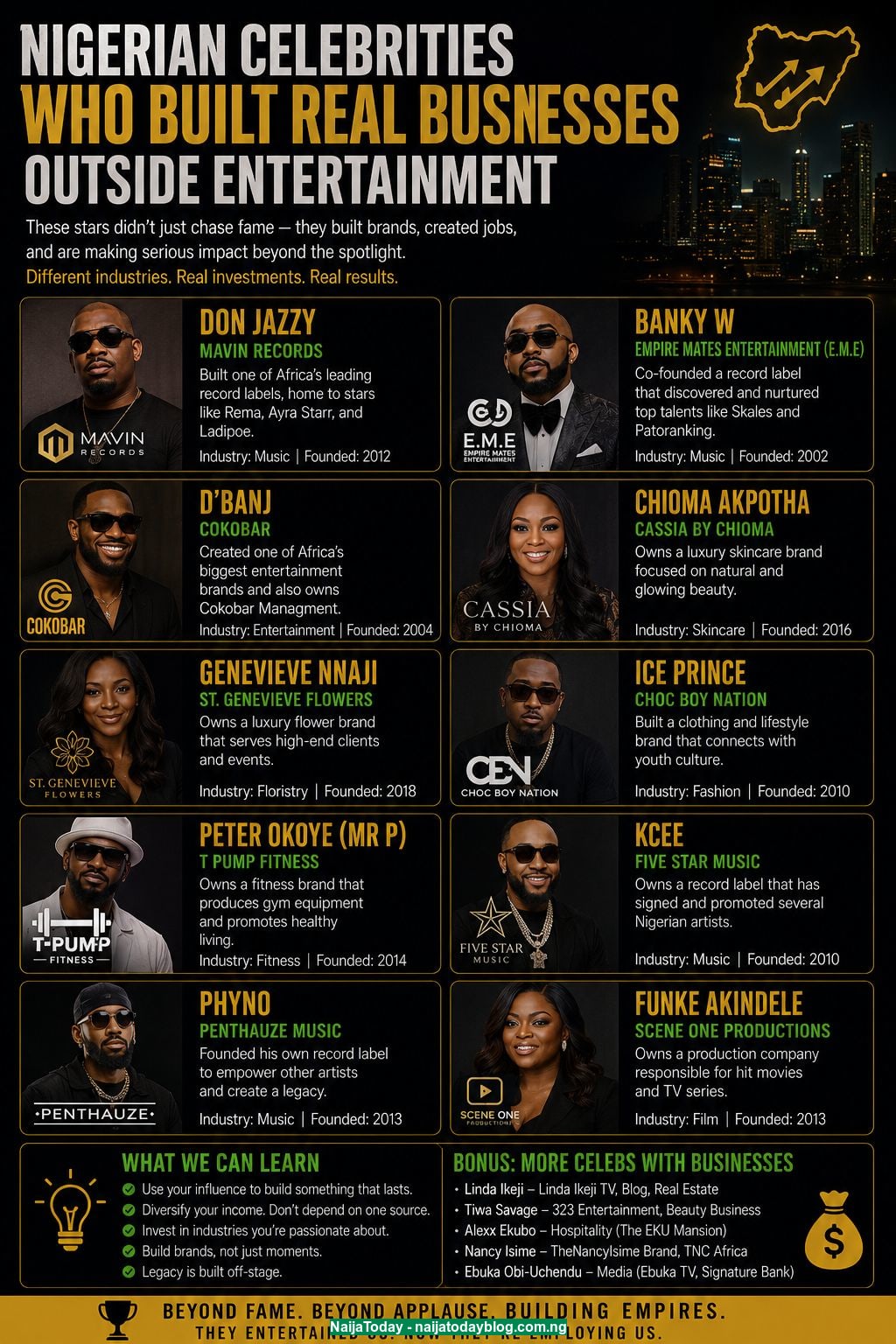
Nigerian Celebrities Who Built Real Businesses
Outside Entertainment
"Fame fades faster than most people admit."
"The smart ones built something that doesn't depend on the next hit song landing."
Nigerian entertainment careers can be brutally short — a hit song or a breakout
role can carry someone for a few years, but the industry has never been kind to
artists who assume the spotlight is permanent. The entertainers who've actually
built lasting wealth are, almost without exception, the ones who took their
fame and turned it into something structurally independent from it — a company,
a product line, a piece of infrastructure that keeps earning whether or not
they're currently trending.
Here's a look at a few who genuinely did the work, not just slapped their name
on a product for a quick endorsement cheque.
D'banj — From "Koko Master" to
FMCG Owner
D'banj's music career made him one of the defining voices of 2000s and 2010s
Nigerian pop, but his business portfolio is where the real longgame strategy
shows. Through Koko Holdings, he launched Koko Garri, a packaged food product
tapping directly into one of Nigeria's most universal staples — smart
positioning for a brand built to outlast any single album cycle. He's also
expanded into manufacturing plans covering products like mattresses, and moved
into the tech and media space through Median Mobile Communications Limited
(MCOMM) and D'Kings Men Media Limited, a full media company. It's a genuinely
diversified portfolio — food, tech, media — rather than a single vanity
project.
Don Jazzy — Built an Empire, Not Just a
Label
Don Jazzy's Mavin Records, founded in 2012, is the obvious headline — the label
behind Tiwa Savage, Korede Bello, Rema, and a long list of artists who went on
to become stars in their own right. But the smarter longterm move was building
the infrastructure around the label rather than stopping at "record label
owner." Mavin Global functions as a broader entertainment company, Mavin
Studios provides recording infrastructure, Mavin Films moves into production,
and Mavin Models extends the brand into a completely different industry. The
pattern here is instructive: rather than one business, Don Jazzy built an
ecosystem where each piece feeds the others.
Genevieve Nnaji — Fashion Beyond the
Screen
Long before her international Netflix moment with Lionheart, Genevieve Nnaji
had already stepped into business with St. Genevieve, a clothing line she
founded in 2008. The brand focused on elegant, wearable womenswear — dresses,
tops, pants, skirts — reflecting her own personal style rather than chasing a
trend. It's a straightforward but smart move: an actress with genuine fashion
influence building a product line that monetises that influence directly,
instead of only earning from endorsement deals for other people's brands.
Olamide — Real Estate and Fuel
Stations
Olamide's business instincts extend well past his own YBNL Nation record label,
which itself launched the careers of several major Nigerian artists. Away from
music, he's invested in tangible, unglamorous assets — landed property across
Lagos and ownership of fueling stations. These aren't flashy businesses built
for headlines; they're the kind of steady, appreciating assets that keep
generating income regardless of whether his latest single charts. It's a notably
different strategy from artists who plough money purely into visible luxury.
Tiwa Savage — Owning Her Own Machine
Even while signed to Mavin Records, Tiwa Savage built 323 Entertainment, her
own entertainment company running alongside her recording career. It's a model
more artists are increasingly adopting — staying within a major label's
ecosystem for reach and resources, while simultaneously owning a separate
structure that captures value independently of any single deal or contract.
The Pattern Worth Noticing
What separates these ventures from the endless list of celebrities who've
slapped their face on a "personal fragrance" or a oneoff clothing
drop that quietly disappeared is structural thinking. Koko Garri isn't just D'banj's
name on a product — it's a food company built to function whether or not he's
actively promoting it. Mavin isn't just Don Jazzy's label — it's a multiarm
entertainment infrastructure. St. Genevieve isn't a celebrity cashgrab — it's a
real clothing brand with its own design identity.
The entertainers who build businesses that outlast their fame tend to share the
same instinct: they treat the business as a real business, with its own logic
and its own customers, rather than as an accessory to their celebrity. Fame
opens the first door. What happens after that is where the actual difference
gets made.
Published on NaijaToday — naijatodayblog.com.ng