A NaijaToday
Feature
There is a particular kind of exhaustion that has settled over large parts of
Nigeria — the exhaustion of communities that have stopped asking if the next
attack will come, and started asking only when. In villages across Zamfara,
Sokoto, Katsina and Benue, families now build their lives around a threat they
cannot see coming and a government response that, for all its announcements,
has struggled to keep pace with the violence. This week alone brought both
halves of that story at once: the Presidency celebrating the rescue of over 300
kidnap victims in a single coordinated operation, even as fresh attacks tore
through four states in the same seven days. To understand why Nigeria keeps
oscillating between these two headlines — triumph and tragedy, often in the
same week — you have to understand how this crisis actually works, not just how
it's reported.
A Crisis With No Single Name
Part of what makes Nigeria's insecurity so hard to fix is that it isn't one
crisis. It's at least four, overlapping and occasionally feeding into each
other, each with its own logic.
In the NorthEast, the story is the one most outsiders know: the longrunning
Boko Haram insurgency, now over 16 years old, which has recently seen a
resurgence of its JAS faction with deadly attacks concentrated in Borno State,
the conflict's original epicentre. In the NorthCentral states — Benue,
Plateau, Nasarawa — the driver is decadesold tension between predominantly
Muslim herding communities and Christian farming communities, tension that
flared again through the first half of 2026 and has claimed lives in Benue as
recently as this past July. In the SouthEast, a smaller but persistent thread
of Biafran secessionist activity continues to produce clashes with security
forces. And in the Niger Delta and SouthSouth, a rise in criminal gang
activity has added yet another layer to an already strained security architecture.
But the crisis dominating headlines week after week — the one behind most of
the masskidnapping stories you've read about this year — is banditry in the
NorthWest. And according to researchers who study it closely, calling it
"banditry" almost undersells what it has become.
The Anatomy Of A Kidnapping Economy
Analysts increasingly describe what's happening in Zamfara, Kaduna, Sokoto and
Katsina not as sporadic crime but as an entire informal economy built on fear.
Armed groups — some purely criminal, some blurring into loosely ideological
territory, almost none of them formally aligned with jihadist movements despite
persistent conflation in public discourse — have established what one recent
security analysis called "protogovernance systems": networks that
impose informal rules, extract resources, and shape the daily behaviour of
entire communities in places where the Nigerian state has limited or only
episodic presence.
The scale of it is staggering once you look past any single week's headlines. A
report by Lagosbased risk firm SBM Intelligence found that 2,938 people were
kidnapped in the NorthWest alone between July 2024 and June 2025 — more than
60 percent of all kidnapping incidents recorded nationwide in that period.
Zamfara State, the epicentre of the crisis, accounted for 1,203 of those
abductions on its own, followed by Kaduna with 629, Katsina with 566, and
Sokoto with 358. Zoom out further, and SBM's broader tracking puts the number
at roughly 15,000 kidnappings recorded nationally between 2019 and 2025.
Even more striking is a National Bureau of Statistics report that has
circulated widely among Nigerian security analysts and, notably, has not been
publicly countered by government. Covering just an 11month window between May
2023 and April 2024, the NBS found that Nigeria recorded 614,937 deaths
connected to insecurity nationwide, with the NorthWest logging the highest
regional toll at 206,030, followed by the NorthEast at 188,992. Over the same
period, the report estimated 2,235,954 Nigerians were kidnapped, with roughly
₦2.23 trillion — close to $1.44 billion — paid out in ransom. Separately, a
Beacon Consulting security report tracking the period since President Tinubu's
May 2023 inauguration put the toll at 13,346 people killed and 9,207 abducted
across 667 local government areas through late 2024, with the situation visibly
worsening between the two periods measured.
Whichever dataset you trust most, the pattern underneath them is the same: this
isn't a series of isolated tragedies. It's a systemic, sustained crisis with
its own internal economics.
And those economics matter, because they explain why kidnapping has proven so
difficult to simply arrest or bomb away. As one Nigerian journalist covering
the conflict put it in a recent analysis, "communities live in constant
fear, with deep trauma and severe social fragmentation" — and those who
can afford it increasingly pay tribute simply to survive, turning kidnapping
into what researchers have called a regressive tax on Nigeria's poorest, most
agrarian communities. The effect compounds: insecurity reduces crop production,
empties markets, disrupts trade and transport routes on which entire local
economies depend, and drives up food prices in a country already fighting
inflation on multiple fronts.
Why Firepower Alone Hasn't Been Enough
It would be inaccurate to say Nigeria hasn't tried to respond. The federal
government has poured increasing budgetary allocations into security year after
year, expanded military acquisitions, and — as this week's headlines showed —
scored real, meaningful wins: over 300 people freed from a single forest
hideout in Niger State's Kainji Lake National Park in a joint operation
involving the military, police, DSS and the National CounterTerrorism Centre;
seven kidnapped Ogun State polytechnic students recovered within days; three
separate captives rescued by troops of Operation Whirl Stroke after a
crossborder pursuit into Taraba State — all in the same sevenday window
covered in this piece.
Yet, as one analyst told a Nigerian newspaper this year, "the security
crisis is severe" regardless of these operational wins, and the reason
cuts to the heart of the problem: rescue operations, however wellexecuted,
treat the symptom rather than the disease. Security researchers increasingly
argue that Nigeria's counterterrorismstyle strategy — built primarily around
the NorthEast insurgency — simply cannot address banditry, communal violence
and separatist unrest with the same toolkit, because each is driven by
genuinely different political, economic and social causes. Treating a criminal
extortion economy in Zamfara the same way you'd treat an ideological insurgency
in Borno risks missing what's actually sustaining the violence: the absence of
consistent state presence, economic desperation in rural farming and herding
communities, and the sheer profitability of ransom kidnapping in places where a
single successful raid can net more than a family might earn legitimately in
years.
There's also a harder truth security commentators have started raising more
openly this year: some of the worst incidents were preceded by ignored early
warnings. In a widely discussed piece published this year, one security
researcher — a postgraduate student at Ahmadu Bello University who has closely
tracked the banditry crisis — argued that Nigeria's catastrophe has been
compounded not just by the violence itself but by a persistent failure to act
on intelligence and early indicators before attacks happen, turning preventable
tragedies into recurring ones.
The Human Cost Behind The Statistics
Numbers, however large, can numb rather than inform. So it's worth sitting,
briefly, with what they represent. Since 2014, more than 1,400 students have
been kidnapped from Nigerian schools alone, the majority in NorthWest and
NorthCentral states — a statistic that has reshaped how millions of Nigerian
parents think about sending their children to school in affected states. Behind
this week's headline rescue of 163 people from Kwara State's Woro community
sits the reality that those victims spent nearly six months in captivity before
their February abduction was resolved. Behind the 37 people abducted in a
single Sokoto raid this week are 37 individual families now living through the
specific, grinding uncertainty of not knowing whether — or when — their
relative comes home.
This is the part statistics can't fully capture: insecurity in Nigeria isn't
just a security problem, it's a mental health crisis playing out at national
scale, largely without formal acknowledgment or support systems for the
survivors and families left behind.
Where This Leaves Nigeria
There are, to be fair, signs of adaptation. The 50,000officer police
recruitment drive that concluded this week — one of the largest in Nigeria's
history, launched directly in response to President Tinubu's November 2025
declaration of a nationwide security emergency — represents a genuine attempt
to address one of the most cited structural problems: Nigeria's
policetopopulation ratio has long been among the weakest in Africa, leaving
vast rural areas essentially unpoliced. Whether 50,000 additional constables
meaningfully change the calculus in Zamfara's forests or Sokoto's border
communities will depend enormously on deployment, training quality, and — as
officials themselves acknowledged this week — funding actually being released
for training to begin.
What's clearer is this: Nigeria's insecurity crisis will not be solved by
rescue operations alone, however impressive individual missions are, and it
will not be solved by recruitment numbers alone, however large. The research is
increasingly consistent on one point — that lasting change requires treating
banditry as the economic phenomenon it has become, not only as a policing
problem: addressing the poverty and state absence that make joining an armed
group appear rational to some, disrupting the ransom economy that makes
kidnapping profitable, and rebuilding the kind of consistent, trusted state
presence in rural communities that has been missing for the better part of a
decade.
Until then, Nigeria will likely keep living out weeks like this one — a
headline rescue and a headline atrocity, arriving almost simultaneously, each
one true, neither one the whole story.
This feature draws on reporting and data from Human Rights Watch's World
Report 2026, SBM Intelligence, the National Bureau of Statistics, Beacon
Consulting, The New Humanitarian, and Lawfare, alongside NaijaToday's own
coverage of security developments this week.
💬 Forum🔥 HOT
Nigeria's Insecurity Crisis Explained: Causes & Data
By NaijaToday Desk · 7 August 2026 · 10 min · 👁 5
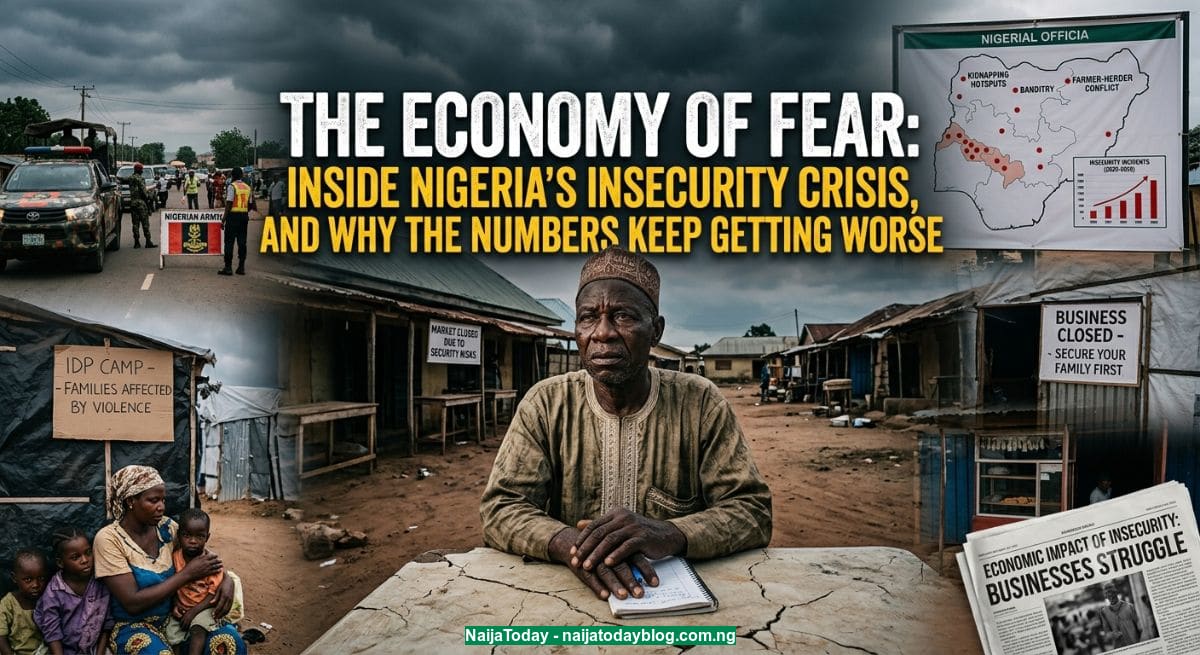
Why does Nigeria's insecurity crisis persist despite rescues and recruitment drives? A deep look at the banditry economy, real data, and root causes.
#nigeria insecurity#banditry#kidnapping nigeria#boko haram#north west nigeria#zamfara#herder farmer conflict#nigeria security crisis#nigeria police#national security#tinubu administration#nigeria analysis#security feature#ransom kidnapping#nigeria statistics
How does this story make you feel?
No account or sign-in needed. You can react instantly.
Share:
NaijaToday Desk
The NaijaToday newsroom
More Stories to Explore
More reporting selected from NaijaToday, based on topics and categories.