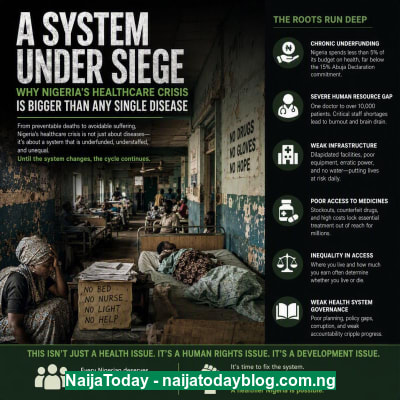
Resident Doctors
Give FG Final 4-Week Ultimatum — What It Means for Hospital Care in Nigeria
Nigeria's public healthcare system is once again standing on the edge of
disruption. The Nigerian Association of Resident Doctors (NARD) has formally
declared an industrial dispute with the Federal Government and issued what it
has described as a final four-week ultimatum, warning that it can no longer
guarantee industrial harmony if its long-standing demands remain unmet. For the
millions of Nigerians who depend on public hospitals and teaching hospitals for
their healthcare, this is news that deserves close attention — not as a distant
labour dispute, but as something that could directly affect access to care in
the weeks ahead.
How We Got Here
This latest development did not come out of nowhere. The decision was reached
during NARD's Extraordinary National Executive Council (E-NEC) meeting, held
virtually on Saturday, June 27, 2026, after the association reviewed the
Federal Government's response to an earlier 21-day ultimatum it had issued at
its May 2026 Ordinary General Meeting. That earlier ultimatum expired without
the government fully implementing its commitments, prompting this latest
escalation.
In a communiqué jointly signed by NARD President Dr. Mohammad Usman Suleiman,
Secretary-General Dr. Shuaibu Ibrahim, and Publicity and Social Secretary Dr.
Abdulmajid Yahya Ibrahim, the association confirmed it has now declared an
official industrial dispute with the Federal Government — a formal escalation
that sets the stage for the National Officers' Committee to begin all necessary
preparations for industrial action should the government fail to demonstrate
satisfactory compliance within the new deadline.
This is a familiar pattern for anyone who has followed Nigeria's healthcare
labour relations over the past few years. NARD declared a similar indefinite
strike back in January 2026, citing the Federal Government's failure to
implement a 19-point Memorandum of Understanding signed just two months earlier
in November 2025, following a 29-day strike that had paralysed hospitals
nationwide at that time. That January strike was suspended within 24 hours
following high-level interventions, but with a two-week ultimatum attached even
then. The cycle of strike threats, partial government concessions, and renewed
grievances has repeated itself with troubling regularity throughout 2026.
What Resident Doctors Are Actually Asking For
At the top of NARD's list of grievances is the Federal Government's continued
failure to release the 2026 Medical Residency Training Fund (MRTF), which the
association says has remained unpaid despite repeated assurances from
officials. This fund is critical because it directly supports the training and
professional development of resident doctors — the backbone of Nigeria's
teaching hospital workforce.
Beyond the MRTF, NARD's core demands include the immediate payment of 19 months
of outstanding professional allowance arrears, the settlement of outstanding
salary and promotion arrears owed to doctors across several health institutions
nationwide, and the accelerated implementation of the Medical and Health
Workers' Collective Bargaining Agreement along with recommendations from
ministerial committees on healthcare worker welfare and safety.
The association has also raised specific concern over the welfare of House
Officers — the most junior tier of resident doctors — describing persistent
delays in their salaries and entitlements as unacceptable and stating plainly
that "the continued hardship imposed on House Officers through delayed
remuneration is unacceptable and will no longer be tolerated."
Another sticking point involves the 25 to 35 percent upward review of the
Consolidated Medical Salary Structure (CONMESS) for medical doctors, with NARD
demanding immediate payment of arrears arising from that review. It is worth
noting that NARD has acknowledged some progress, praising state governments and
private tertiary hospitals that have already implemented the revised CONMESS
structure, paid outstanding arrears, and released residency training funds to
eligible doctors — suggesting this is fundamentally a federal-level
implementation problem rather than a universal failure across the entire
system.
The Brain Drain Behind the Strike
Underlying all of these specific demands is a much larger and more troubling
trend: the continued exodus of Nigerian medical professionals abroad. NARD
President Dr. Suleiman has previously disclosed that 4,700 doctors left Nigeria
in 2024 alone, contributing to a brain drain crisis that has seen approximately
15,000 medical practitioners emigrate over the past seven years.
This is not an abstract statistic. Every doctor who leaves for the United
Kingdom, Canada, the United States, the Gulf states, or elsewhere represents
years of training, often subsidised significantly by Nigerian taxpayers, that
ultimately benefits another country's healthcare system instead. Resident
doctors argue, with considerable justification, that unresolved welfare issues,
delayed salaries, and poor working conditions are direct contributors to this
exodus — and that genuinely addressing their demands is not simply about
appeasing striking workers, but about retaining the medical workforce Nigeria
desperately needs.
Nigeria's broader health indices underscore the stakes. The country continues
to grapple with high maternal and child mortality, life expectancy hovering
around 54 years, and a heavy disease burden spanning both infectious conditions
like malaria and a rising tide of non-communicable diseases such as
hypertension and diabetes. Health worker shortages, chronic underfunding, low
health insurance coverage, and stark geographic disparities in access to care
all compound these challenges, particularly for women and children in rural
areas.
The Government's Position
The Federal Government, for its part, has previously pushed back on the
characterisation of inaction. Minister of State for Health and Social Welfare
Dr. Iziaq Salako has stated that the funding for the Professional Allowance
arrears has already been captured in the 2026 budget, with an implementation
cost of roughly ₦90 billion provided for and assurances from the Budget Office
that sufficient provision exists in the service-wide vote to cover this and
other wage commitments.
Salako has also defended the government's approach to negotiating under
pressure, arguing that "agreements reached under pressure are not
enduring" and signalling a preference for the government to no longer be
"stampeded by strikes into agreements." This tension — between
resident doctors who feel repeatedly let down by unimplemented promises, and a
government that says it wants to avoid making rushed concessions purely to end
strikes — is at the heart of why this cycle keeps repeating itself.
What Past Strikes Have Actually Cost Nigerian Patients
To understand why this latest ultimatum is being taken so seriously, it helps
to look at the real-world impact of previous industrial actions by resident
doctors. The 29-day strike that paralysed hospitals nationwide in late 2025,
which produced the 19-point Memorandum of Understanding that has since gone
largely unimplemented, left countless patients across federal teaching
hospitals without access to specialist care for nearly a month. Elective
surgeries were postponed indefinitely. Patients requiring ongoing treatment for
chronic conditions were forced to seek alternative, often more expensive, care
at private facilities, if they could afford it at all. For lower-income
Nigerians who rely entirely on public teaching hospitals because they cannot
afford private healthcare, a prolonged strike is not an inconvenience; it can
mean the difference between receiving treatment and going without it
entirely.
Resident doctors occupy a particularly critical position within Nigeria's
hospital hierarchy. They are not junior staff in the way the term might suggest
to outsiders; resident doctors are fully licensed physicians undergoing
specialist training, and they make up a substantial proportion of the actual
clinical workforce delivering day-to-day care in federal teaching hospitals,
handling everything from emergency room triage to ward rounds to assisting in
surgical procedures. When resident doctors withdraw their services, hospitals
do not simply operate at reduced capacity; in many departments, they come close
to a standstill, with senior consultants left trying to cover workloads that
would normally be distributed across dozens of resident doctors.
This is precisely why the cycle of strikes, ultimatums, and partial
implementation has become such a source of frustration, not just for doctors
but for the Nigerian public broadly. Every unresolved ultimatum represents a
countdown toward another potential disruption to a healthcare system that
millions of vulnerable Nigerians depend on daily, often for life-threatening
conditions that cannot simply wait for a labour dispute to resolve itself.
The Human Cost Behind the Statistics
It is worth connecting this directly to Nigeria's broader public health
emergency. Nigeria's health indices remain genuinely alarming by global
standards: a 2021 analysis found that at least 750,000 Nigerians died that year
from preventable diseases including respiratory infections, malaria, diarrhoea,
and child mortality, conditions that, with adequate funding and a stable
healthcare workforce, are largely treatable or preventable in better-resourced
health systems. Every resident doctor who emigrates abroad, frustrated by
unpaid allowances and unstable working conditions, represents a further erosion
of the system's capacity to address this preventable mortality crisis.
This is the deeper context that should inform how Nigerians read this latest
four-week ultimatum. It is not simply a labour dispute over salary figures; it
is a direct referendum on whether the Federal Government can demonstrate,
through consistent and verifiable action rather than repeated promises, that it
takes seriously the retention of the medical workforce the country desperately
needs to address a public health crisis already costing hundreds of thousands
of lives annually.
What Happens Next
NARD has set its own internal deadline for assessing the government's
compliance: the association's National Executive Council meeting scheduled for
July 2026 in Gombe State. That meeting will determine whether the four-week
extension has produced meaningful results or whether Nigeria faces another
nationwide doctors' strike.
For now, NARD has reiterated its commitment to dialogue and constructive
engagement, stating it remains open to continued negotiation. But the language
of the latest communiqué is notably firmer than in previous rounds, with the
association stating clearly that it "could no longer guarantee industrial
harmony beyond the new deadline" if demands remain unresolved.
What This Means If You Need Medical Care
For ordinary Nigerians, the practical implication is this: the next four weeks
represent a critical window. If the Federal Government moves decisively to
release the Medical Residency Training Fund, settle outstanding allowance
arrears, and demonstrate concrete progress on the other demands, a strike may
once again be averted, as has happened multiple times this year. If not,
hospitals could face the kind of skeletal operations that accompanied previous
industrial actions, with consultants overstretched and patients facing longer
waits and reduced access to specialist care, particularly in federal teaching
hospitals.
If you or a family member has an ongoing medical condition requiring regular
hospital visits, it may be worth having an early conversation with your
healthcare provider now about contingency options, rather than waiting until
the four-week window closes to find out whether services will be disrupted.
Patients scheduled for elective procedures at federal teaching hospitals in
particular should stay closely in touch with their treating physicians about
scheduling, given the real possibility of postponement if industrial action
does eventually resume.
NaijaToday will continue monitoring this situation closely as the July deadline
approaches, and we encourage readers, particularly those managing ongoing
medical conditions or planning hospital procedures, to stay informed and plan
accordingly in case industrial action resumes.
This is a developing health and labour story. If you are personally affected
by an ongoing medical condition and have concerns about continuity of care,
speak with your healthcare provider about contingency plans during this
period.*
Resident Doctors Give FG Final 4-Week Ultimatum — What It Means for Hospital Care in Nigeria
By NaijaToday Desk · 30 June 2026 · 6 min · 👁 4
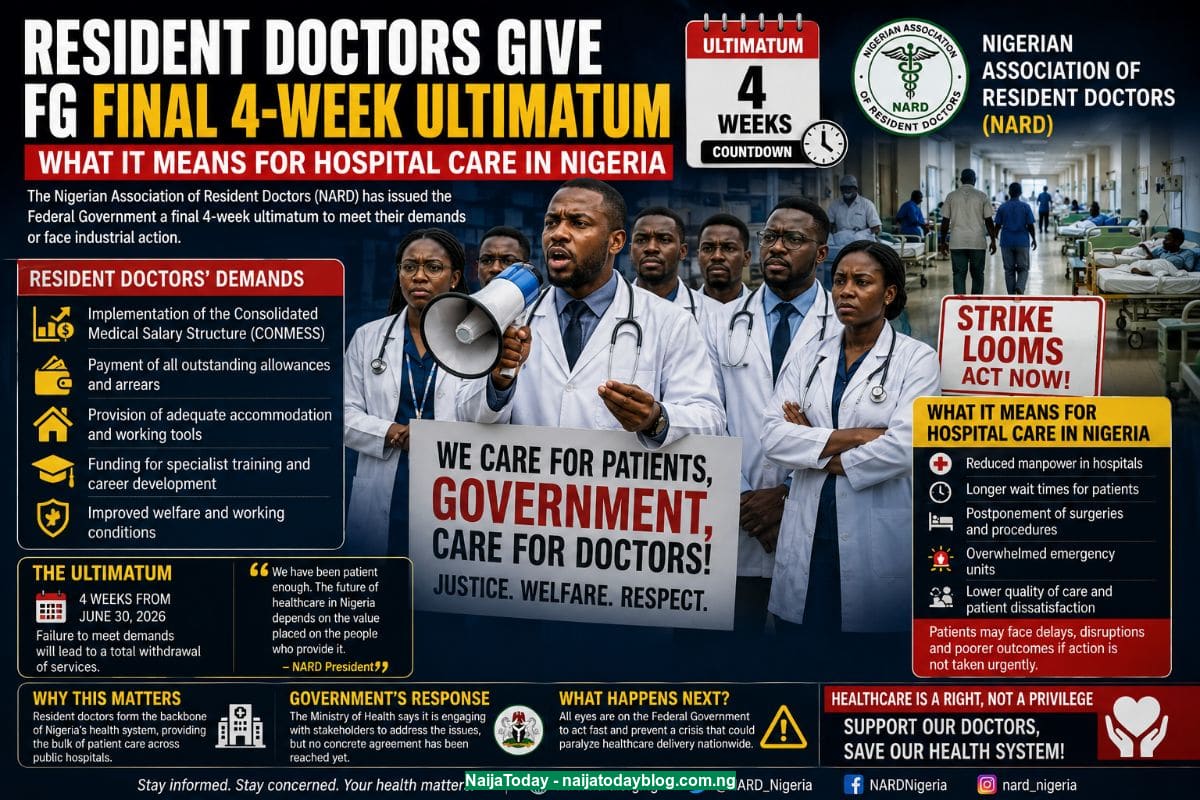
NARD has declared an official industrial dispute with the Federal Government and issued a final four-week ultimatum before a possible nationwide strike. Here's what's driving the crisis and what it means for patients.
#nard strike 2026#resident doctors nigeria#nigeria health crisis#doctors strike news#nard ultimatum#medical residency training fund#nigeria healthcare system#doctor brain drain nigeria#conmess salary
How does this story make you feel?
No account or sign-in needed. You can react instantly.
Share:
NaijaToday Desk
The NaijaToday newsroom
More Stories to Explore
More reporting selected from NaijaToday, based on topics and categories.