Every year, millions of Nigerians apply for federal government jobs — across the civil service, the military and paramilitary agencies, parastatals, and federal ministries — yet the process itself remains confusing to most first-time applicants. Portals open and close without warning, some exercises take months to move from application to shortlisting, and misinformation from unofficial sources leads many genuine candidates to miss real opportunities or fall victim to scams.
This guide explains how Nigerian federal government recruitment actually works, the main categories of agencies you can apply to, and how to give yourself a realistic shot at getting in.
Why Federal Government Jobs Remain So Competitive
Federal government employment in Nigeria continues to attract enormous interest for reasons that go beyond salary alone — job security, pension benefits, and a clear structure for career progression make these roles attractive in a labour market where private sector job security can feel far less predictable. This demand means that even relatively junior positions can attract applications running into the tens or hundreds of thousands, making preparation and understanding the process genuinely important rather than optional.
The Main Categories of Federal Recruitment
Understanding which category a role falls into matters, because the application process, eligibility criteria, and timeline differ significantly between them.
Civil Service Positions. These are the administrative and technical roles within federal ministries, departments, and agencies (commonly referred to as MDAs). Recruitment into the mainstream federal civil service is coordinated through the Federal Civil Service Commission, and increasingly processed via a centralised online recruitment portal rather than agency-by-agency paper applications.
Military Recruitment. The Nigerian Army, Navy, and Air Force each run periodic recruitment exercises for enlisted personnel and, separately, officer cadet or short service commission intakes for graduates. These typically follow a well-defined multi-stage process: online registration, document screening, physical and medical fitness tests, written examinations, and interviews.
Paramilitary Agencies. Organisations including the Nigeria Police Force, Nigeria Security and Civil Defence Corps (NSCDC), Nigeria Customs Service, Federal Road Safety Corps (FRSC), and the Nigerian Correctional Service each run their own recruitment cycles, generally following a similar structure to military recruitment — online application, screening, physical assessment, and interviews.
Parastatals and Agencies. Beyond the core ministries, a wide range of federal parastatals and agencies — from regulatory bodies to development agencies — run their own independent recruitment processes, often announced directly on the specific agency's website rather than through a single centralised portal.
Empowerment and Skills Programmes. Separate from direct employment, several federal ministries run structured empowerment and skills-training programmes — for instance, technical education intervention schemes engaging facilitators in federal technical colleges — which, while not permanent employment in the traditional sense, offer paid, structured opportunities that can lead to further federal engagement.
The Typical Recruitment Timeline
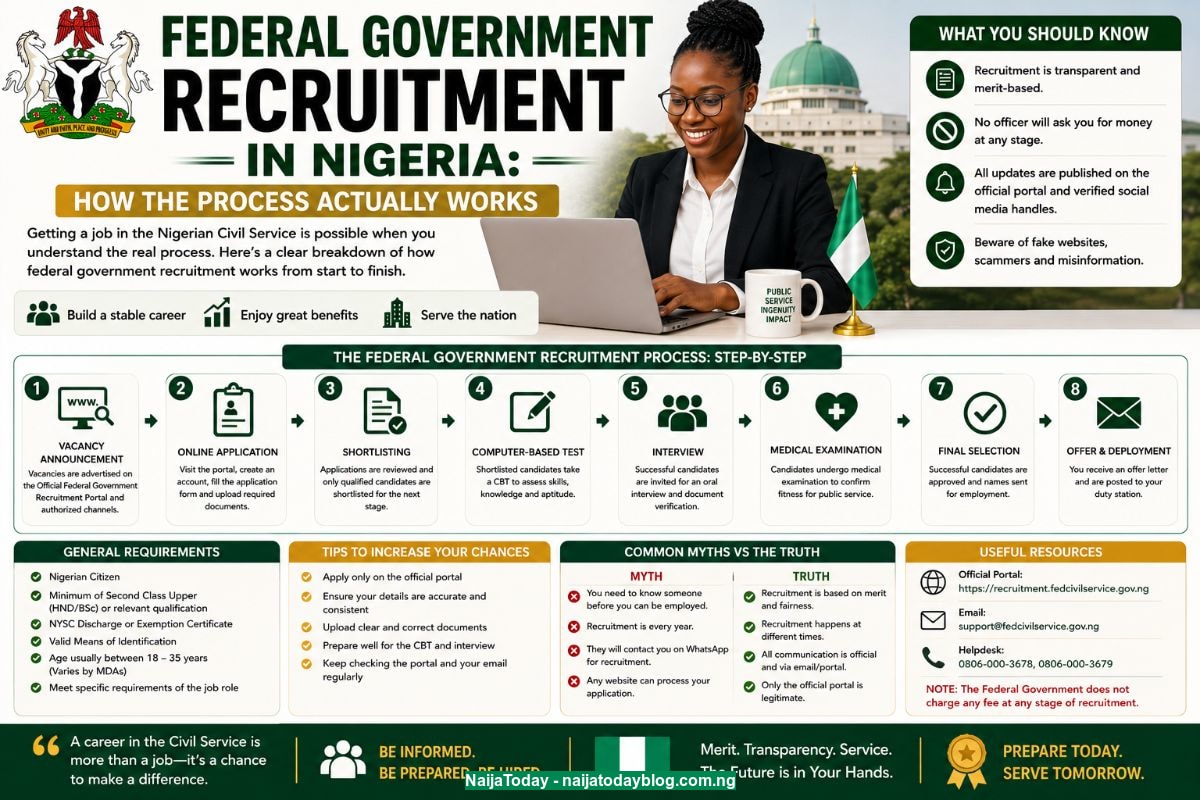
While exact timelines vary by agency and by the scale of the exercise, most federal recruitment processes in Nigeria follow a broadly similar sequence:
Announcement and portal opening. The agency announces the recruitment exercise, typically through official government channels, national newspapers, and its own website, with a defined application window rather than an indefinite open period.
Online registration and document upload. Applicants register on the designated portal, providing personal details, educational qualifications, and often uploading supporting documents such as credentials, birth certificate or age declaration, and local government identification.
Screening and shortlisting. The agency reviews applications against stated eligibility criteria — minimum qualifications, age limits, and sometimes state-of-origin quotas reflecting federal character principles — before shortlisting candidates for the next stage.
Computer-Based Test (CBT) or written examination. Many federal recruitment exercises now include a standardised computer-based test, assessing general knowledge, numeracy, and sometimes subject-specific knowledge relevant to the role.
Physical and medical assessment (for military and paramilitary roles). Uniformed service recruitment includes physical fitness testing and medical screening, which disqualifies a significant portion of otherwise successful candidates who haven't prepared physically in advance.
Interviews and final selection. Successful candidates from earlier stages typically proceed to a final interview, after which successful candidates receive formal offer letters and further onboarding or training instructions.
The full process, from initial announcement to final selection, can take anywhere from a few weeks for smaller exercises to several months for large-scale national recruitment drives — patience and continued monitoring of your application status matter throughout.
How to Avoid Federal Recruitment Scams
Unfortunately, the popularity and complexity of federal recruitment has made it a consistent target for scammers. Protect yourself with these principles:
Federal government recruitment is free. No legitimate federal agency charges a fee to apply, to be shortlisted, or to "secure" a position. Any individual or platform requesting payment in exchange for guaranteed employment is running a scam, regardless of how convincing their claims sound.
Verify the official portal directly. Search for the agency's name alongside "official recruitment portal" and cross-check the URL against the agency's known official website before entering any personal information. Scammers frequently create convincing but fake portals mimicking real agencies.
Be skeptical of unsolicited job offers. Legitimate federal recruitment is never offered to you directly through a random phone call, text message, or social media direct message claiming you've been "selected" without having gone through an application process.
Cross-check recruitment news with multiple sources. Before acting on recruitment news from any single blog or social media account, verify the same information appears on the agency's own official channels or in reputable national news coverage.
How to Prepare a Strong Application
Beyond avoiding scams, genuinely improving your chances comes down to specific, practical preparation:
Keep your documents ready year-round. Credentials, birth certificate or age declaration, local government identification, and NYSC discharge certificate (where applicable) should be scanned and readily accessible, since recruitment windows can open with limited notice and close quickly.
Understand and meet the stated eligibility criteria exactly. Age limits, minimum qualifications, and sometimes specific certifications are usually non-negotiable. Applying despite not meeting a clearly stated requirement wastes your time and, in some processes, can affect your eligibility for future exercises from the same agency.
Practice for computer-based tests. Past questions and practice materials for common federal recruitment CBTs are widely available, and familiarity with the test format and typical question style meaningfully improves performance under exam conditions.
Prepare physically for uniformed service recruitment. If you're applying to the military, police, or paramilitary agencies, begin physical conditioning well before the recruitment exercise, since fitness testing eliminates a substantial number of candidates who are otherwise qualified on paper.
Track multiple agencies simultaneously. Rather than waiting on a single agency's recruitment cycle, monitor several relevant agencies at once, since exercises open independently of one another and applying broadly improves your overall odds.
Where to Find Reliable Recruitment Information
Given how much outdated or false information circulates around federal recruitment, prioritise these sources:
- The specific agency's own official website, which is always the authoritative source for its own recruitment exercise
- The Federal Civil Service Commission's recruitment portal, for mainstream civil service positions
- Established, reputable Nigerian news outlets, which typically report recruitment announcements accurately once verified
- Official government social media accounts, which increasingly serve as a first point of announcement for many agencies
Understanding Federal Character and Quota Considerations
One aspect of federal recruitment that often confuses first-time applicants is the federal character principle — a constitutional provision requiring federal appointments to reflect Nigeria's diversity across states and geopolitical zones, rather than being concentrated among applicants from any single region. In practice, this means some federal recruitment exercises allocate a portion of available positions by state of origin, which can affect how competitive a specific exercise is depending on how many qualified applicants come from your state.
This isn't something you can change about your application, but understanding it helps set realistic expectations — a highly qualified candidate from a state with a large pool of similarly qualified applicants may face steeper competition for a fixed quota than an equally qualified candidate from a state with fewer applicants. Where this applies, your local government identification and state of origin documentation become particularly important parts of your application, so ensure these are accurate and properly certified.
The Role of State and Local Government Recruitment
Beyond federal-level recruitment, it's worth remembering that state governments and local government areas run their own separate recruitment exercises for state civil service positions, state-owned enterprises, and local government roles. These are distinct from federal recruitment, follow their own timelines set by each state, and are generally less nationally publicized — meaning less competition in many cases for candidates willing to look beyond purely federal opportunities.
If you're specifically tied to a particular state or region, checking your state Ministry of Establishments or State Civil Service Commission's recruitment announcements alongside federal opportunities broadens your realistic options considerably.
What to Do While You Wait for a Response
Federal recruitment processes, particularly larger national exercises, can take months to move from initial application to final selection. This waiting period causes genuine anxiety for many applicants, but there are productive ways to use this time rather than simply refreshing your email inbox.
Continue applying to other relevant opportunities — federal, state, and private sector — rather than pausing your job search while waiting on a single application's outcome. Use the time to prepare for likely computer-based tests by practicing with available past questions relevant to the specific agency or role category. If the role requires specific certifications or skills, use the waiting period to strengthen these credentials. And maintain your physical fitness if you've applied to a uniformed service role, since fitness assessments can be scheduled with relatively short notice once you're shortlisted.
Final Word
Federal government recruitment in Nigeria is genuinely competitive, but it is also a well-defined, learnable process rather than a mysterious or purely luck-based one. Candidates who understand which category of agency they're targeting, prepare their documents and test readiness well in advance, understand how federal character considerations may affect their specific application, and stay alert to scams consistently perform better than those who apply reactively at the last minute or fall for shortcuts promising guaranteed placement.
Recruitment cycles and specific requirements shift regularly, so always verify current details directly on the relevant agency's official portal before applying or paying any attention to third-party claims about "connections" or paid guarantees — these are, without exception, red flags rather than genuine pathways into federal employment.