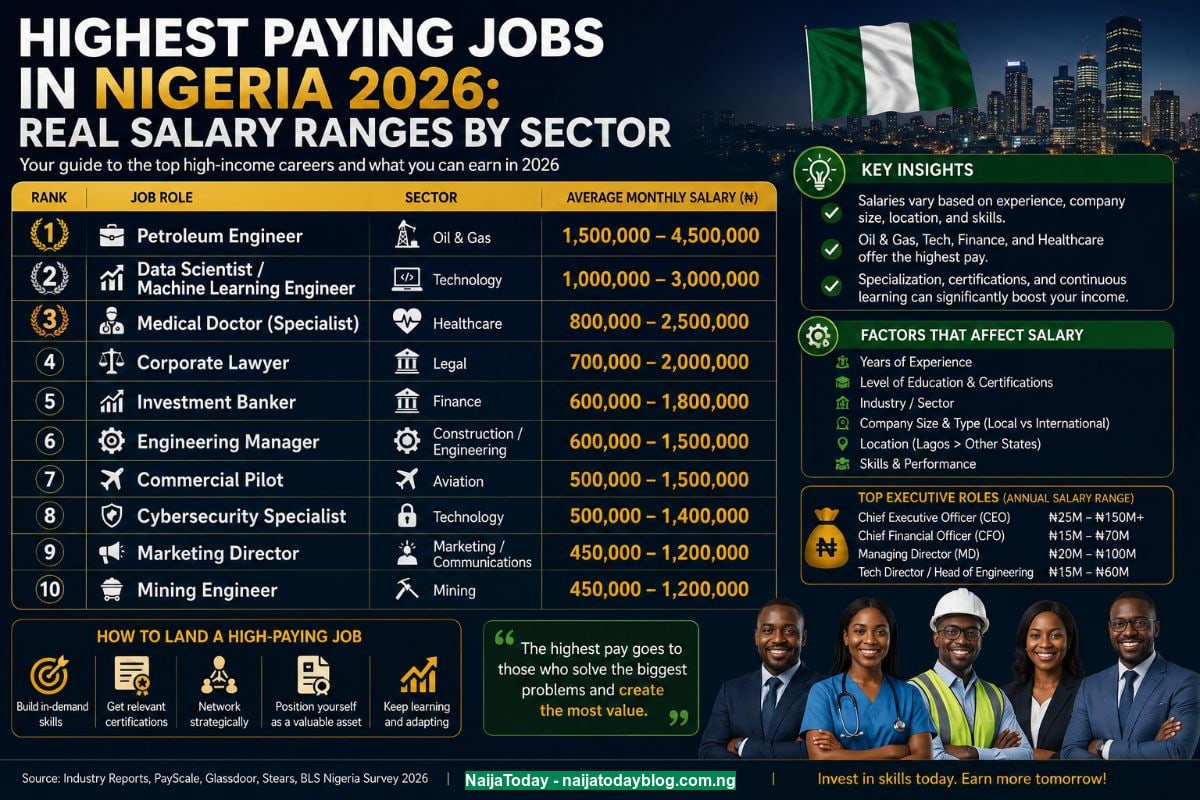
Choosing a career path in Nigeria based on genuine earning potential — rather than assumption or outdated advice — can be the difference between financial stability and years of underpayment relative to your skill. This guide breaks down what the highest-paying fields in Nigeria actually pay in 2026, based on current market data across oil and gas, technology, healthcare, finance, and federal government employment.
Why Salary Research Matters More Than Ever
With inflation continuing to pressure household budgets and the naira remaining volatile against major currencies, choosing or transitioning into a genuinely high-paying career isn't about luxury anymore — for many Nigerians, it's increasingly about financial survival and staying ahead of rising costs. Understanding realistic salary benchmarks, rather than relying on outdated assumptions about which fields pay well, puts you in a much stronger position when negotiating your next role.
Oil & Gas: Still Nigeria's Highest-Paying Sector Overall
Given Nigeria's standing as a major oil-producing nation, it's no surprise that oil and gas roles continue to dominate the top of the salary charts.
Petroleum Engineers remain among the very highest earners, with reported figures ranging widely depending on employer and experience — from roughly ₦500,000 to ₦3,000,000 monthly at multinational companies like Chevron or Shell, and annual averages cited around ₦5.8 million for the broader field. Multinational players typically bundle this with housing, travel, and hazard allowances on top of base pay.
At the specific multinational level, reservoir engineers at companies like ExxonMobil have been reported earning in the ₦6-10 million annual range, with Chevron and TotalEnergies offering broadly comparable packages for experienced engineers and geoscientists. Indigenous players like Seplat Energy also offer strongly competitive packages, often in the ₦4.5-9 million annual range.
Getting in: A five-year engineering degree (Petroleum, Chemical, or Mechanical) from an approved institution, plus relevant certifications, is the standard entry path. The field is highly competitive precisely because of the compensation on offer.
Healthcare: Consistently Among the Best-Compensated Professions
Healthcare remains one of Nigeria's most respected and well-paid sectors, reflecting both the intensity of training required and the critical nature of the work.
Surgeons report average annual earnings around ₦11.7 million (roughly ₦975,000 monthly), among the highest in the medical field. Anesthesiologists report median monthly figures around ₦1,058,000. Specialist consultants generally command significantly more than general practitioners across the board.
Getting in: An MBBS degree (roughly six years), followed by specialisation training, is the standard route — a long path, but one that consistently ranks among Nigeria's best-compensated career tracks.
Technology: The Fastest-Closing Gap on Traditional High Earners
Tech has moved from "promising new field" to a genuine rival to oil and gas and healthcare at the top of Nigeria's salary tables — and unlike those fields, many tech professionals can earn in foreign currency without ever leaving Nigeria.
| Tech Role | Reported Annual Salary Range |
|---|---|
| Machine Learning Architect / AI Security | Among the highest-paid in tech, reflecting global AI demand |
| Full-Stack Developer | ₦5,280,000+ average |
| Business Systems Analyst | ₦8,000,000 average |
| Software Engineer | ₦4,872,000+ average |
| IT Project Manager | ₦4,830,000 average |
| Data Scientist / Analyst | ₦300,000–1,500,000+ monthly range |
| Cybersecurity Engineer | ₦2,400,000+ average |
| Web Developer | ₦3,000,000 average |
What makes tech distinctive: A significant share of Nigerian tech professionals working remotely for international companies or fintech firms earn substantially more than these baseline figures, since dollar or pound-denominated pay effectively insulates their income from naira volatility — a genuine structural advantage over most other high-paying fields.
Getting in: Unlike oil and gas or healthcare, tech offers real alternative paths through self-taught skills, bootcamps, and certifications rather than requiring a specific formal degree, making it one of the more accessible high-paying fields to break into with focused effort.
Finance & Banking: Consistently Strong, Increasingly Diverse
Investment bankers report average monthly take-home around ₦404,500, with senior roles in top banks reaching six figures monthly including bonuses — some reports place experienced investment banking compensation between ₦500,000 and ₦2,000,000+ monthly with bonuses factored in.
Banking associates report average annual figures around ₦4,420,000, working directly with retail and business clients on financial products and loans.
Beyond traditional banking, finance careers extend into corporate accounting, risk management, and financial consulting — accountants report average annual earnings around ₦1.3-1.5 million, with senior and specialised roles significantly exceeding that baseline.
Getting in: Interestingly, investment banking has no fixed degree requirement — professionals enter from a range of academic backgrounds, though finance, economics, or business-related degrees remain the most common route.
Aviation: A High Barrier, High Reward Path
Pilots report median monthly figures around ₦1,500,000, with some sources citing ranges up to ₦3,000,000+ monthly for commercial pilots on international routes or with major carriers.
Getting in: This is one of the more expensive career paths to enter — requiring strong performance in Mathematics and Physics at secondary level, enrollment in a Nigerian Civil Aviation Authority-recognised flight school, and progression from a Private Pilot Licence through to a Commercial Pilot Licence, alongside mandatory medical certification.
Federal Government Roles: Often Underestimated
Federal government employment doesn't always come to mind first when Nigerians think about high pay, but several roles buck that assumption significantly. Reports place federal Bank Manager roles (within government-linked financial institutions) around ₦9.5 million annually, and Tax Accountant roles around ₦5 million annually — reflecting the reality that public sector employment, particularly within revenue-generating and financial regulatory agencies, can rival private sector compensation while offering the job security government roles are known for.
What Actually Drives Salary Differences in Nigeria
A few consistent factors separate high earners from average earners within the same field:
Experience compounds fast. Professionals in many high-paying roles can expect their salary to roughly double within five years, making early-career patience genuinely worthwhile.
Location matters significantly. Lagos consistently offers salaries 20-40% higher than Abuja or other state capitals for comparable roles, reflecting both cost of living and concentration of major employers.
Foreign currency exposure protects against inflation. Roles tied to multinational companies, export-oriented sectors, or remote international work carry a structural advantage in years of high inflation and naira volatility, since dollar or pound-denominated components hold value that pure naira salaries don't.
Hybrid skill combinations command premiums. Professionals combining a traditional strength (like engineering or medicine) with tech proficiency, or combining finance with data skills, consistently report higher compensation than single-discipline specialists.
Practical Next Steps
If you're evaluating a career move based on this data, a few honest next steps: audit your current skills against the requirements of your target field and identify genuine gaps rather than assuming you're already qualified; prioritise sectors and employers with real foreign currency exposure if inflation protection matters to you; and consider that certifications (in fields like project management, cloud computing, or specific engineering credentials) can often accelerate entry into high-paying tracks faster than starting a new full degree.
Emerging Fields Worth Watching
A few areas showing early but genuine salary momentum, worth tracking even if they're not yet as established as the sectors above: renewable/green energy engineering, as Nigeria's energy sector gradually diversifies; AI and machine learning specialisation layered on top of existing tech skills, which multiple sources point to as an accelerating premium within an already well-paying field; and fintech-specific roles that blend traditional banking knowledge with technology skills, reflecting how aggressively Nigerian fintech companies continue to compete with traditional banks for talent.
None of these are guaranteed to match today's top earners, but positioning yourself early in a genuinely growing niche has historically outperformed joining an already-saturated high-paying field late.
How to Actually Negotiate Toward These Numbers
Knowing the benchmark figures is only useful if you can translate that knowledge into an actual offer. A few practical principles:
Never be the first to name a number if you can avoid it. When asked your salary expectation, redirect where possible: "I'd like to understand the full scope of the role first, but based on my research, roles like this typically range from X to Y — where does this position sit within that?" This anchors the conversation around market data rather than your own potentially conservative guess.
Bring evidence, not just confidence. Referencing genuine market research — like the ranges in this article — gives your negotiation position credibility beyond simply asserting you deserve more.
Negotiate the full package, not just base salary. Housing allowance, transport allowance, health insurance quality, professional development budget, and performance bonuses can meaningfully close the gap even when a company's base salary band is fixed.
For dollar-exposed roles specifically, ask directly about currency. If you're being considered for a role with international clients or remote work for a foreign company, clarify upfront whether compensation is naira-denominated, dollar-denominated, or naira-pegged to a specific exchange rate — this distinction alone can represent a very significant difference in real purchasing power over time.
Final Word
Salary figures for any profession vary by employer, experience level, and negotiation — treat the ranges here as realistic benchmarks to research further, not guarantees. But the broader pattern is clear: oil and gas and healthcare remain Nigeria's traditional high-pay anchors, while technology has genuinely closed the gap and, for those able to work remotely or in dollar-denominated roles, may now offer the strongest inflation-protected earning potential of any sector on this list.
Whatever field you're already in or considering, understanding where you actually sit against these benchmarks — rather than guessing — is the first real step toward negotiating what your skills are worth.