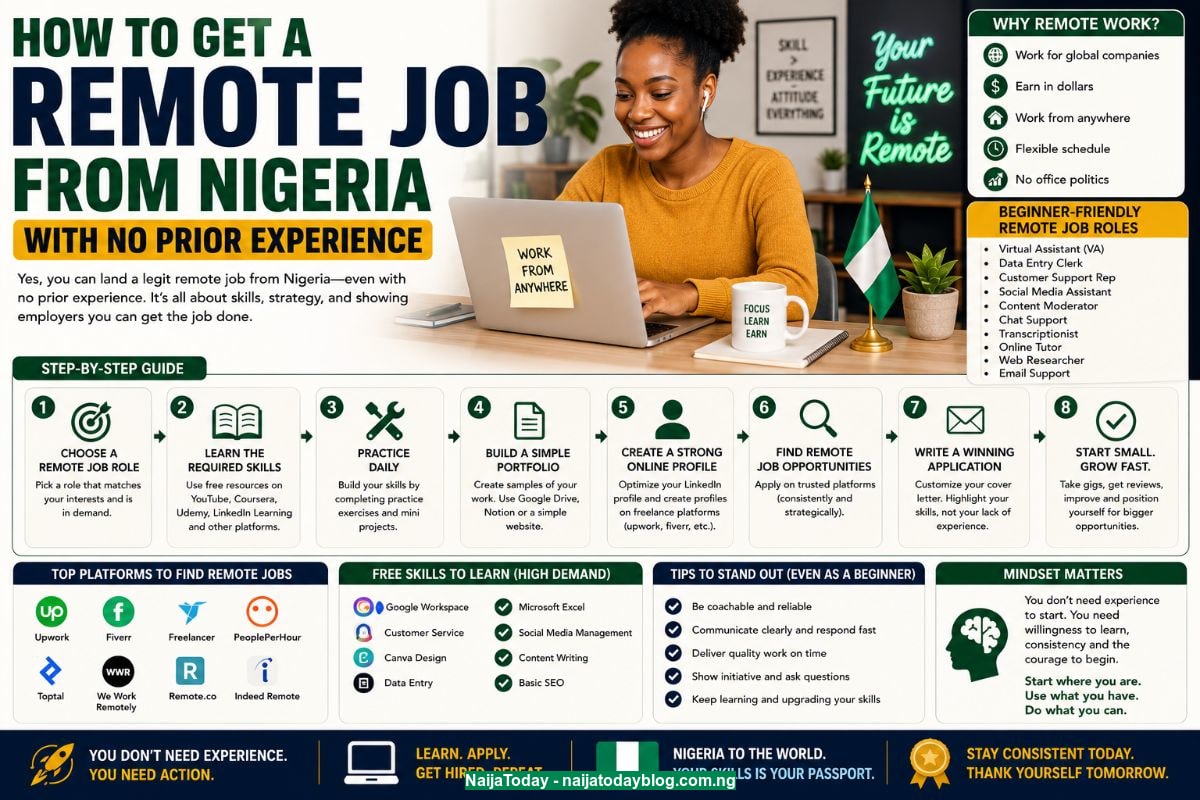
"I have no experience, so no one will hire me. I can't get experience because no one will hire me." This is the trap that stops thousands of talented young Nigerians from ever starting a remote career — even though the global remote work market genuinely doesn't care about your local job history the way many Nigerian employers do. International clients hiring on platforms like Upwork and Fiverr care about one thing above almost everything else: can you actually do the work well?
This guide is specifically for Nigerians with zero prior professional experience who want to break into remote, dollar-earning work — what to expect, how realistic it actuallay is, and the specific steps to take in your first 30 days.
First, a Realistic Expectation Check
Before diving into steps, it's worth being honest about what "no experience" remote work actually looks like at the start. Your first paid project will very likely pay less than what an experienced freelancer charges, and it may take several weeks of consistent effort before you land that first client. This is normal and does not mean the path doesn't work — it means you're building a track record, exactly the way anyone starting any career does.
The difference with remote freelance work is that this track record builds fast, and once you have 3 to 5 completed projects with positive client feedback, your opportunities and rates improve substantially. The hard part is genuinely just the first stretch.
Step 1: Pick ONE Skill You Can Learn Well in 4-8 Weeks
The single biggest mistake beginners make is trying to learn five different skills at once, becoming mediocre at all of them, and having nothing strong enough to show a client. Instead, pick one skill with clear beginner demand and go deep:
Virtual assistance — managing email inboxes, scheduling, and administrative support for busy entrepreneurs abroad. This has one of the lowest barriers to entry since it primarily requires organisation, clear communication, and comfort with basic tools like Google Workspace or Microsoft Office.
Content writing — blog posts, website copy, and articles for international businesses. If you write clearly and can research a topic properly, this is very learnable quickly, and Nigerian English proficiency is a genuine advantage here.
Basic graphic design — social media graphics and simple branding materials using free or low-cost tools like Canva initially, before progressing to more advanced software as you gain clients and can reinvest in better tools.
Data entry and research support — organising information, populating spreadsheets, and basic online research tasks for small businesses. While this pays less per hour than more specialised skills, it has extremely low barriers to entry and provides a starting point to build platform reviews.
Whichever you choose, commit to it for at least a month before considering switching — most beginners give up on a skill just before they were about to get good enough to land their first client.
Step 2: Learn the Skill Using Free Resources
You do not need to pay for expensive courses to start. YouTube alone has extensive free tutorials for every skill listed above. Search specifically for beginner-level, practical tutorials rather than broad theory content — you want to be creating actual work samples within your first two weeks, not just watching videos.
As you learn, create 3 to 5 practice projects even before you have a paying client. If you're learning content writing, write sample articles on topics you understand well. If you're learning design, create sample social media graphics for a fictional or real local business. These become your initial portfolio.
Step 3: Set Up Your Profile on One Platform First
Don't spread yourself across five platforms at once when starting. Pick one — Fiverr is often the more beginner-friendly starting point because you create specific service listings ("gigs") that clients search for and come to you, rather than you needing to write dozens of proposals to unresponsive job postings.
When setting up your profile:
- Use a real, clear photo of yourself — profiles with real photos are trusted more than generic icons or stock images
- Write a specific, outcome-focused headline rather than a generic job title (for example, "I Write SEO Blog Posts That Help Small Businesses Rank on Google" rather than simply "Content Writer")
- Upload your practice portfolio pieces from Step 2, even without prior paying clients
- Set your starting price at a competitive, slightly below-average rate for your skill category — this is a deliberate strategy to win your first few reviews quickly, not a long-term pricing plan
Step 4: Apply or List Consistently, Every Single Day
Landing your first client is primarily a numbers game combined with quality. If you're on Fiverr, this means regularly refining and adding new service listings. If you're on Upwork, this means submitting well-written, personalised proposals daily rather than sending the same generic message to every job posting.
A personalised proposal references something specific from the client's job posting, briefly explains how you'd approach their specific problem, and links to your most relevant portfolio sample — not your entire portfolio, just the one piece most relevant to that specific job.
Expect to submit many proposals before landing your first response. This is completely normal and not a sign that something is wrong with your approach — it's simply how competitive entry-level remote work currently is.
Step 5: Set Up How You'll Receive Payment Before You Need It
Don't wait until you've landed a client to figure out how you'll actually get paid. Set up a Payoneer account in advance — it's free to create, requires basic identity verification (your BVN and a valid ID), and gives you a US, UK, and EU virtual bank account that most major freelance platforms support directly. Once set up, linking it to your Upwork or Fiverr account takes just a few minutes.
Having this ready before you need it means you can accept and start working on your first project immediately, rather than losing days scrambling to set up payment infrastructure after a client has already agreed to work with you.
Step 6: Deliver Your First Project Better Than Expected
Your very first client matters disproportionately, because their review becomes the foundation of your entire profile. Slightly over-deliver where reasonable — respond faster than expected, ask clarifying questions rather than guessing at unclear instructions, and submit slightly ahead of any agreed deadline if you can do so without sacrificing quality.
This isn't about working for free or accepting unreasonable scope changes — it's about the specific first few projects where building trust and a strong review matters more than maximising your immediate earnings.
Common Mistakes That Slow Beginners Down
Trying to charge experienced-level rates from day one. Clients hiring beginners expect beginner pricing. Price accordingly for your first few projects, then raise your rates once you have reviews to justify them.
Giving up after the first week of silence. Most freelancers who eventually succeed report a period of multiple weeks with no responses before their first client. This is standard, not a sign of failure.
Spreading effort across too many platforms or skills at once. Depth on one platform with one clear skill beats a shallow presence across five platforms with an unclear specialty.
Ignoring communication and professionalism. International clients often value reliability and clear communication as much as raw skill, particularly for beginners. Responding promptly and professionally can outweigh a slightly less experienced skill level.
Accepting payment outside the platform. Even as a beginner eager for any opportunity, never agree to receive payment through informal channels outside your chosen platform's system — this removes your protection entirely and is a common scam pattern targeting inexperienced freelancers specifically.
What Realistic Progress Looks Like
For most beginners starting from genuinely zero experience, a realistic (not guaranteed) trajectory looks something like this: the first four to eight weeks are spent learning the skill and building an initial portfolio, weeks eight through twelve involve actively applying or listing services while landing an occasional smaller, lower-priced project, and by the three to six month mark, consistent effort typically produces a small but real stream of repeat or referred work at improving rates.
This timeline can move faster for naturally strong communicators or slower depending on how much time you can dedicate daily — but the pattern of gradual, compounding progress rather than overnight success holds true across virtually every successful remote freelancer's actual starting story.
Final Word
Breaking into remote work from Nigeria with no prior experience is genuinely achievable, but it requires treating it as a real skill-building process rather than expecting instant results. Pick one skill, learn it properly using free resources, build a small portfolio before you have paying clients, set up your payment infrastructure in advance, and commit to consistent daily effort on one platform rather than scattering your energy.
The Nigerians earning steady dollar income through remote work today almost universally went through this same uncertain starting period — the difference between those who succeeded and those who gave up usually wasn't raw talent, but simply consistency through the slow initial weeks before momentum built.