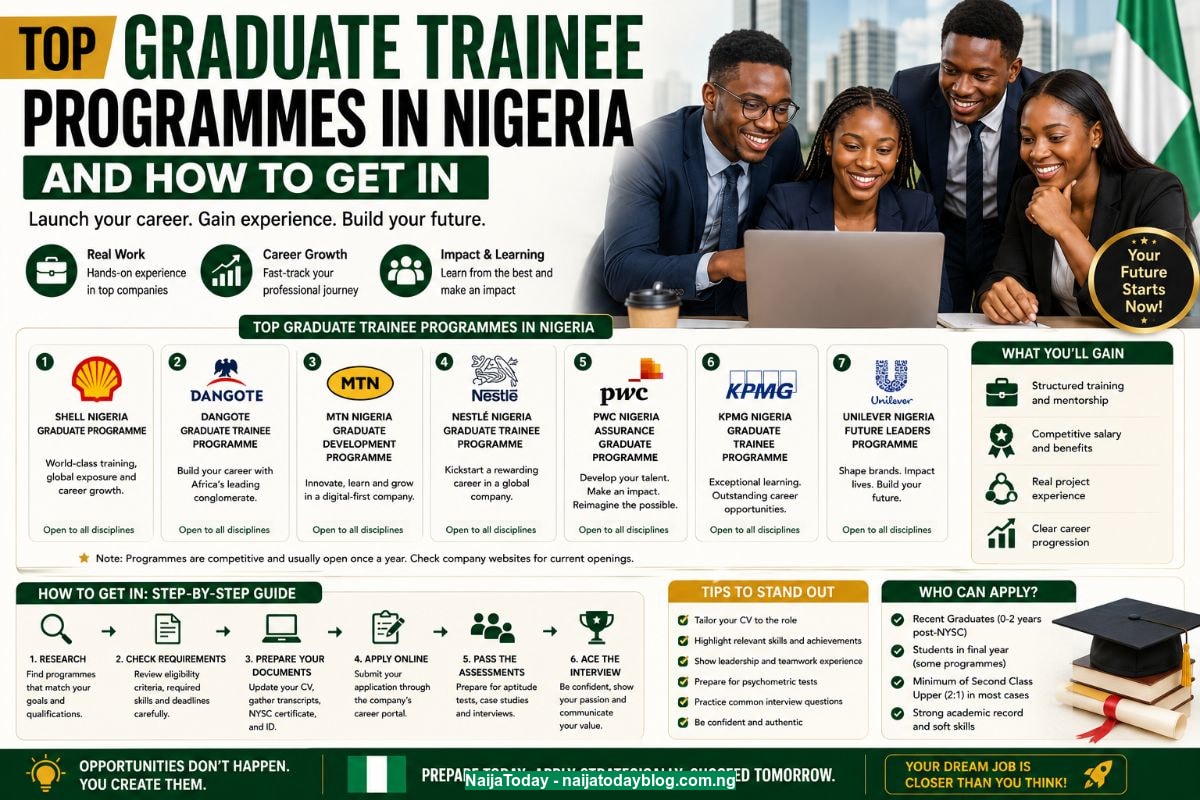
For fresh Nigerian graduates trying to break into a stable, well-structured career, graduate trainee programmes remain one of the most reliable paths available. Unlike a regular entry-level job application where you're competing against candidates of every experience level, graduate trainee schemes are specifically designed for people in your exact position — recently graduated, limited or no work experience, and looking for structured training rather than being thrown into a role with no support.
This guide covers some of the most consistently run graduate trainee programmes in Nigeria across banking, manufacturing, telecoms, and professional services, along with what it actually takes to get selected.
Why Graduate Trainee Programmes Are Worth Targeting
Beyond the training itself, graduate trainee programmes solve a specific problem many Nigerian graduates face: the frustrating cycle of being told they need experience to get a job, but can't get experience without a job. These programmes are explicitly built for people with little to no post-graduation work history, and most combine structured classroom learning with real, hands-on placement in the business — meaning you leave with actual experience on your CV, not just a certificate.
Many of the programmes below also come with clearly communicated compensation, unlike some entry-level roles where salary details are vague until late in the hiring process.
Dangote Group Graduate Trainee Programme
Dangote Group, spanning cement manufacturing and, more recently, the Dangote Petroleum Refinery and Petrochemicals business, runs one of the most hands-on industrial graduate trainee schemes in the country. The programme is structured as an extended training period — commonly around 18 months for the refinery track — giving participants exposure to large-scale manufacturing and supply chain operations across the group's plant sites, including its Lagos headquarters and major facilities such as Obajana and Ibese.
What it covers: Trainees are placed across functions including engineering, procurement, HR, finance, and logistics, depending on their academic background, and receive a competitive monthly stipend alongside accommodation and logistics support during training.
Who qualifies: Nigerian graduates with a First Degree or Higher National Diploma in relevant disciplines — engineering fields (chemical, mechanical, electrical, instrumentation, production, mining), geological or laboratory sciences, or support disciplines including accounting, finance, business administration, law, and information technology. Academic requirements typically call for at least a Second Class Lower degree or HND Upper Credit, and applicants are usually expected to be under a specified age limit — historically around 28 years old at the time of the application cycle.
How to apply: Applications go through Dangote's official careers portal (careers.dangote-group.com for the wider group, with the Refinery running its own dedicated application process). Dangote's graduate intake tends to open with public announcements rather than being a hidden, rolling process, so following the company's official social media and careers page directly is the most reliable way to catch the application window when it opens.
MTN Nigeria Global Graduate Development Programme
MTN's graduate scheme is built around developing future leaders within the telecom giant's business and technology functions. The programme combines structured classroom learning, job shadowing, and cross-functional project work, with participants also enrolled in MTN's internal leadership and personal development academy.
What it covers: Beyond the structured learning path, MTN's programme is known for genuine cross-functional exposure — meaning trainees don't stay boxed into one department, but rotate through different parts of the business to build a broader understanding of how a large telecom operation runs.
Who qualifies: Fresh Nigerian graduates, generally targeted at those with limited post-NYSC work experience, across a range of academic backgrounds relevant to MTN's business functions — technology, commercial, finance, and support roles.
How to apply: MTN typically opens its graduate programme applications in the first quarter of the year through its official careers portal (careers.mtnonline.com). Because MTN is a highly visible employer, expect significant competition — a well-tailored application that speaks specifically to MTN's business rather than a generic cover letter matters considerably here.
UBA Graduate Management Associate Programme (GMAP)
United Bank for Africa's GMAP is a well-established, fast-paced graduate training scheme aimed at developing future leaders across the bank's retail and corporate banking operations. It combines digital learning modules, hands-on in-branch training, and structured mentorship from senior banking staff.
What it covers: Training spans retail and corporate banking, digital channels, banking operations, and customer experience — giving graduates broad exposure across how a modern Nigerian bank actually functions, rather than narrowly training them for a single fixed role. UBA has reported a strong retention rate of trainees into full-time banking positions after completing the programme.
Who qualifies: Nigerian graduates from accredited universities, generally open across a wide range of academic disciplines rather than being restricted to finance or accounting alone — banks value strong communication, analytical thinking, and customer service aptitude alongside academic performance.
How to apply: Applications run through UBA's official careers page (ubagroup.com/about-uba/careers), typically opening in two windows during the year — a first cycle around January to March, and a second around June to August. UBA's programme is also noted as being relatively more flexible on specific degree classification requirements compared to some other banking graduate schemes, which can make it a strong option for graduates who narrowly missed a First Class or Second Class Upper classification.
Nestlé Nigeria Graduate Internship Programme (Nesternship)
Nestlé's graduate programme, often referred to as the "Nesternship," gives young graduates structured exposure to factory operations, nutrition, quality assurance, and commercial functions within one of the world's largest food and beverage companies. Participants go through Nestlé's international learning and development framework and are paired with mentorship from senior managers within the business.
What it covers: The programme is designed to build both technical understanding of FMCG (fast-moving consumer goods) operations and softer professional skills, through participation in real improvement projects rather than purely observational training.
Who qualifies: Nigerian graduates typically within two years of completing NYSC, across relevant academic disciplines depending on the specific track advertised for that cycle (engineering, supply chain, commercial, and related fields).
How to apply: Nestlé Nigeria's graduate internship applications are announced through the company's official careers channels and are typically time-limited, so watch for the specific announcement period each year rather than assuming the programme is open on a rolling basis.
PwC Nigeria Graduate Associate Programme
For graduates interested in audit, tax, consulting, and advisory work, PwC Nigeria's Graduate Associate Programme is one of the most competitive and respected entry points into professional services in the country. The 12-month structured programme covers audit, risk advisory, technology consulting, and tax, and notably includes funding support toward professional qualifications such as ACA or ACCA alongside performance-based bonuses.
What it covers: Beyond technical training in accounting, audit, and advisory work, participants gain exposure to real client engagements — a significant advantage for graduates hoping to build a long-term career in professional services or eventually move into corporate finance roles elsewhere.
Who qualifies: Strong academic performers, typically expected to hold or be working toward relevant qualifications in accounting, finance, or related analytical fields, with PwC placing considerable weight on analytical thinking and attention to detail during its selection process.
How to apply: Applications are processed through PwC Nigeria's official careers portal, and the selection process for professional services firms of this caliber typically includes multiple stages — an initial application screening, aptitude or numerical reasoning tests, and interview rounds — so candidates should prepare accordingly rather than expecting a single-step application process.
How to Actually Improve Your Chances of Getting Selected
Across all of these programmes, a few consistent patterns separate successful applicants from the much larger pool who apply and hear nothing back:
Tailor your application to the specific company. A generic CV and cover letter sent to every graduate programme you can find performs worse than a shorter application that specifically references the company's business, values, or recent activities. Recruiters reviewing hundreds of applications notice the difference immediately.
Prepare for aptitude tests in advance. Most large Nigerian graduate schemes — particularly in banking and professional services — include a numerical and verbal reasoning test stage. Practicing with past questions (widely available online for major Nigerian employers like GTBank, UBA, and PwC) significantly improves performance under time pressure.
Apply within the stated window, not after. Unlike ongoing job postings, graduate trainee programmes typically have a defined application period. Missing it means waiting an entire year for the next cycle, so track the specific companies you're interested in and apply the moment the window opens rather than after seeing other people's success stories on social media.
Have your documents ready before you apply. Degree certificate, NYSC discharge or exemption certificate, transcripts, and a valid means of identification are near-universal requirements. Having these ready in advance means you can apply within hours of a window opening, rather than scrambling while the clock runs on a limited application period.
Final Word
Graduate trainee programmes remain one of the clearest, most structured paths into stable employment for Nigerian graduates, precisely because major employers use them to build their next generation of managers and specialists rather than simply filling entry-level vacancies. The specific programmes, salary details, and application windows shift somewhat from year to year, so always confirm current details directly on each company's official careers portal before applying — and apply to more than one programme rather than waiting on a single application.