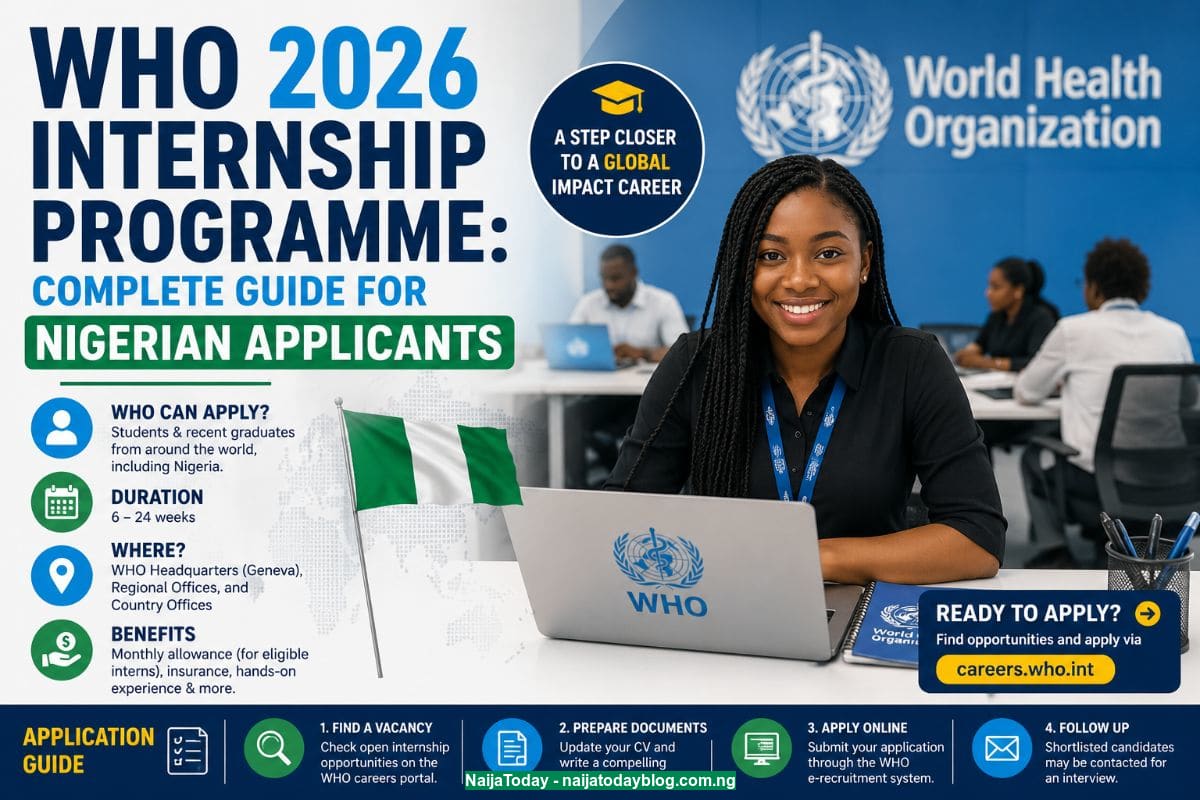
For Nigerian students and recent graduates looking to break into international public health work, few opportunities carry the weight of a World Health Organization internship on a CV. With applications now open for the 2026 programme, this guide breaks down exactly what it involves, who qualifies, and how to actually apply.
What the WHO Internship Programme Actually Is
The World Health Organization runs a structured internship programme connecting students and recent graduates with its technical and administrative teams — based at WHO headquarters in Geneva, Switzerland, or across its regional and country offices spanning Africa, the Americas, Europe, the Eastern Mediterranean, South-East Asia, and the Western Pacific. Rather than being a single fixed programme, each internship is posted as its own specific vacancy notice with its own requirements, location, and closing date, meaning "applying to WHO" in practice means applying to a specific posted position that matches your background.
Interns work on genuinely live projects, not busywork — contributing directly to initiatives in areas like epidemic and pandemic preparedness, disease surveillance, and public health research, working alongside WHO's technical experts on issues that matter to global health outcomes.
Fields Available
The programme spans both technical and administrative tracks, which is worth knowing if your background isn't strictly medical or public health:
Technical areas include public health, epidemiology, disease surveillance, nutrition, mental health, environmental health, emergency preparedness, and health data analysis.
Administrative areas include communications, external relations, human resources, legal services, procurement, and IT.
This breadth means the programme genuinely welcomes applicants from fields like law, data science, communications, and engineering — not exclusively medicine or nursing, which surprises many prospective Nigerian applicants who assume otherwise.
Who Can Apply
Nationality: Applicants must hold a valid passport from a WHO Member State — with 194 member states, this covers virtually every country, including Nigeria. Importantly, there are no nationality-based quotas; selection is based entirely on qualifications and fit for the specific role, not where you're from.
Academic status: Requirements vary by specific vacancy, but a common baseline across postings is having completed at least three years of undergraduate study at a recognised university, or being currently enrolled in a university programme leading to a formal degree. Recent graduates are also eligible for many postings.
Prior participation: You must not have previously participated in the WHO Internship Programme — this is a one-time opportunity per individual, which is worth keeping in mind if you're weighing when in your academic journey to apply.
What You Actually Get
Unlike many "internship" opportunities that offer only experience and no financial support, the WHO programme is genuinely paid — interns receive a living allowance and medical insurance coverage for the duration of their placement, alongside the professional experience itself. Specific internships, such as ones based in the Health Emergencies programme, have run for structured periods (commonly around 24 weeks) with the living allowance calculated accordingly.
Beyond the financial support, the real long-term value is what the experience unlocks afterward: practical research experience, direct exposure to specialists tackling real global health emergencies, professional skill development, and an international network that meaningfully strengthens future applications to public health, medical, research, or international development careers.
Step-by-Step: How to Apply
Step 1 — Visit the official WHO Careers portal. All genuine WHO internship applications run exclusively through WHO's own recruitment system (called Stellis) accessed via the official WHO Careers site. Be wary of any third-party site charging a fee to "help" you apply — the application itself is entirely free and direct.
Step 2 — Search for available internship vacancies matching your qualifications. Since postings are added throughout the year on a rolling basis rather than a single fixed annual intake, checking the portal regularly rather than once is genuinely important — a strong match for your background could appear at any point in the year.
Step 3 — Create a detailed Stellis profile. This is more than a formality — a complete, well-written profile covering your education, languages, relevant experience, and skills forms the actual foundation reviewers assess. Treat this with the same care as a formal CV, not a quick afterthought.
Step 4 — Complete the online application for your chosen vacancy. Provide your personal and academic information accurately, and upload all required documents as specified for that particular posting — requirements can differ slightly between vacancies.
Step 5 — Complete the Declaration of Interest form where applicable. Some postings require this additional step; check the specific vacancy notice carefully so you don't miss a required component.
Step 6 — Review carefully before submitting. Given the volume of applications WHO receives globally, an application with careless errors is an easy one for reviewers to deprioritise. Read everything through fully before hitting submit.
Step 7 — Watch for your confirmation email, then be patient. You'll receive an email confirming your application submission. Given WHO's global reach and reputation, the programme is genuinely competitive, and response times can take a while — this isn't a sign your application was overlooked.
What Makes a Strong WHO Application
Since specific postings are highly competitive precisely because of the programme's international prestige, a few things consistently separate successful applicants:
A CV specifically tailored to the posting, not a generic document reused across every application — WHO's technical reviewers can tell the difference between an applicant who genuinely understands the specific role and one who's mass-applying.
Demonstrated commitment to public health (or the relevant field for administrative postings) through your academic choices, volunteer work, or prior projects — reviewers look for genuine alignment, not just a qualifying degree.
Applying early within a posting's window rather than at the last moment, since rolling deadlines mean earlier applicants sometimes have an advantage before a position fills.
A strong, complete Stellis profile maintained consistently, since this underlying profile supports every application you submit through the system going forward.
Important Things to Know Before You Apply
This is not a path directly into WHO employment. The internship is explicitly separate from the organization's regular recruitment process — interns are not eligible for formal WHO appointments until three months after their internship concludes. After that waiting period, former interns can apply for open positions as external candidates like any other applicant, but the internship itself doesn't guarantee or fast-track future employment.
Each vacancy has its own deadline — don't assume a single annual cutoff. Some specific 2026 postings have closing dates around end of July, but this varies significantly by role and location, so always check the specific vacancy notice rather than assuming a general programme-wide deadline.
Why This Matters for Nigerian Applicants Specifically
International experience of this caliber is genuinely rare on Nigerian CVs, which makes it a significant differentiator for anyone pursuing careers in public health, medicine, international development, or global policy work. Beyond the immediate stipend and experience, a completed WHO internship signals to future employers — Nigerian or international — that you've operated successfully within a demanding, high-standards global institution, which carries real weight well beyond the internship period itself.
If you've read our guide on writing a Nigerian CV that gets interviews, apply those same principles here with extra care — WHO's applicant pool is genuinely global, and your application needs to hold up against candidates from every WHO member state, not just other Nigerian applicants.
Frequently Asked Questions
Do I need to speak French or another language besides English to apply?
Language requirements vary by specific posting and location — some roles, particularly those based in Geneva or certain regional offices, may prefer or require French proficiency alongside English, while many others operate primarily in English. Always check the specific vacancy notice, since this isn't a blanket requirement across the entire programme.
Can I apply if I'm still in my final year of university?
Yes — many postings accept applicants currently enrolled in a university programme leading to a formal degree, not exclusively those who have already graduated. Check the specific academic requirements listed on each vacancy, since the exact threshold (such as having completed a minimum number of years of study) can vary.
How long does a typical WHO internship last?
Duration varies by specific posting, but several current 2026 vacancies run for structured periods around 24 weeks. Always confirm the exact duration and any possible extension terms in the specific vacancy notice you're applying to.
Is there an age limit?
The programme doesn't apply a fixed age cutoff in the way some national scholarship schemes do — eligibility centers on academic status (current enrollment or recent completion) rather than age specifically. Confirm against the specific posting if you're unsure whether your situation qualifies.
What if I don't hear back after applying?
Given the global competitiveness of the programme and the volume of applications WHO receives, silence for an extended period doesn't necessarily mean rejection. That said, if a reasonable amount of time has passed relative to the vacancy's stated timeline, it's reasonable to consider your application unsuccessful for that specific posting and continue applying to others that open.
Final Word
The WHO 2026 Internship Programme offers a rare combination that's hard to find elsewhere: genuine international public health experience, financial support through a living allowance and insurance, and a credential that meaningfully strengthens your career trajectory — open to Nigerians across a much wider range of academic backgrounds than many assume. Given the rolling nature of postings, the practical next step is simple: visit the official WHO Careers portal today, review current vacancy notices against your own background, and prepare your Stellis profile properly before applying — not after you've already found a role that interests you.