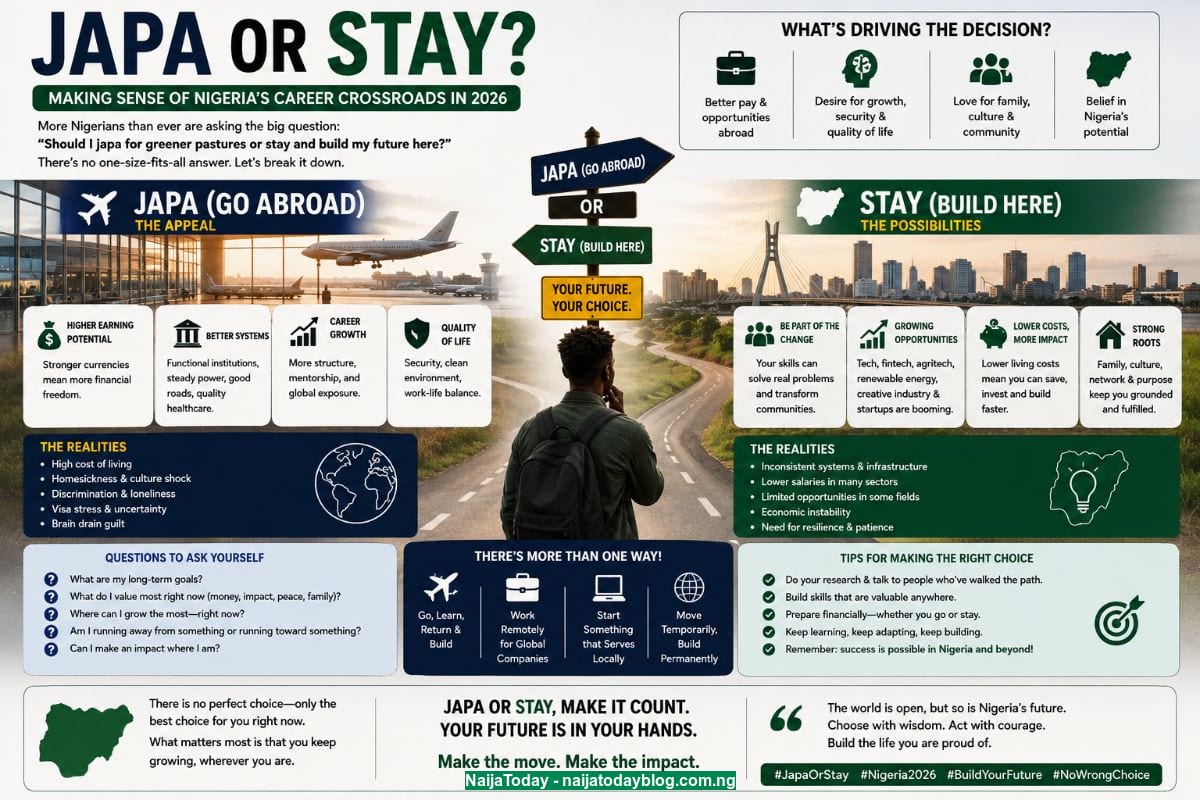
Japa or Stay?
Making Sense of Nigeria's Career Crossroads in 2026
Every Nigerian family now seems to have at least one WhatsApp group chat
dedicated entirely to "japa gist." You know the one. Someone shares a
Canada Express Entry update, another person asks about UK skilled worker visa
sponsorship for nurses, someone else drops a screenshot of a UCAS deadline, and
somewhere in the middle of it all, an uncle who traveled in the 90s reminds
everyone that "things were not this hard when I left o." I have that
group chat too. Everyone does.
But behind the memes and the group chat banter is a genuinely heavy decision
that millions of young Nigerians are wrestling with right now, quietly, at 2am,
staring at their phone: do I stay and try to build something here, or do I join
the wave and leave?
I don't think there's a single right answer, and I'm suspicious of anyone, on
either side, who tells you there is. What I want to do instead is lay out
what's actually driving this decision, what the data says, and what people
who've made either choice have told me about how it's actually working out for
them.
Why the Question Even Exists
Let's not pretend the japa conversation came from nowhere. It's rooted in real,
measurable frustration. Depending on which unemployment figure you look at, and
there's genuine controversy over how Nigeria calculates and reports this data,
young people face a labour market that simply hasn't kept pace with population
growth. Officially, the National Bureau of Statistics reported youth
unemployment around 6.5 percent for those aged 15 to 24 using a revised
methodology, but that number has been widely disputed by economists and
ordinary Nigerians alike, since it counts anyone who worked even an hour in the
reference period as "employed." Earlier figures using a different
methodology put youth unemployment closer to 53 percent, a number that,
frankly, matches what most of us see and feel on the ground far more than the
newer figure does.
Whatever the "correct" number is, the sentiment is unmistakable. A
recent Afrobarometer survey found that an overwhelming 91 percent of young
Nigerians believe the country is headed in the wrong direction, and when asked
to rate government performance on job creation, the approval rating was a
dismal 6 percent. When you combine that with inflation that's made saving
nearly impossible for anyone earning in naira, and a cost of living that keeps
climbing regardless of what your paycheck looks like, it becomes very easy to
understand why "japa" stopped being a fringe idea and became a
default life plan for so many young graduates.
Academic research into what's actually driving this migration wave backs up the
gut feeling. Studies looking at the "push factors" behind Nigerian
emigration consistently point to youth unemployment, inflation, and weak
government effectiveness as the strongest predictors, more significant even
than instability or insecurity in some models. In plain English, people aren't
primarily leaving because they're scared. They're leaving because they've done
the math and it doesn't add up here anymore, at least not for them.
The Case for Leaving
I've spoken with enough people who've relocated to know that japa isn't the
guaranteed paradise some of the more polished Instagram posts suggest, but for
a lot of people, it genuinely has delivered on its promise.
A friend who moved to Canada as a registered nurse a few years ago told me
something simple but powerful: "Here, my salary actually means something.
I can plan a month ahead and know the plan will still make sense by the time
the month ends." That predictability, the ability to budget without the
ground shifting under you every few weeks, is something a lot of Nigerians
simply don't have access to anymore at home, and it's hard to overstate how
much mental peace that alone can bring.
There's also the professional growth angle. Certain fields, particularly
healthcare, tech, and engineering, offer clearer, more structured career
progression abroad, with defined pathways for promotion, further study, and
specialization that can feel frustratingly opaque or politically gated within
many Nigerian institutions and companies.
And honestly, for some people, it's simply about wanting to see more of the
world, to raise their children in a different kind of environment, to access
healthcare systems that don't require you to personally fund your own emergency
surgery before treatment begins. These are legitimate, deeply personal reasons
that don't need to be justified purely in economic terms.
The Case for Staying
At the same time, I want to push back gently on the narrative that leaving is
automatically the smarter move, because the people I know who've chosen to stay
and build here aren't naive, and many of them are doing genuinely well.
Nigeria's tech and creative industries, in particular, have created
opportunities that simply didn't exist a decade ago. Remote work has quietly
become one of the biggest equalizers in the Nigerian job market. A software
developer in Enugu can now work for a company in London or Toronto without ever
leaving Nigeria, earning in dollars or pounds while spending in naira, which,
when the exchange rate cooperates even slightly, creates a standard of living
that's genuinely comfortable by local standards. I know several people doing
exactly this, and their quality of life at home, with family, with familiar
food, with a support system already built, is something a lot of japa migrants
spend years trying to rebuild abroad from scratch.
There's also an argument that resonates with a certain kind of person, the
"someone has to build this place" argument. Nigeria's fintech sector,
its entertainment industry, Nollywood and Afrobeats reaching genuinely global
audiences, its growing startup ecosystem, none of that happened because
everyone left. It happened because enough talented, frustrated, determined
people decided to stay and build anyway, despite the very real obstacles. For
some people, particularly those with an entrepreneurial streak, the sheer scale
of unmet need in Nigeria, in healthcare, logistics, education, retail,
represents genuine opportunity rather than just a source of frustration.
One founder I interviewed a while back put it memorably: "Everybody dey
run comot, but nobody dey fill the gap wey dem leave. If you fit stay and solve
even one small problem well, the market don dey wait for you since."
A More Honest Framework Than "Leave or Stay"
Here's what I've come to believe after all these conversations, and I say this
as someone who's chosen, for now, to stay and build here myself. The "japa
or stay" question is often framed as a permanent, binary decision, when in
reality, for most people, it isn't.
A growing number of Nigerians are choosing a third path, one that doesn't get
talked about as much because it doesn't fit neatly into either camp. They're
building remote-friendly skills, in tech, in digital marketing, in freelance
writing and design, that let them earn in stronger currencies while remaining
physically in Nigeria, at least for now, keeping the option to relocate later
fully open without burning any bridges. Others are pursuing study-abroad routes
not necessarily as a permanent exit, but as a way to gain international
experience and qualifications while keeping strong ties and investments back
home.
This hybrid approach, I think, is quietly becoming the most common path, even
if it doesn't get the same dramatic WhatsApp group energy as a full relocation
announcement. It's less about "escaping" Nigeria and more about
diversifying your options, professionally and financially, so that whatever
happens with the naira, with inflation, with the job market here, you're not
entirely at its mercy.
What I'd Actually Tell Someone Deciding Right Now
If you're genuinely at this crossroads, and I know a lot of people reading this
are, here's my honest, unsponsored advice.
Don't make the decision purely out of panic or peer pressure from your group
chat. I've seen people relocate hastily because "everyone was doing
it," only to find themselves isolated, underemployed relative to their
qualifications, and quietly miserable in a country that, while more stable
economically, offered none of the community and cultural fluency they took for
granted at home. Migration is genuinely hard, even when it's the right
decision, and it deserves more thought than a group chat consensus.
Equally, don't stay purely out of fear of the unknown or guilt about
"abandoning" Nigeria, if leaving genuinely serves your goals and
wellbeing better. Neither choice makes you more or less Nigerian, more or less
loyal, more or less hardworking.
Whatever you choose, build skills that travel well, financially and
geographically. Save in more than one currency if you possibly can. Stay
connected to opportunities both at home and abroad rather than closing doors
prematurely. And talk to people who've actually lived both realities, not just
the highlight reels on social media, before you make a decision this
significant.
Nigeria isn't going to solve its unemployment and cost of living crisis
overnight, and pretending otherwise would be dishonest. But it's also not the
closed, opportunity-less place some of the more dramatic narratives suggest
either. The truth, as usual, sits somewhere in the messier middle, and that's
exactly where most of us are trying to figure out our next move from.
🌟 Lifestyle🔥 HOT
Japa or Stay? Making Sense of Nigeria's Career Crossroads in 2026
By NaijaToday Desk · 10 July 2026 · 8 min · 👁 8
Every Nigerian family now seems to have at least one WhatsApp group chat dedicated entirely to "japa gist." You know the one. Someone shares a Canada Express Entry update, another person asks about UK skilled worker visa sponsorship for nurses, someone else drops a screenshot of a UCAS deadline, and somewhere in the middle of it all, an uncle who traveled in the 90s reminds everyone that "things were not this hard when I left o." I have that group chat too. Everyone does.
How does this story make you feel?
No account or sign-in needed. You can react instantly.
Share:
NaijaToday Desk
The NaijaToday newsroom
More Stories to Explore
More reporting selected from NaijaToday, based on topics and categories.