Fame in Nigeria does not arrive quietly. It does not ease into your life the way a slow sunrise does, giving you time to adjust, to prepare, to put on shoes before the ground gets hot. Nigerian fame arrives the way Lagos traffic does — all at once, from every direction, loud and relentless and completely indifferent to whether you are ready for it.
And once it finds you, it does not let go.
This is something that often gets lost in the conversation about African celebrity culture. We see the red carpets. We see the designer outfits and the music videos with Lamborghinis and the Instagram posts from Dubai hotel balconies. We see the sold-out concerts and the brand deals and the millions of followers and the way an entire country seems to hold its breath when a particular person walks into a room.
What we do not always see is what it costs.
The Contract Nobody Signs
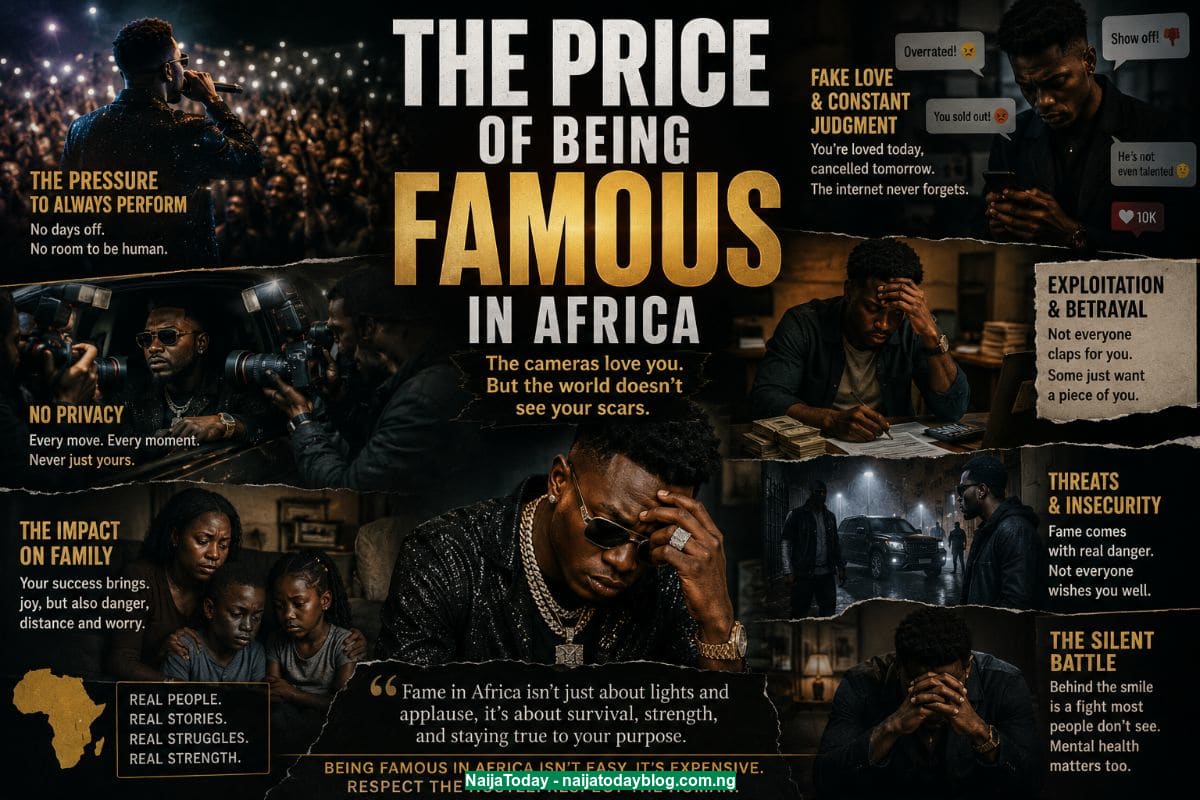
When you become famous in Nigeria — truly, nationally famous — you enter into an unspoken contract with the public. And the terms of that contract are not negotiable.
You owe them access. Not just to your music or your movies or your comedy skits, but to your life. Your relationships. Your family. Your grief. Your opinions. Your weight. Your skin. Your choices. The car you drive and the church you attend and whether you remembered to greet your mother on her birthday on social media and why you were spotted at an event where a particular person was also present.
You owe them a version of yourself that is simultaneously aspirational and relatable — which is an impossible thing to be. You must be successful enough that they can dream through you, but humble enough that they never feel you have forgotten where you came from. You must be wealthy but not arrogant. Talented but not self-important. Confident but not proud.
The moment you slip — the moment you say the wrong thing in an interview, or your body changes in a way the public did not approve, or you make a business decision that somebody on Twitter decides to misinterpret — the same people who were praising you on Monday will be writing your obituary on Wednesday.
And unlike in Hollywood, where there are publicists and crisis management teams and entire infrastructures built to protect celebrities from the worst of public opinion, most Nigerian celebrities face this completely alone.
The Family Problem
There is a particular kind of pressure that Nigerian celebrities face that their Western counterparts simply do not understand: the pressure of being the family's way out.
In Nigeria, success is never individual. When you make it, the understanding — unspoken but absolute — is that you have made it for all of you. Your parents. Your siblings. Your cousins. Your uncle who you have not seen in eleven years but who will call you within forty-eight hours of your first hit single going viral. Your village. Your local government area.
This is not purely a bad thing. There is something profoundly beautiful about a culture where success is communal, where the person who rises turns around and pulls others up with them. Many Nigerian celebrities speak with genuine pride about what they have been able to do for their families, and that pride is real and deserved.
But the weight of it is also real. The expectation that you will fund school fees and hospital bills and house constructions and wedding expenses and business capital — all while managing a career that is itself unstable and unpredictable — is a weight that does not lift simply because a song is doing well on Apple Music.
Several Nigerian artists have spoken in recent years about the financial pressure that comes with fame. About how a chart-topping year can still leave you broke because the money that came in went straight out to obligations that existed before the first cheque was signed. This is a conversation the industry needs to have more openly.
Social Media and the New Cruelty
If fame in Nigeria was complicated before social media, social media has turned it into something genuinely dangerous.
Nigerian Twitter — now X — is one of the most ruthless arenas in the world. It is also one of the most creative, most witty, most culturally alive spaces on the internet. These things are not contradictions. The same energy that produces the most brilliant cultural commentary also produces pile-ons of a ferocity that can be genuinely devastating.
Celebrities in Nigeria have had their relationships dissected, their mental health questioned, their physical appearances mocked, their sexuality speculated about, and their darkest moments turned into memes — all in real time, all publicly, all with the full participation of people who would describe themselves as fans.
The death of celebrities has been celebrated on Nigerian Twitter. Breakdowns have been streamed live. Private messages have been leaked and shared without a second thought. And through all of it, the person at the centre of the storm is expected to either respond with grace or stay silent — because responding with anger, however justified, will simply become the next thing to be ridiculed.
This culture is not unique to Nigeria. But in a country where mental health support is still dramatically under-resourced and stigmatised, it hits differently.
The Ones Who Didn't Make It Out
We need to talk about the celebrities we have lost.
Not just to death — though Nigeria has buried too many talented young people too soon — but to obscurity, to addiction, to mental illness that went unaddressed because asking for help felt like weakness, to the slow grinding erosion of a person who was asked to perform happiness for public consumption long after they had forgotten what happiness actually felt like.
The music industry specifically has a history of chewing people up. Artists who had number-one songs in the nineties and early two-thousands who are now struggling in ways that the public either does not know or does not care about. Nollywood actors who defined an era and now cannot afford medical treatment. Comedians whose laughter masked pain so deep that even the people closest to them did not see it until it was too late.
Fame without infrastructure is a dangerous thing. And for too long, the Nigerian entertainment industry has had a lot of fame and very little infrastructure.
The Ones Getting It Right
But this is not a eulogy. It is a reckoning — and reckonings can lead to better things.
There is a new generation of Nigerian celebrities who are approaching fame differently. Who are setting boundaries publicly and unapologetically. Who are talking about therapy in interviews without lowering their voices. Who are choosing silence over performance when silence is what they need. Who are building businesses and investment portfolios because they understand that fame has an expiry date and financial literacy does not.
Artists like Tems, who guards her private life with a quiet firmness that commands respect. Like Rema, who at a young age has shown a clarity about who he is and what he will not compromise. Like the wave of content creators and influencers who are turning their platforms into genuine businesses and refusing to be exploited by brands who want their audience without wanting to pay properly for access to it.
There is also a growing conversation among Nigerian fans about the responsibility of audiences. About what it means to love a public figure. About the difference between accountability and cruelty, between criticism and harassment, between caring about someone's work and feeling entitled to their entire existence.
These conversations are slow. They are incomplete. But they are happening.
What We Owe Them
Here is a thought that Nigerian celebrity culture rarely entertains: what do we owe them?
We talk endlessly about what celebrities owe their fans. Their time, their gratitude, their accessibility, their authenticity. But rarely do we turn the question around.
We owe them the basic dignity of remembering they are human. That the person behind the stage name has a body that gets tired, a mind that can break, a heart that feels every unkind word even when they pretend not to. We owe them the grace to allow them to evolve — to change their sound, their look, their opinions, their relationships — without treating every evolution as a betrayal.
We owe them honest support, not parasocial possession.
Fame in Africa is a beautiful, brutal, complicated thing. It is a gift that comes wrapped in barbed wire. And the celebrities who navigate it with their souls intact deserve not just our applause, but our genuine respect.
Not because they are perfect. But because they are human — doing an extraordinarily difficult thing in front of an audience that never fully sleeps.
Published on NaijaToday — naijatodayblog.com.ng