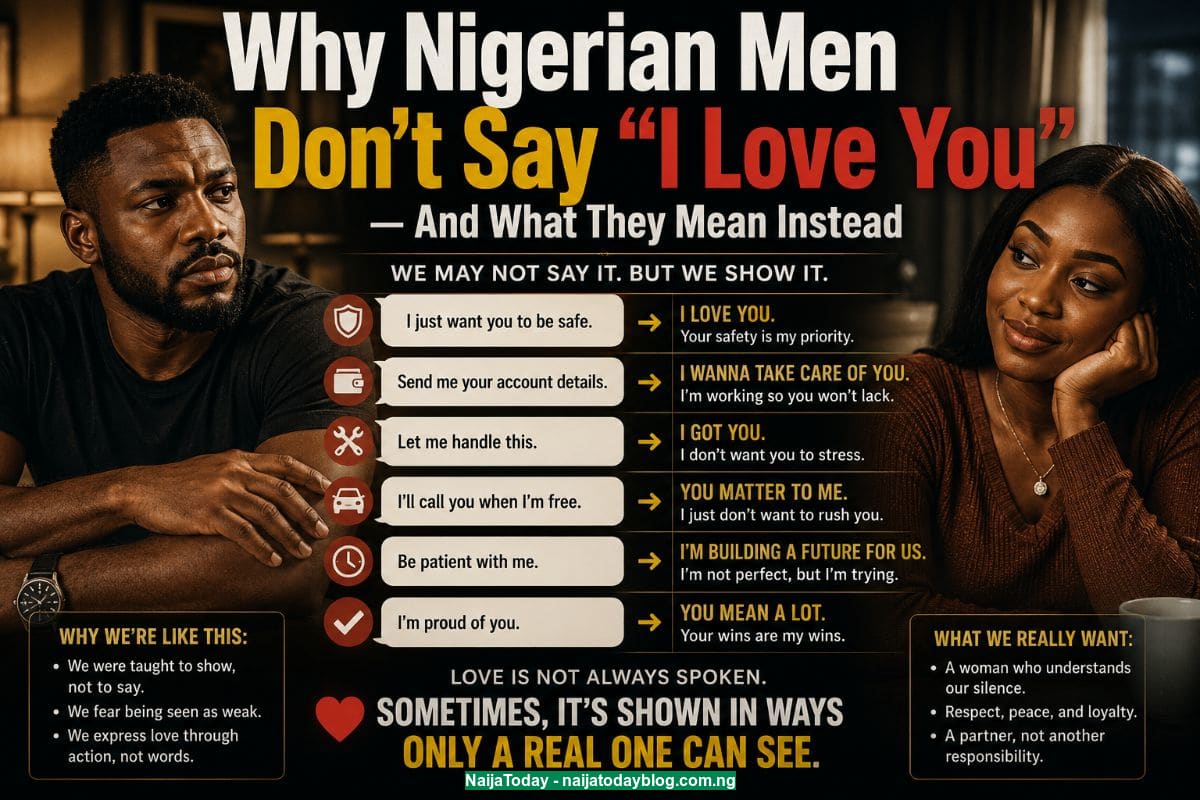
Why Nigerian Men Don't Say "I Love You" — And What They Mean Instead
On love, silence, and the unspoken dialects of African affection
There is a man somewhere in Nigeria right now who has been married to the same woman for thirty-one years. He has never, not once, looked her in the eyes and said the words. Not on their wedding day. Not when she survived a difficult childbirth. Not even last Christmas when the grandchildren were gathered in the sitting room and the television was playing and the jollof rice was perfect and the moment was, by every possible standard, made for the words.
He did not say them.
But here is what he did. He woke up every morning for thirty-one years and made sure there was money for food before he left for work. When she was sick in 1999, he sat outside the hospital room on a plastic chair for eleven hours and did not leave even when the nurses told him visiting hours were over. When her mother died, he drove four hours in the rain to the village and carried the coffin on his shoulder and did not complain once. When her business failed, he did not say a single word about it. Just quietly gave her money to start again.
He has never said "I love you." But if you asked his wife whether she is loved, she would look at you the way you look at someone who has just asked a question so obvious it is almost offensive.
Of course, she would say. Can't you see?
The Language We Were Never Taught to Translate
The problem with the global conversation about love and relationships is that it was largely written in English, by people whose emotional culture expresses itself in words. And when you grow up watching American movies and reading romance novels where love is always announced, always declared, always verbal — you begin to believe that love which is not spoken is love which does not exist.
This is one of the most damaging lies that Western cultural exports have told African people about themselves.
Love in Nigeria — in most of Africa — has always had a different grammar. It is a language of action rather than declaration. Of presence rather than proclamation. Of sacrifice rather than statement. And learning to read that language, rather than waiting for a translation that may never come, might be one of the most important things a person can do for their own emotional life.
This is not to say that words do not matter. They do. There is something that happens when someone looks at you and says the words — something that no amount of action can fully replace, because human beings need to hear themselves spoken into significance by the people they love.
But it is to say that a man who has never said "I love you" in thirty-one years and a man who is not in love are not the same man. And collapsing those two different realities into one is a failure of emotional literacy that costs people — costs women especially — the ability to recognize what they actually have.
What They Do Instead
So what does Nigerian love actually look like when it is not wearing the clothes of Hollywood romance?
It looks like a father who works a job he hates so his children can attend a school he is proud of. Who never tells the children this, because in his understanding, that is simply what a man does. The love is in the doing, not the telling.
It looks like a mother who wakes at four in the morning to cook before anyone else is up, not because she has been asked to but because feeding the people she loves is how she holds them. How she says — without words — you matter, you matter, you matter.
It looks like an older brother who transfers money to his younger sibling's account on the first of every month without waiting to be asked. Who never mentions it. Who would be embarrassed if the sibling thanked him too effusively because in his mind it is not a favour, it is just what family does.
It looks like a husband who notices that his wife's car is making a strange sound and books it into the mechanic before she even mentions it. Who fills her fuel tank when it gets low without being asked. Who, when she travels, texts to ask if she arrived safely in the most casual possible tone — as if the text is nothing, as if the waiting for the reply is nothing — when both of them know that the text is everything.
This is love. It is just love with a different accent.
The Generation Caught in Between
The difficulty right now is that a generation of young Nigerians is caught between two emotional cultures and is not fully fluent in either.
They grew up watching their parents express love through action and sacrifice — learning, whether consciously or not, that this is what love looks like. But they have also grown up online, on Instagram and TikTok and Twitter, consuming a global romantic culture that is drenched in verbal expression, in grand gestures, in the expectation that love should be performed as well as felt.
So you have young Nigerian men who feel deeply but cannot say it, because nobody modelled that for them. And young Nigerian women who are receiving love in the old language but yearning to hear it in the new one. And the distance between those two realities is where a great deal of Nigerian relationship pain is living right now.
The argument is not that one culture is right and the other is wrong. The argument is that Nigerian couples need to learn to do something their parents largely did not have to do: talk about love explicitly. Not assume. Not interpret in silence. But sit across from each other and say — this is how I show you I care. This is what I need to feel cared for. This is the language I speak. Can you learn some of it? Can I learn some of yours?
On Nigerian Women and the Patience That Should Not Be Infinite
Something needs to be said here that is not said often enough in these conversations.
The same culture that produced the beautiful, quiet love languages described above also produced a tolerance for emotional neglect that has been dressed up as African womanhood. There is a version of "he shows love through action" that is genuine and should be honoured. And there is a version that is simply a woman convincing herself that a man who is indifferent to her feelings is actually loving her in a secret language only she can see.
These are not the same thing. And learning to tell the difference is urgent and important.
Love — in any language, in any culture — should make you feel seen. It should make you feel safe. It should make you feel that your inner life matters to the person you are with, not just your cooking and your appearance and your role in the household. A man can fill your fuel tank every week and still be completely uninterested in your dreams, your fears, your sadness, your joy. And a full fuel tank, by itself, is not enough.
Nigerian women have been told for too long that asking for more is greed. That wanting emotional presence in addition to material provision is a foreign idea imported by women who watch too many movies. That the right response to a man who is physically present but emotionally absent is gratitude, because at least he is there.
This is not wisdom. This is exhaustion that has been given a cultural name.
Learning to Say It Anyway
To the Nigerian men reading this — the ones who feel it but cannot say it — this is for you too.
The silence was not your fault. You were raised in homes where emotional expression was considered weakness, where men showed love by doing and providing and protecting but almost never by sitting across from someone and saying the words that made them vulnerable. You inherited a language and nobody gave you another one.
But here is the thing about languages: you can learn them. At any age. It is uncomfortable at first — the way any new language is uncomfortable. The words feel strange in your mouth. You feel exposed. You feel like you are doing something slightly ridiculous.
Say them anyway. To your wife. To your children. To your mother before it is too late. To your friend who is going through something hard.
Not because the old language was wrong. But because the people you love deserve to hear themselves named — out loud, in words, in the direct and unambiguous way that the heart sometimes needs.
The actions will always matter. But the words matter too.
Published on NaijaToday — naijatodayblog.com.ng