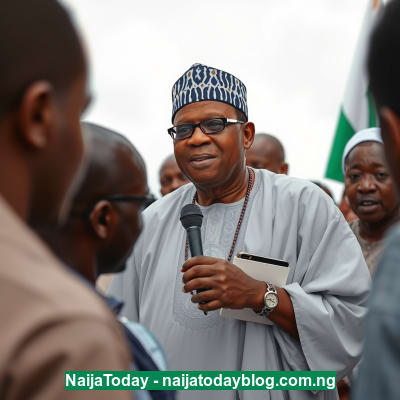
Nigeria prays
more than almost any nation on earth. We fast more. We tithe more. We build
more churches per square kilometre than hospitals. We name our children
Chukwuemeka, Oluwaseun, Abubakar, and Chisom — every name a declaration of
faith, a tiny sermon pressed into a birth certificate. We spray "God is
good" on danfo buses, paint "By His Grace" on container trucks
barreling down the Lagos-Ibadan expressway at 120 kilometres per hour, and open
PTA meetings, company board sessions, and even football press conferences with
prayer.
By every measurable standard, Nigeria is the most intensely religious country
in the world.
And yet.
And yet we remain one of the most economically unequal nations on earth. And
yet our hospitals still lack basic equipment. And yet our roads swallow lives
every rainy season. And yet millions of Nigerians go to bed hungry in a country
sitting on some of the most fertile land on the African continent.
How do we hold both of these things at the same time? How do we square our extraordinary,
almost violent devotion to God — on both sides of the Christian-Muslim divide —
with the lived reality of a nation that, by so many measures, does not reflect
the blessing we declare over it every single day?
That is the question this article dares to ask. Not to mock faith. Not to
dismiss religion. But to look honestly, lovingly, and without flinching at what
religion has done for us, what it has done to us, and what it still has the
power to do.
The Numbers Don't Lie
Let's start with the data. The Pew Research Centre has consistently ranked
Nigeria among the top countries in the world for religious commitment — not
just in Africa, but globally. Over 90 percent of Nigerians report that religion
is very important in their daily lives. Compare that to 53 percent in the
United States, 21 percent in the United Kingdom, and under 10 percent in
France.
Nigeria has an estimated 86,000 registered churches — and that figure doesn't
account for the thousands of unregistered fellowships operating out of rented
shops, converted warehouses, and open fields. There are more Pentecostal
Christians in Lagos alone than in the entire country of Sweden. On the Muslim
side, Nigeria has the highest number of Muslims in sub-Saharan Africa, with a
practice that ranges from the deeply Sufi traditions of the North to growing
Salafi movements reshaping how young Nigerians in Kano and Sokoto think about
piety.
We do not half-commit to faith. When a Nigerian believes, they believe with
their whole chest.
Where It Comes From
To understand Nigerian religiosity, you have to understand history — not just
the colonial history that brought Christianity and formalised Islam into the
territory that became Nigeria, but the deeper, older spiritual consciousness
that was already here.
Before the missionaries arrived, before the jihads reshaped the North, the
people of this land already lived inside a world that was densely, profoundly
spiritual. The Yoruba had Ifa — one of the most sophisticated divination
systems ever developed by any civilisation, a body of oral literature so vast
that UNESCO recognised it as an Intangible Cultural Heritage of Humanity. The
Igbo had Chukwu — a supreme being so abstract and transcendent that early
Christian missionaries were confused to find that people they assumed had no
God actually had a concept of God more philosophically refined than many
European theological traditions of the same era. The Hausa-Fulani communities
of the North had already been reshaped by centuries of Islamic scholarship,
producing great centres of learning in Kano, Sokoto, and Timbuktu.
The arrival of Christianity and the deepening of Islam did not land on empty
spiritual ground. They landed on soil that was already rich with the sacred.
And what grew from that encounter was something unique — a Nigerian spiritual
temperament that is not quite like anywhere else on earth. Passionate.
Personal. Expectant. A faith that believes God is not distant but immediate,
not theoretical but practical, not interested merely in your soul after death
but in your visa application, your job promotion, your mother's surgery, your
WAEC results.
This is the God of the Nigerian church. Present. Interventionist. Ready to act
— if you pray hard enough, fast long enough, give generously enough.
The Prosperity Gospel Problem
Here is where we must be honest, because love demands honesty.
In the last four decades, a particular strand of Christianity has come to
dominate the Nigerian religious landscape in ways that have had profound and
not always positive consequences. The prosperity gospel — the theological
position that financial blessing is the direct, inevitable reward of sufficient
faith and generosity toward God's servants — did not originate in Nigeria. It
came largely from American televangelists of the 1970s and 80s. But it found in
Nigeria extraordinarily fertile soil.
The reasons are understandable. A population under enormous economic pressure,
watching a tiny elite live lives of incomprehensible luxury while the majority
struggled, reached toward a theology that said: God wants you to be wealthy
too. Your poverty is not God's plan. Name it and claim it. Sow a seed and reap
a harvest.
At its best, this message gave dignity and ambition to people who had been told
— by colonialism, by corruption, by circumstance — that prosperity was not for
them. It produced an entrepreneurial spirit, a refusal to accept mediocrity, an
almost aggressive optimism that is one of the most recognisable qualities of
Nigerians everywhere in the world.
At its worst, it produced something darker. It produced a culture in which
spiritual leaders — some of them genuinely gifted, others frankly predatory —
accumulated private jets, luxury estates, and billions in personal wealth while
their congregations, who had sown their "seeds of faith," remained
poor. It produced a theological framework that, in a cruel inversion, blamed
the poor for their poverty. You're not healed because your faith is weak.
You're not promoted because you haven't given enough. The structural causes of
poverty — corruption, bad governance, lack of infrastructure — were essentially
spiritualised away. Why demand accountability from your senator when the answer
to your problems is a midnight prayer?
This is the tragedy. Not faith itself. But a distortion of faith so convenient
for the powerful that one sometimes wonders whether its rapid spread was
entirely accidental.
The North's Own Reckoning
Nigerian Islam faces its own version of this reckoning — different in character
but similarly urgent.
The Islamic North of Nigeria is home to some of the most ancient scholarly
traditions on the continent. The great mosque of Kano, the libraries of Sokoto,
the oral and written traditions of Quranic scholarship that have sustained
communities for centuries — these are extraordinary achievements that deserve
far more recognition than they receive.
And yet the same North that produced this scholarship now produces some of the
worst human development indicators in the country. Female literacy in some
northern states remains below 20 percent. Child marriage continues despite
being illegal. Almajiri children — young boys sent to study the Quran in urban
centres — sleep on the streets of Kano and Kaduna, begging for food, their religious
education unconnected to the economic skills that would allow them to live
dignified adult lives.
Here too, religion has sometimes been used as a reason not to change rather
than an inspiration to change. Here too, those who benefit from existing arrangements
have wrapped those arrangements in sacred language to make them harder to
challenge.
Boko Haram, at its most stripped-down ideological core, was a violent
manifestation of a real and legitimate grievance — that Western education had
failed the North — twisted into something monstrous by manipulation and
despair. Its name, loosely translated, means "Western education is
forbidden." The violence it produced was unforgivable. But the failure of
the Nigerian state to provide quality education and economic opportunity in the
North was also a failure — one that preceded the terror and, in many ways,
enabled it.
What Religion Has Built
Before we go further, fairness demands we account for the other side of the
ledger. Because Nigerian religion has built extraordinary things.
The mission hospitals established by Catholic, Anglican, and Methodist
missionaries in the nineteenth and early twentieth centuries were, for decades,
the only places where Nigerians could access modern medical care. Many still
operate today — Sacred Heart Hospital in Abeokuta, St. Nicholas in Lagos — and
continue to serve millions.
Nigerian churches run some of the best schools in the country. The great
secondary schools — King's College, Government College Umuahia, Queens College
— have secular origins, but Mission schools like Loyola Jesuit College in Abuja
and Baptist Boys' High School in Abeokuta have educated generations of Nigerian
leaders.
Islamic education, at its most functional, produces graduates of remarkable
discipline, memorisation, and ethical formation. The Izala and Tijaniyya
movements have built mosques, schools, and community support systems across
northern Nigeria that function where the state does not.
At the community level, religious organisations remain the primary social
safety net for millions of Nigerians. When a man dies in Lagos, it is his
church that feeds his widow and helps school fees get paid. When a student from
Kano arrives in Ibadan for university, it is the mosque that gives him somewhere
to sleep while he finds his feet. The Nigerian state has largely abdicated its
responsibility to its citizens. Religion stepped into that vacuum — and
whatever its flaws, that must be acknowledged.
The New Generation's Quiet Crisis
Something is shifting, though — quietly, in ways that are not yet fully visible
in statistics but are unmistakable to anyone paying attention.
A growing number of young Nigerians, particularly those between 18 and 35, are
experiencing what researchers call "religious disaffiliation" — not
necessarily atheism, but a pulling back from institutional religion. The JAPA
generation, the young Nigerians who have watched their parents give to churches
and mosques for decades without seeing commensurate improvement in their lives,
are asking harder questions.
They see pastors living in mansions while preaching sacrifice. They see imams
endorsing politicians who have looted public funds. They have watched the COVID
pandemic expose the limits of prayer as a public health strategy. They are,
many of them, not abandoning God — but they are becoming increasingly
suspicious of the institutions that claim to speak for God.
This is not necessarily a bad thing. Every great religious tradition in history
has been periodically reformed by exactly this kind of honest, uncomfortable
questioning. Martin Luther nailing his theses to the door. Usman Dan Fodio's
reform movement challenging the corrupt Islamic establishment of early 19th
century Hausaland. These were not attacks on faith. They were faith insisting
on integrity.
Perhaps Nigeria is overdue for its own reformation.
What We Actually Need
The answer is not less faith. Nigeria without its spiritual energy would be
unrecognisable — diminished, stripped of something essential. The resilience,
the joy, the refusal to be defeated that characterises the Nigerian spirit is
inseparable from its spiritual roots.
What Nigeria needs is a faith that faces outward as much as inward. A faith
that prays on Sunday and votes on Tuesday — and votes well. A faith that builds
hospitals because God is in the medicine, not instead of it. A faith that holds
its leaders accountable precisely because corruption is a spiritual problem,
not just a governance failure. A faith that educates girls in the North not
despite Islam but because of it — because the Prophet Muhammad, peace be upon
him, said explicitly that the pursuit of knowledge is a duty for every Muslim,
male and female.
We need preachers who will stand at their pulpits and say: yes, pray — and also
register to vote, and also demand your elected official's account of what
happened to the constituency funds. We need imams who will say: yes, trust in
God — and also take your child to the hospital, and also refuse to marry your
daughter at fourteen because God did not create her for suffering.
We need a Nigerian faith that is mature enough to hold both the mystery of God
and the responsibility of citizenship at the same time.
A Final Word
There is a moment, early every morning across Nigerian cities and towns, that I
think captures something true about who we are.
Before the traffic begins. Before the generators roar to life. Before the
hawkers start calling. In that thin, quiet hour before dawn — in Lagos, in
Kano, in Enugu, in Maiduguri — you can hear them. The sound of the muezzin
calling the faithful to Fajr. And not far away, perhaps, the sound of a
pastor's voice lifted in early morning prayer. And somewhere, an old woman
whose grandmother's grandmother knew older names for God, pressing her palms
together in a gesture that predates them both.
Nigeria prays. Deeply, honestly, desperately, joyfully.
The question that will define the next generation is not whether we will keep
praying. We will. The question is whether we will allow our faith to demand
more of us — more honesty, more accountability, more courage, more justice.
Because a faith that comforts us without challenging us is not faith. It is
sedation.
And Nigerians were never built to be sedated.
🕌 Religion🔥 HOT
God, Money, and the Nigerian Soul: Why We Are the Most Religious People on Earth — Yet Still Searching
By NaijaToday Desk · 25 June 2026 · 10 min · 👁 18
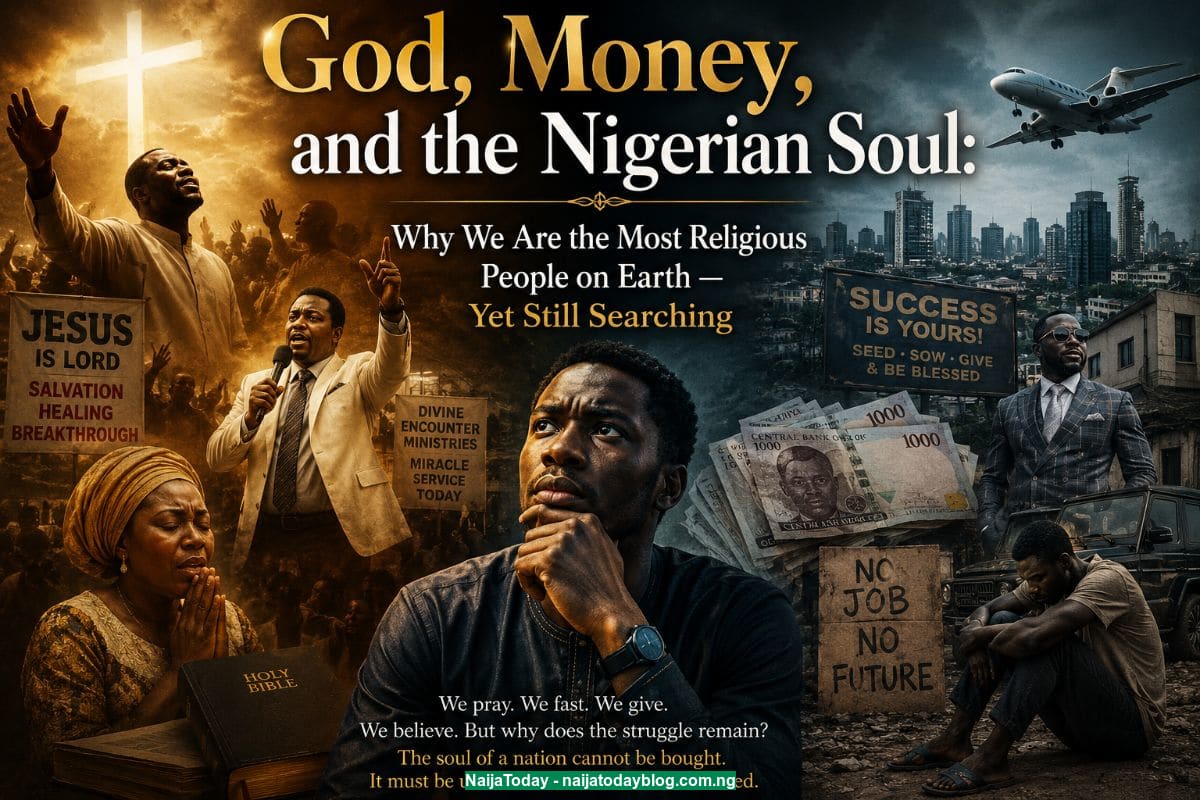
Nigeria prays more than almost any nation on earth. We fast more. We tithe more. We build more churches per square kilometre than hospitals. We name our children Chukwuemeka, Oluwaseun, Abubakar, and Chisom — every name a declaration of faith, a tiny sermon pressed into a birth certificate. We spray "God is good" on danfo buses, paint "By His Grace" on container trucks barreling down the Lagos-Ibadan expressway at 120 kilometres per hour, and open PTA meetings, company board sessions, and even football press conferences with prayer.
How does this story make you feel?
No account or sign-in needed. You can react instantly.
Share:
NaijaToday Desk
The NaijaToday newsroom
More Stories to Explore
More reporting selected from NaijaToday, based on topics and categories.