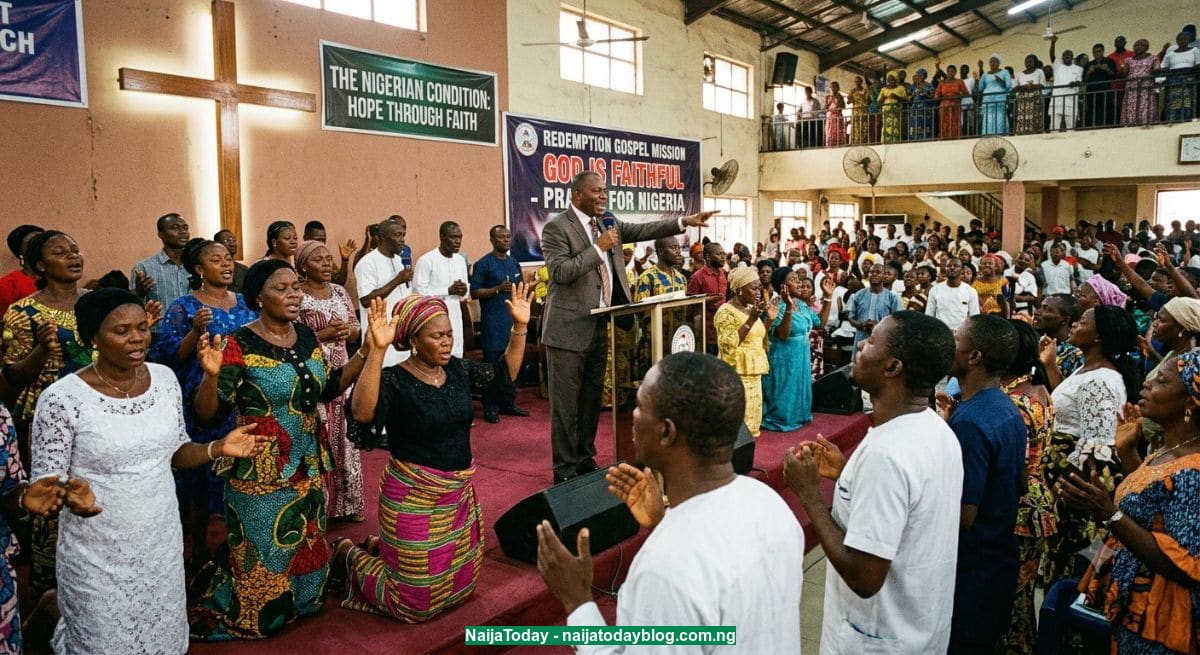
There is a joke that Nigerians tell about themselves — the kind of joke that is only funny because it is entirely true — that Nigeria has more churches per square kilometre than any other country on earth, and yet things have never been harder. You cannot walk two streets in Lagos without passing a white-garment congregation singing at full volume at six in the morning, a Pentecostal megachurch with a car park that looks like a Rolls-Royce showroom, a mosque with loudspeakers that reach four neighbourhoods simultaneously, and a roadside prophet with a megaphone and a handwritten banner promising miracles before Friday.
Nigeria is, by any measurable standard, one of the most religious countries in the world. And it is also one of the most difficult places on earth to live a dignified life.
These two facts sit side by side every single day, and nobody quite knows what to do with the tension between them.
This is not an article written to attack faith. Religion in Nigeria is not a simple thing that can be dismissed or celebrated without nuance. It is woven into the fabric of daily life in ways that go far deeper than Sunday services and Ramadan fasts. It is how people survive grief. It is how mothers hold themselves together when the money runs out and the children are still hungry. It is the language through which entire communities understand themselves, their history, their pain, and their hope.
But it is also something else. And that something else needs to be talked about — honestly, without flinching, and with the kind of love that tells the truth.
Where It Begins
To understand religion in Nigeria, you have to understand what Nigeria has put its people through.
Decades of military dictatorship. A civil war whose wounds have never been properly tended. Corruption so entrenched that it has become structural — not just the behaviour of bad individuals but the operating system of entire institutions. Infrastructure that collapses faster than it can be built. A healthcare system that sends the wealthy abroad and leaves the poor to pray. An education system that produces graduates who cannot find work. A currency that loses value while the people who hold it watch helplessly.
When your earthly systems fail you this completely and this consistently, where do you turn?
You turn to God. Not as a last resort — as a first language. As the only power that has not yet disappointed you. As the relationship that, unlike government and unlike institutions and sometimes unlike people, has never asked you to lower your expectations and then failed to meet even those.
This is the ground from which Nigerian faith grows. And it is important to hold that ground with respect before anything else is said.
The Church That Built Itself an Empire
But something happened along the way. Something shifted.
The church — particularly the Pentecostal church that exploded across Nigeria in the 1980s and 1990s — began as a genuinely radical thing. It was loud and democratic in ways that older, more hierarchical religious structures were not. It welcomed the poor. It sang in languages people actually spoke. It promised that God was not distant and formal but close and personal and actively interested in your promotion at work and your healing from sickness and your deliverance from the spiritual forces that the average Nigerian understood, without question, to be real and active in daily life.
The early Pentecostal church in Nigeria gave people something they desperately needed: agency. The sense that through prayer and faith and the right relationship with the divine, their circumstances could change. That they were not simply victims of forces beyond their control.
And then the prosperity gospel arrived. And everything became more complicated.
The prosperity gospel — the theology that says financial wealth is a sign of God's favour and that poverty is evidence of insufficient faith — did something very specific to Nigerian Christianity. It turned the church into a marketplace. It made pastors into spiritual entrepreneurs. It created a system where the more you gave to the man of God, the more God was supposed to give back to you — a transaction dressed in the language of faith.
Suddenly, the private jets were not an embarrassment to be explained. They were evidence. Proof that God rewards those who serve him. And if your pastor has a private jet and you are still struggling to pay rent, the implication — never stated directly but always present — is that the problem is your faith. Your giving. Your spiritual positioning.
This theology did not just take money from people who could not afford to give it. It did something more damaging: it made poverty a moral failure. It told struggling Nigerians that their hardship was their own spiritual fault, and that the solution was to give more to an institution that was already taking too much.
The Prophets and the People
Nigeria has produced some of the most remarkable religious figures in the world. It has also produced some of the most dangerous.
There are pastors in this country whose genuine care for their congregations is evident in the way they show up — in hospitals, in communities, in moments of national crisis. Men and women of faith who have built schools and hospitals and feeding programmes and who have used their platforms to genuinely serve rather than to accumulate.
These people exist. They are real. And they deserve acknowledgement.
But they share a landscape with something far darker. With men who have used the authority of the pulpit to sexually exploit women who came to them for spiritual help. With prophets who have convinced parents to bring their children — their own children — for deliverance sessions that turned into abuse. With religious leaders who have told HIV-positive congregants to stop taking their medication because God was going to heal them, and who have watched people die as a result without ever being held accountable.
With the commercialisation of miracles. The selling of anointing oil and holy water and prayer handkerchiefs at prices that make no sense to anyone who has actually read the Bible. With crusades where the testimonies are sometimes scripted and the miracles are sometimes staged, and where the offering is always, always real.
Nigeria loses billions of naira every year to religious exploitation. Billions that flow from the pockets of people who cannot afford to lose it into institutions that are answerable to nobody — not to government, not to any regulatory body, not to any external accountability structure whatsoever.
And because questioning the man of God has been coded into Nigerian Christian culture as a form of spiritual rebellion — as the kind of thing that invites a curse rather than a conversation — most people do not question. They give again. They fast again. They believe harder. And when the miracle still does not come, they blame themselves.
Islam and the Questions It Is Also Asking
The conversation about religion in Nigeria cannot be complete without the North, without Islam, without the very different but equally complex relationship that Muslim Nigerians have with their faith.
Islam in northern Nigeria is not a monolith. It contains within it Sufi traditions of remarkable spiritual depth, scholarly lineages that stretch back centuries, and communities where faith genuinely organises life around justice and care and communal responsibility.
It also contains the political weaponisation of religion that has caused immeasurable suffering. The exploitation of genuine religious grievance by those whose actual interests are power and resources rather than the faith they invoke. The subordination of women in ways that are cultural rather than theological but which are defended as divine. The violence that erupts along religious fault lines and consumes communities that had been living as neighbours for generations.
The questions that Nigerian Muslims are asking within their own tradition — about reform, about interpretation, about the relationship between faith and citizenship, about what it means to be Muslim in a plural, modern, troubled state — are serious and important questions. And they deserve the same honest engagement that questions about Christianity deserve.
What Faith Actually Does
Here is what neither the defenders nor the critics of Nigerian religion talk about enough: what faith actually does, day to day, for ordinary people.
It gets them out of bed. In a country where depression goes undiagnosed and untreated for millions of people — where the mental health infrastructure is so thin that most Nigerians will go their entire lives without ever speaking to a therapist — the belief that there is a God who sees them and cares about them and is working on their situation is not a delusion. It is a survival mechanism of extraordinary power.
It creates community. The average Nigerian church or mosque is not just a place of worship. It is a social network, a welfare system, a space where news is exchanged and businesses are connected and marriages are arranged and people in crisis find hands to hold. In a country where formal welfare structures are almost entirely absent, religious communities fill a gap that nothing else is filling.
It gives language to grief. When a mother loses a child — and in Nigeria, too many mothers lose too many children — she needs somewhere to put that pain. She needs a framework that can hold something that cannot be held otherwise. Faith, at its most genuine, does this work. It sits with grief without trying to explain it away. It says that the loss matters, that the child mattered, that the suffering is not meaningless even when it feels like it is.
These are not small things. They are enormous things. And any honest conversation about religion in Nigeria has to honour them.
The Reformation That Is Coming
But honouring them does not mean pretending that everything is fine. And increasingly, Nigerians themselves — particularly young Nigerians — are refusing to pretend.
There is a generation growing up that has watched their parents give and give and give to institutions that gave very little back. That has seen the contradiction between the wealth of religious leaders and the poverty of their congregations. That grew up in a country that prays more than almost any nation on earth and still cannot fix its roads.
This generation is not abandoning faith wholesale. What they are doing is something more interesting and more difficult: they are trying to separate faith from exploitation. Spirituality from performance. The genuine encounter with the divine from the transaction that has been built around it.
They are asking questions that their parents were told not to ask. About accountability. About transparency in church finances. About the theology of suffering that has been used to keep people passive in the face of injustice. About whether the God they believe in actually wants them poor.
These are reformation questions. And reformations, historically, do not arrive gently. They arrive with the same energy that the original faith arrived with — urgent, disruptive, unwilling to be quiet.
A Faith Worth Having
Nigeria needs its faith. But it needs a faith that tells the truth.
A faith that says God cares about justice as much as he cares about offerings. That prayer and action are not opposites but partners. That the miracle you are waiting for sometimes requires that you stand up and demand what is right from the systems that are failing you, not simply fold your hands and declare it done.
A faith that holds its leaders accountable. That understands that the collar and the microphone do not confer immunity from scrutiny. That being a man or woman of God does not mean being above the questions that every other human being with power must answer.
A faith that sits with doubt instead of punishing it. That understands that the person asking hard questions about God is often the person who takes God the most seriously. That certainty is not always holiness, and uncertainty is not always unbelief.
Nigeria is a spiritual country. That is not going to change and should not change. But the spirit of a nation is not just expressed in how many times it prays. It is expressed in how it treats its most vulnerable people. In whether the faith that is so loud and so visible in every street and every market and every public space translates into the kind of society where dignity is available to everyone — not just those lucky enough to be born into the right family, or the right region, or the right relationship with the right man of God.
That is the Nigeria that faith, at its most genuine, has always been promising.
It is time to start demanding it.
Published on NaijaToday — naijatodayblog.com.ng