Why the Super Eagles Are NOT at the 2026 World Cup — And
What It Means for Nigerian Football
Right now, as you read this, the biggest football tournament
on the planet is happening. The 2026 FIFA World Cup. Stadiums packed to the
brim across the United States, Mexico and Canada. Billions of people watching.
The beautiful game at its absolute peak.
And Nigeria? Nowhere to be found.
As the 2026 FIFA World Cup kicked off across the
United States, Mexico and Canada, Nigeria's Super Eagles were watching from
afar — despite being one of the highest-ranked teams not participating in the
tournament. The latest FIFA rankings placed Nigeria 26th in the world, making
the Super Eagles the second-highest-ranked nation to miss the expanded 48-team
World Cup.
Let that sink in for a moment. Forty-eight teams. Almost
half the FIFA member nations. And Africa's most decorated footballing nation —
three-time AFCON champions, a country that once dazzled the world at USA '94 —
couldn't get a seat at the table.
Only Denmark, ranked 21st globally, sits higher among
countries that failed to qualify.
This isn't just a sporting disappointment. For over 200
million Nigerians, this is a wound that cuts deep. This is about identity.
Pride. And the uncomfortable question that nobody in Moshood Abiola Stadium or
the NFF boardroom wants to answer honestly: How did we get here?
Today, we're going to trace every step of this painful
journey — from the shambolic qualifying campaign, to the AFCON heartbreak, to
the World Cup playoff disaster in Rabat, to the controversial
"voodoo" accusations, to what this all means for the future.
No sugarcoating. Just the raw, honest truth.
Let's dive in.
Chapter 1: The Qualifying Campaign — A Disaster from Day
One
Nigeria's World Cup qualifying campaign didn't collapse
overnight. It was a slow, agonizing death by a thousand cuts that started long
before Coach Eric Chelle ever arrived.
The Super Eagles were drawn into Group C of the African
World Cup qualifiers alongside South Africa, Benin Republic, Rwanda, Zimbabwe
and Lesotho. On paper, this looked manageable. Nigeria were the biggest name in
the group. They should have walked it.
They didn't.
Portuguese tactician José Peseiro and Super Eagles legend
Finidi George handled the team in the first four games of the qualifying
series. By the time Chelle took charge, the former African champions had
managed only three points from a possible 12.
Three points out of twelve. Let me put that in perspective.
That's ONE win (or three draws) from FOUR matches. Against teams like Lesotho
and Zimbabwe. For a nation ranked among the top 30 in the world.
José Peseiro managed 1-1 draws against Lesotho and
Zimbabwe, while Finidi George drew South Africa and lost 2-1 to Benin,
gathering three points in the first four matches.
Drawing against Lesotho at home. Losing to Benin Republic.
This was the foundation of the disaster. By the time Chelle was appointed in
January 2025, the Super Eagles were already in a hole so deep that only
perfection could dig them out.
And perfection is not a word you associate with Nigerian
football administration.
Chapter 2: The Chelle Era Begins — Hope, Then Heartbreak
When Eric Chelle was appointed as Super Eagles head coach in
January 2025, Nigerians were cautiously optimistic. Here was a young, hungry
Franco-Malian coach with a point to prove. He immediately got to work.
Chelle started his managerial era with a 2-0 win over Rwanda
in Kigali, but a late Tawanda Chirewa goal in Uyo held Nigeria to a 1-1 draw
against Zimbabwe.
That Zimbabwe result at home — in the Godswill Akpabio
Stadium — would come back to haunt Nigeria like a ghost that refuses to leave.
"It's true that in some matches, like against Zimbabwe,
we drew at home while the match was in our hands. In the end, these two dropped
points Nigeria's
Super Eagles fought to a 1-1 draw against South Africa in Bloemfontein. The
result left Bafana Bafana six points ahead at the top of the table, while
Nigeria remained under pressure.
Despite the inconsistency, Chelle somehow kept hope
alive. The Super Eagles clinched a play-off spot after a hard-fought 2-1
victory over Lesotho and a convincing 4-0 win against Benin Republic in Uyo.
Nigeria didn't qualify automatically — South Africa took the
group — but they had a lifeline: the CAF World Cup playoffs. Beat two teams,
and you'd go to the inter-confederation playoffs with a World Cup ticket still
within reach.
The first playoff match was against Gabon. And for one
glorious night in Rabat, Nigerians dared to dream again.
Nigeria beat Gabon 4-1 at the Moulay Hassan
Stadium, with goals from Akor Adams, Chidera Ejuke and a brace from Victor
Osimhen.
Four goals. Osimhen scoring twice. The Super Eagles playing
beautiful, aggressive, confident football. Nigeria Twitter was on fire. The
memes were flowing. "We're going to the World Cup!" echoed across
every WhatsApp group in the country.
Then came the final. DR Congo. And with it, the night that
broke 200 million hearts.
Chapter 3: The Night Everything Fell Apart
November 16, 2025. Moulay Hassan Stadium, Rabat, Morocco.
In a sad end to a shambolic campaign, Nigeria's
Super Eagles missed the 2026 FIFA World Cup after losing 3-4 to the Leopards of
DR Congo on penalties. DR Congo had clawed back into the game after Frank
Onyeka's early opener, with Meschak Elia drawing them level at the half-hour
mark. Nigeria created the better chances in extra time but could not find a
breakthrough, and the miss-filled shootout condemned them to another World Cup
heartbreak. Nigeria missed out on the tournament after losing
the playoff to DR Congo on penalties, marking the second consecutive absence
after also missing the 2022 edition in Qatar.
Two consecutive World Cups missed. For a country of
Nigeria's size, talent pool and football heritage, this is beyond embarrassing.
It's a full-blown crisis.
But as heartbreaking as the result was, it was what happened
AFTER the final whistle that truly set Nigerian social media ablaze.
Chapter 4: The "Voodoo" Controversy
This. This right here is the part of the story that nobody
will forget.
The Super Eagles' exit from the World Cup playoff
final was overshadowed by a heated post-match controversy, as Nigeria head
coach Eric Chelle accused the DR Congo contingent of resorting to what he
described as "voodoo" during the penalty shootout. The tension flared
moments after Chancel Mbemba converted the decisive kick to hand DR Congo a 4-3
shootout win. Chelle stormed toward the Congolese technical area immediately
after the match, confronting members of their staff and exchanging words with
head coach Sébastien Desabre before Nigeria's backroom crew intervened. The
altercation caught the attention of those inside the stadium.
When asked what had set him off, Chelle didn't hold back.
"During all the penalty decision the guy of Congo
did some Voodoo. Every time ... Every time. So this is why I was a little
nervous after him," Chelle told reporters.
Now. Let's pause here.
On one hand, many Nigerians online rallied behind Chelle.
"We know what happens in African football," they said. "Juju is
real." The comments sections were filled with stories of rituals, charms
and spiritual warfare in African football going back decades. Whether you
believe in it or not, the cultural context is undeniable — the intersection of
spirituality and sport in African football is as old as the game itself on the
continent.
On the other hand, many observers — including international
media — saw the accusations as a convenient excuse for a team that simply
didn't perform when it mattered most. Desabre dismissed the touchline
incident during his press conference, saying it was "nothing
serious." Chelle, however, later told reporters that he was angered by
what he claimed were repeated gestures from the opposing bench during the
spot-kicks. DR Congo officials flatly denied the accusations.
The truth? Probably somewhere in the middle. But one thing
is certain: no amount of juju — real or imagined — made Nigeria draw 1-1 with
Lesotho. No voodoo forced Nigeria to drop points against Zimbabwe at home. No
dark magic caused the coaching chaos that saw three different managers in one
qualifying campaign.
The problems were human. Structural. Administrative. And until Nigeria addresses those, no amount of prayers, fasting or counter-juju will take the Super Eagles to a World Cup.
Chapter 5: The AFCON Consolation — Bronze, But Not Gold
After the World Cup heartbreak, the Super Eagles turned
their attention to the 2025 Africa Cup of Nations in Morocco. And to their
credit, they showed up.
Nigeria tore through the group stages unbeaten. In the
quarter-finals, they produced one of the performances of the tournament. Victor
Osimhen scored one and set up another as Nigeria powered to a deserved 2-0
victory over Algeria to set up a semi-final with hosts Morocco.
Osimhen was on fire. The team was playing with purpose and
belief. For a few beautiful weeks, Nigerians forgot about the World Cup
heartbreak and dared to dream of continental glory.
Then came the semi-final against Morocco. In Rabat. In front
of a hostile home crowd.
After 120 minutes of grit, discipline and tactical
chess that ended goalless, Morocco held their nerve to edge Nigeria in a
dramatic penalty shootout, sending the hosts through to the final.
Penalties again. Nigeria losing on penalties. AGAIN.
Nigeria's hopes of reaching a ninth Africa Cup of
Nations final were dashed as the Super Eagles fell to hosts Morocco. The Lions
edged Nigeria 4-2 in a shoot-out, following a goalless 120 minutes at the
Prince Moulay Abdellah Stadium. Goalkeeper
Yassine Bounou emerged the hero of the night, saving penalties from Samuel
Chukwueze and Bruno Onyemaechi in the shoot-out. Bounou's heroics paved the way
for Youssef En-Nesyri to convert the decisive kick, sending the home crowd into
celebration. Nigeria departed with heads held high after another
powerful showing, but it was Morocco who took the final step. The coach guided Nigeria to a bronze medal finish
at the 2025 Africa Cup of Nations in Morocco and has restored some belief
around the national team after a turbulent period.
Bronze. Not bad. But for a country that has won the AFCON
three times, bronze feels like a participation trophy. Especially when the two
penalty shootout losses — against DR Congo and Morocco — were separated by just
two months.
Chapter 6: The NFF Problem — It's Bigger Than Football
Let's address the elephant that's been sitting in the room
this entire article: the Nigeria Football Federation.
NFF President Sanusi pointed directly to the
instability in Nigeria's coaching setup as one of the biggest reasons behind
the disappointing qualifying campaign. He believes the team's form under the
Franco-Malian coach showed that Nigeria had enough quality to qualify
comfortably.
Think about that. The NFF president himself is admitting
that coaching instability — something entirely within the NFF's control — is
what derailed the campaign. Three managers. One qualifying campaign. Zero
accountability.
Nigeria would not even have qualified for the
inter-confederation playoffs if Eritrea had not withdrawn from the qualifiers
in Group E, a factor that boosted Nigeria's qualification for the World Cup
playoffs.
Read that again. Nigeria's "qualification" for the
playoffs partly depended on ANOTHER COUNTRY WITHDRAWING. That's how bad it got.
And after the DR Congo loss, what did the NFF do? Nigeria's
absence from the World Cup followed the Super Eagles' loss to DR Congo in the
African playoff final. A subsequent attempt by the Nigeria Football Federation
to seek entry through a petition to FIFA, which alleged that DR Congo had
fielded ineligible players, was dismissed by the governing body.
They tried to petition their way into the World Cup. FIFA
said no. As they should have.
You can't administrate your way out of a problem you
administrated your way into.
Chapter 7: The Chelle Question — Stay or Go?
Now, despite everything, there's one interesting subplot
that has emerged from all of this chaos: Eric Chelle himself.
The man was handed a broken team with three points from four
games. He stabilized them. Won matches. Took them to the AFCON semi-finals. Won
a bronze medal. And restored genuine belief among the players and fans.
Although missing out on the 2026 FIFA World Cup remains a
major disappointment, many observers believe continuity could be more
beneficial than starting another rebuilding process under a new manager. For
the NFF, securing Chelle's future has become more than a contractual issue — it
is about maintaining continuity. The Super Eagles are expected to begin
preparations for the 2027 Africa Cup of Nations qualifiers in the coming
months, and another coaching change could disrupt the progress already made.
But here's the twist. Nigeria is facing increasing
competition from several African national teams and North African clubs
interested in securing the services of Chelle.
Reports suggest that Algeria, following their
disappointing World Cup campaign, have identified Chelle as a potential
candidate to lead their rebuilding project. Chelle agreed a new contract with the NFF. The
manager received an improved salary of $100,000 per month.
But the situation remains unresolved. According to
respected BBC journalist Oluwashina Okeleji, the coach has not yet signed the
extension, leaving the door open for other interested parties to make their
move.
$100,000 per month. In a country where the minimum wage is
N70,000. While his players play their hearts out and the NFF can barely
organize a qualifying campaign without changing coaches three times.
Nigerian football, ladies and gentlemen.
Chapter 8: What This World Cup Miss Really Costs Nigeria
Let me tell you what people aren't talking about enough.
Missing the World Cup isn't just about 90 minutes of football. It has real,
lasting consequences.
Money: FIFA distributes hundreds of millions of
dollars to participating teams. Group stage elimination alone earns a team
approximately $13 million. Nigeria isn't getting a single cent of that.
Player Development: The World Cup is where young
African talents get spotted by elite European clubs. Missing the tournament
means fewer eyes on Nigerian players, fewer transfer deals, and less money
flowing back into the football ecosystem.
Dual-Nationality Talent: This is a big
one. Without World Cup football, Nigeria may struggle to
attract dual-nationality talents who often consider major tournaments before
committing their international future.
Think about all the talented Nigerian-born players in
England, Spain, Germany and Italy who hold dual citizenship. When they're
deciding whether to play for Nigeria or their country of birth, the World Cup
is often the deciding factor. Miss two in a row? Good luck convincing them.
Rankings and Draw Seedings: The Super Eagles are also expected to slide down the FIFA
rankings, which could make future Africa Cup of Nations and World Cup
qualifying draws even more difficult.
It's a vicious cycle. Miss the World Cup → rankings drop →
get harder draws → harder to qualify → miss again. Nigeria needs to break this
cycle urgently.
Chapter 9: Meanwhile, at the Actual World Cup...
While Nigeria sits at home, the 2026 World Cup has been
delivering unforgettable moments.
The FIFA World Cup in North America generated the
largest search volumes of the period in Nigeria — several times bigger than any
other topic. Nigerians followed the Super Eagles' group-stage campaign
vicariously, alongside Shakira and Burna Boy's performance of "Dai
Dai" at the Mexico City opening ceremony, and every twist on the road to
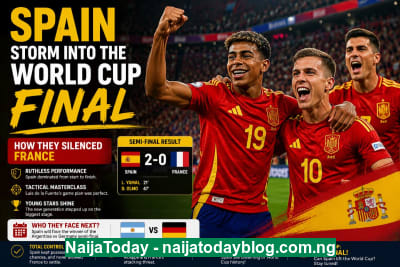
Spain's 1-0 win over Argentina in the final. According to Google, no story generated as much
search interest during the period as the 2026 FIFA World Cup in North America.
Nigerians followed developments surrounding the tournament, from the Super
Eagles' campaign to individual players and participating countries. Search
interest also extended to entertainment surrounding the tournament, including
Burna Boy and Shakira's opening-ceremony performance.
Even from the couch, Nigerians couldn't look away. We
watched. We commented. We debated. We suffered through every match involving
African teams, wondering, "What if that was us?"
Erling Haaland peaked in Nigerian search interest
in July as Norway's run ended against England, and France drew waves of
attention for ending Morocco's historic quarter-final run.
Nigerians were searching for Haaland. For Morocco. For
France. For anyone and everyone. Because our own team wasn't there to search
for.
Chapter 10: The Road Ahead — 2027 AFCON and 2030 World
Cup
So where do the Super Eagles go from here?
The next chance for the Super Eagles to recover lost ground
in the standings comes in September, when the 2027 Africa Cup of Nations
qualifiers get underway. Former international Mobi Oparaku advised the NFF
to determine Eric Chelle's future, adding that the Super Eagles need stability
in commencing early preparations for the 2030 FIFA World Cup.
The 2030 World Cup will be hosted across six countries —
Spain, Portugal, Morocco, Argentina, Uruguay and Paraguay. Three of those six
hosts are countries where Nigeria has significant football ties. Morocco,
especially, is practically a second home ground for the Super Eagles after
spending so much time there during AFCON 2025 and the World Cup playoffs.
But qualifying for 2030 means fixing the problems NOW. Not
in 2028. Not "when things settle down." NOW.
Here's what needs to happen:
1. Coaching Stability: No more hiring and firing
coaches mid-campaign. Whether it's Chelle or someone else, pick a coach and
BACK them. Give them at least a full qualifying cycle.
2. NFF Accountability: The administrators who
presided over this disaster need to answer for it. Not with press conferences
and petitions to FIFA, but with structural reform.
3. Youth Development: Nigeria's Under-17 teams
used to win World Cups. What happened? The pipeline from youth football to the
senior team has broken down completely. Fix it.
4. Home Stadium Consistency: Nigeria played
"home" games in different venues, sometimes in neutral countries. The
Super Eagles need a fortress — a home ground where opposing teams fear to
tread.
5. Player Welfare: The stories of players going
on strike over unpaid bonuses and poor conditions are embarrassing. Pay the
players. Treat them with respect. It's not complicated.
The Final Whistle
Let me end with this.
I love the Super Eagles. You love the Super Eagles. Two
hundred million Nigerians love the Super Eagles. That love is precisely why
this hurts so much.
But love without accountability is just sentimentality. And
sentimentality doesn't win World Cups.
Nigeria has the talent. Victor Osimhen is one of the best
strikers on the planet. Ademola Lookman won the CAF Player of the Year. The
depth of Nigerian football talent scattered across Europe's top leagues is
staggering. No other African country comes close.
The talent has NEVER been the problem. The problem is
everything around the talent — the administration, the planning, the coaching
carousel, the petty politics, the lack of infrastructure, the failure to build
systems that outlast individuals.
Chelle himself said it best: "When I arrived,
Nigeria had three points out of 12, so we fought hard to try to qualify. Having
reached the playoffs, we lost against the Democratic Republic of Congo. We lost
on penalties; they deserved the victory."
He's honest. The question is: will the people who run
Nigerian football be equally honest with themselves?
The 2026 World Cup is happening without Nigeria. That's a
fact we can't change. But 2030 is coming. AFCON 2027 is around the corner. The
future is not written yet.
But if Nigeria approaches the next cycle the same way it
approached this one — with chaos, instability and last-minute desperation —
then we'll be sitting at home again in 2030, watching other countries live our
dream.
And no amount of voodoo accusations will change that.
The ball is in the NFF's court. Literally
What do you think? Is Eric Chelle the right man to take
Nigeria forward? Was the NFF's coaching chaos the real reason we missed the
World Cup? And can the Super Eagles realistically qualify for 2030? Drop your
thoughts in the comments — let's debate it!
Share this article with every football-loving Nigerian
you know. And for more articles on Nigerian sports, entertainment and current
affairs, stay locked to Naijatodayblog.com.