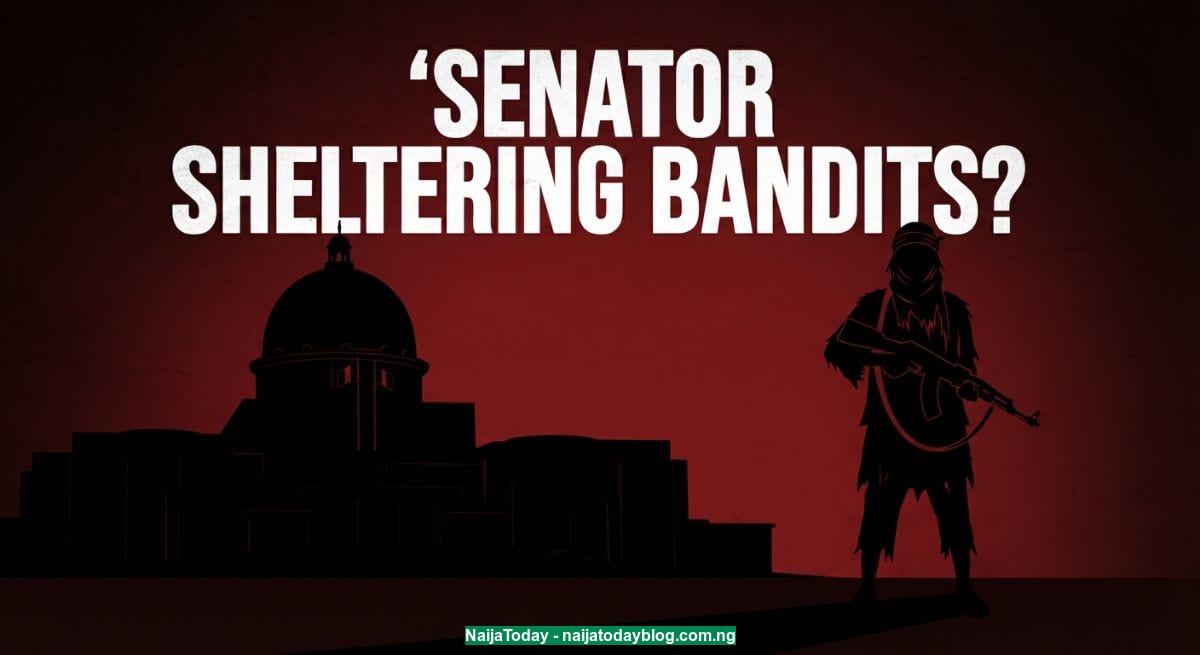
Bandits Found in a Nigerian Senator's House — This Is
Nigeria's Worst Kept Secret Finally Exposed
For years — literally years — security experts, community
leaders, and ordinary Nigerians living in bandit-affected zones of the
North-West have been saying it.
They've been saying it in hushed tones. They've been saying
it in petitions that went unanswered. They've been saying it in community
meetings that no journalist covered and no government official attended.
They've been saying it on social media, where it got dismissed as conspiracy
theory or ethnic profiling.
They've been saying that the banditry crisis in Nigeria's
North-West is not just a security failure. It is, in part, a political failure.
That some of the people responsible for protecting Nigerian communities from
bandits are, in fact, the same people who are protecting the bandits from
Nigerian security forces.
And now, this Sunday, that allegation has taken its most
concrete, most explosive form yet.
High-profile bandit kingpins have allegedly been found in
the residence of a Nigerian senator.
A senator. Elected by Nigerians. Paid by Nigerian taxes.
Sworn to uphold the Nigerian constitution. Allegedly sheltering the very
criminals who have turned the North-West into a killing field.
If this is confirmed — and we must be clear that these are
allegations at this stage — it would represent one of the most damning
revelations in the history of Nigerian politics. Not because it's entirely
surprising to those who have been watching the banditry crisis closely. But
because it would make explicit, with evidence, what has long been suspected but
never proven at this level.
Let's talk about this honestly.
What We Know: The Allegations
The reports indicate that high-profile bandit kingpins were
allegedly found in the residence of a Nigerian senator. The specific senator's
name has not been officially confirmed in verified reports at the time of
writing. Security agencies are reportedly involved in the investigation.
We want to be very clear about what we know and what we
don't:
What is alleged: Bandit leaders of significant
standing were found at a senator's home.
What this would mean if confirmed: That a
sitting Nigerian lawmaker has been providing shelter — or possibly more — to
the criminals responsible for mass kidnappings, killings, and the terror that
has gripped communities across the North-West for years.
What we don't yet know: The senator's identity
(in confirmed reports), the specific circumstances under which the bandits were
found, whether this was a surprise security operation or a tip-off, and what
charges if any will be filed.
We are reporting this story because it is circulating across
major Nigerian news platforms and has entered the public domain. But we want
our readers to hold this information appropriately — with awareness of the
allegations while awaiting official confirmation of the full details.
Why This Allegation Is Not Entirely Surprising
Here is the uncomfortable truth that Nigerian security
analysis has been dancing around for years:
The banditry crisis in the North-West did not emerge from
nowhere. And it has not persisted for nearly a decade purely because of
security force incompetence.
Bandit groups in Zamfara, Katsina, Sokoto, and surrounding
states have shown an extraordinary ability to survive, adapt, regroup, and
expand despite billions of naira spent on security operations, multiple
military deployments, aerial surveillance, and the declarations of various
"final offensives."
How? Because they have supply chains. They have weapons.
They have food. They have intelligence about security force movements. They
have people who tip them off before raids. They have places to shelter when
things get hot.
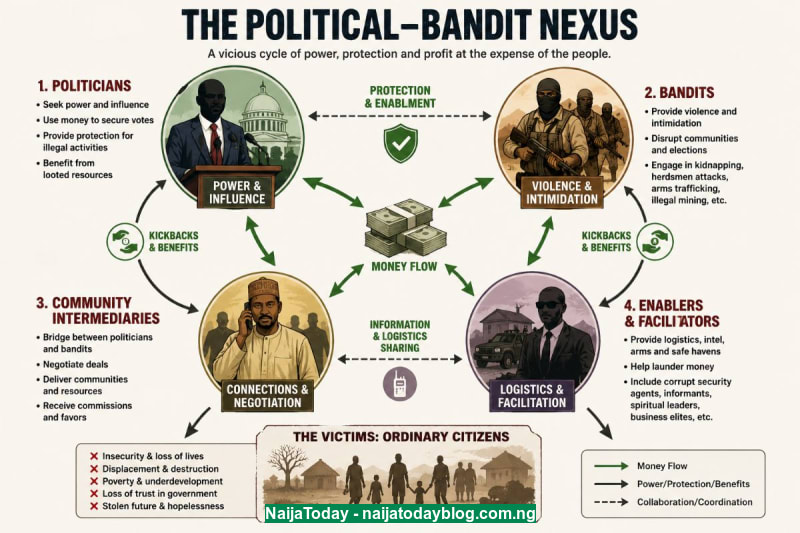
None of this is possible without networks that extend into
legitimate society. Networks that include people with phones, with vehicles,
with information, and — critically — with the political influence to create
space for bandit operations to continue.
Multiple security experts and community leaders over the
years have pointed to political patronage as one of the enabling factors in the
North-West banditry crisis. The argument is straightforward: in some
communities, bandits provide economic benefits — through kidnapping ransoms
that flow through local economies, through protection rackets that powerful
people profit from, through cattle theft operations that feed into legitimate
cattle markets.
Some politicians have historically served as intermediaries
— people who negotiate between communities and bandit groups, people who
facilitate "peace deals" that allow bandits to operate in exchange
for reducing visible violence.
The line between "negotiating with bandits" and
"protecting bandits" is one that some Nigerian political figures have
clearly crossed.
The Devastating Human Cost of Political Complicity

Let's put a human face on what political complicity with
bandits actually costs.
Since 2019, tens of thousands of Nigerians in the North-West
have been killed, kidnapped, or displaced by bandit violence. Schools have been
shut — sometimes for years — because of bandit threats. Farmers cannot go to
their fields. Communities have been burned. Markets have been destroyed.
The psychological toll on communities that live under
permanent terror is immeasurable. Children who have grown up knowing nothing
but the threat of kidnapping. Women who cannot fetch water from the village
well without fear of abduction. Elderly people who have watched their
communities emptied as younger residents flee to cities.
This is the human cost of the banditry crisis.
If a senator — or multiple senators, or any elected
officials — have been providing shelter, protection, or political cover to the
people responsible for this, they are not just guilty of a crime. They are
guilty of a betrayal so profound that ordinary language struggles to capture
it.
They took an oath. They represent constituencies full of
people living under bandit terror. They collect salaries paid by those same
terrorized people. And if the allegations are true, they sheltered the men
doing the terrorizing.
That is not politics. That is treason against the Nigerian
people.
The Security Agencies: Will There Be Accountability?
Here is where the story will get complicated.
In Nigeria, when security agencies arrest or expose
politically connected individuals, the outcomes are rarely straightforward.
There is enormous pressure — phone calls from powerful people, threats from
influential networks, legal maneuvers, media counternarratives — that can slow
or derail investigations involving the political class.
The history of high-profile arrests in Nigeria is filled
with cases that began with dramatic revelations and ended with quiet
discontinuation, nolle prosequi, or acquittals that had more to do with
political influence than judicial analysis.
For this case to result in actual accountability, several
things need to happen:
1. The senator must be publicly named by official
security agencies. Anonymous allegations, however credible, are
insufficient for serious legal action.
2. The evidence must be preserved and presented
transparently. Chain of custody. Documented searches. Witness
statements. The kind of evidentiary foundation that can survive aggressive
legal challenge.
3. The prosecution must be insulated from political
pressure. This is perhaps the hardest requirement to meet in Nigeria's
current political environment, where the ruling party controls the machinery of
federal government and has relationships with senators across party lines.
4. The investigation must follow the money. Finding
bandits in a senator's house is one thing. Understanding how they got there —
what relationship existed, what transactions occurred, what communications were
exchanged — is the full picture that leads to genuine dismantling of the
political-bandit nexus.
What This Means for the 2027 Campaign
Every presidential candidate currently running or planning
to run in 2027 needs to answer directly for this story.
Not with vague statements about "taking security
seriously." With specific answers to specific questions:
- Do
you believe that some Nigerian politicians have relationships with bandit
groups?
- What
specific legislative and executive actions will you take to investigate
and prosecute political enablers of banditry?
- Will
you support an independent, internationally observed commission of inquiry
into political complicity in the North-West banditry crisis?
Tinubu, as incumbent, has the most direct responsibility to
answer. The security agencies that reportedly found bandits in a senator's
residence are under his executive authority. What he does next — whether he
allows a thorough, transparent investigation or whether the story quietly
disappears — will tell Nigerians everything about his commitment to genuine
security reform.
Atiku, whose political base is the North, also has questions
to answer. The North-West has been burning under his watch as political boss of
that region. Has he done everything he could have done to use his political
influence to pressure for accountability?
Peter Obi, who has been most vocal about security failures,
has an opportunity here to push for specific structural reforms — not just
moral condemnation.
Security is not an abstract policy issue in Nigeria. It is
41 dead in a Sokoto boat tragedy. It is 24 dead in Plateau State. It is bandits
allegedly being sheltered in a senator's home. It is real people, real
communities, real terror.
The 2027 election must be fought — in part — on who has the
most credible plan to end this.
The Bottom Line
A Nigerian senator allegedly sheltering bandit kingpins. If
confirmed, this is the most direct evidence yet of what security experts have
long argued: that the banditry crisis in the North-West is not just a security
problem. It is a political problem. Enabled, sustained, and protected by people
who should be fighting it.
The Nigerian public deserves full transparency. The security
agencies must complete their investigation and release their findings publicly.
The senator — whoever he is — must face the full weight of the law.
And the millions of Nigerians living under bandit terror
deserve to know that their government is finally, genuinely, on their side.
Not on the side of the people in the senator's house.
What do you think about this development? Should senators
found sheltering bandits face treason charges? Drop your thoughts in the
comments!
📰 Source: Nigerian Eye 🔗
Naijatodayblog.com