Nigeria Hits
Record 24 Universities in Global Rankings — Plus 7 Students Just Won ₦35m for
Academic Excellence
There is genuinely good news coming out of Nigeria's education sector this
week, and it deserves more attention than it has received. While much of the
national conversation around education in Nigeria tends to focus,
understandably, on funding shortfalls, strikes, and access challenges, two
separate developments this week tell a more encouraging story: Nigerian
universities are gaining unprecedented international recognition, and a new
generation of brilliant students is being celebrated and rewarded for genuine
academic merit.
Nigeria's Best-Ever Performance in Global University Rankings
Nigeria has recorded its strongest-ever result in the Times Higher Education
(THE) World University Rankings, with 24 Nigerian universities earning places
on the prestigious 2026 global list — three more than the 21 that featured in
the previous edition. This makes Nigeria the most represented country in Sub-Saharan
Africa within the rankings, a genuinely significant milestone for a higher
education system that has weathered well-documented challenges over the past
decade.
The University of Ibadan (UI), Nigeria's oldest university, reclaimed its
position as the country's highest-ranked institution, placing in the 801–1000
global band — a spot it last held back in 2023, having dropped to fourth place
as recently as 2025. Joining UI in that same top global band is the University
of Lagos (UNILAG), marking the first time two Nigerian universities have
simultaneously broken into the global top 1,000 since the current ranking
methodology began.
What makes UI's return to the top particularly notable is the institutional
context. Founded in 1948, UI is home to Africa's largest postgraduate school,
runs 16 faculties, and has a student population of approximately 36,851.
Federal universities like UI, Ahmadu Bello University, UNILAG, and the
University of Nigeria face structural pressures that private institutions with different
financing models simply do not — including the recurring impact of ASUU
strikes, persistent infrastructure deficits, and chronic underfunding. The fact
that UI clawed its way back to the top of a globally credible, rigorously
assessed ranking despite those headwinds is arguably the most meaningful part
of this story for public education advocates.
UNILAG, for its part, recorded the highest research quality score among all
Nigerian universities at 66.7, reflecting its strong industry engagement and
international collaboration, advantages that flow naturally from its location
in Lagos, Nigeria's commercial and innovation hub.
Rounding out the national top five are Bayero University Kano (BUK) in third
place, Covenant University in fourth, and Landmark University in fifth — a
meaningful reshuffling from 2025, when Covenant held the top spot for two
consecutive years. BUK's strong showing is particularly notable as evidence
that academic excellence in Nigeria is not confined to the traditional Lagos-Ibadan
corridor; the Kano-based institution led the national table in international
outlook, a category measuring the proportion of international students, staff,
and research collaborations.
How the Rankings Actually Work
The THE World University Rankings 2026 assessed 2,191 universities across 115
countries and territories, evaluating institutions across 18 performance
indicators organised under five broad pillars: teaching environment, research
environment, research quality, industry engagement, and international outlook.
The methodology drew on more than 174.9 million citations from 18.7 million
research publications and survey responses from over 108,000 scholars globally
— making it one of the most rigorous and widely respected university ranking
systems in the world.
Of the 24 ranked Nigerian institutions, 17 are federal universities, a detail
the Minister of Education, Prof. Tunji Alausa, highlighted as evidence of
progress within the country's public higher education system specifically,
rather than gains driven primarily by private universities. Beyond the 24
officially ranked institutions, an additional 27 Nigerian universities
submitted data for assessment this cycle without making the cut, which
officials point to as evidence of a growing institutional culture of
transparency, benchmarking, and continuous improvement across the wider
sector.
It is worth being honest about where Nigeria still stands relative to global
leaders: no Nigerian university has yet cracked the global top 500. UI and UNILAG,
sitting in the 801–1000 band, represent strong performance by African and
Sub-Saharan standards, but there remains considerable distance to the upper
tiers occupied by leading global institutions. Still, the trajectory — three
more ranked universities than the previous cycle, two institutions breaking
into the global top 1,000 simultaneously for the first time, and a broadening
base of participating universities — points in a genuinely positive
direction.
Seven Students, ₦35 Million, and a New Model for Rewarding Merit
While the rankings story reflects institutional progress, a second education
story this week celebrates individual excellence. The Joint Admissions and
Matriculation Board (JAMB), in partnership with Rite Foods Limited, hosted its
maiden Academic Excellence Recognition Award Ceremony in Lagos on Tuesday, June
30, 2026, honouring seven exceptional Nigerian undergraduates who distinguished
themselves during the 2025 admission exercise.
Each of the seven award recipients received ₦5 million — a combined total of
₦35 million — in recognition of their outstanding performance in both the
Unified Tertiary Matriculation Examination (UTME) and the Post-UTME or
institutional screening exercises conducted by their respective universities. According
to JAMB's Public Communication Adviser, Dr. Fabian Benjamin, the beneficiaries
emerged through a rigorous, transparent, and merit-based selection process
coordinated entirely by the Board.
The ceremony drew an impressive list of dignitaries, including the Minister of
Education, Prof. Maroof Alausa; the outgoing JAMB Registrar, Prof. Is-haq
Oloyede; vice-chancellors of the universities attended by the award recipients;
vice-chancellors of universities across Lagos State; and executive secretaries of
key regulatory agencies including the National Universities Commission (NUC),
the National Board for Technical Education (NBTE), and the National Commission
for Colleges of Education (NCCE).
This initiative arrives at a particularly relevant moment. JAMB recently
announced that the highest scorer in the 2026 UTME was a 16-year-old candidate
from Ogun State, Owoeye Daniella Jesudunsin, who recorded an extraordinary
aggregate score of 372 — a result she has attributed publicly to disciplined
preparation and smart study methods. Stories like Jesudunsin's, paired with
this new ₦35 million reward initiative, are clearly designed to reinforce a
culture where genuine academic merit is visibly and tangibly celebrated,
providing real motivation for the next generation of UTME candidates preparing
for their own exams.
What These Rankings Actually Mean for Prospective Students
For Nigerian students currently weighing university options, or for parents
trying to make sense of where to direct their children, it is worth
understanding what these rankings practically signal, because the categories
within them point to different strengths depending on what a student actually
values. UNILAG's leading research quality score of 66.7 makes it a particularly
strong choice for students interested in postgraduate research careers or
academic pathways, since this metric reflects citation impact and the influence
of the institution's published research within the global academic community.
BUK's leadership in international outlook, meanwhile, signals a university with
stronger ties to international students, staff, and cross-border research
collaborations, which can matter considerably for students hoping to eventually
study or work abroad and want exposure to that kind of academic environment
during their undergraduate years. Covenant University's category-leading
industry score points to strong connections with employers and industry
partners, a relevant consideration for students prioritising direct pathways
into the private sector after graduation.
This kind of category-level nuance matters because a single overall ranking
position can obscure genuinely important differences between institutions. A
student deciding between UI and UNILAG, for instance, is choosing between Nigeria's
joint top-ranked universities, but the specific strengths each institution
demonstrates in this year's rankings suggest they may serve different academic
goals particularly well, even though both sit in the same overall global
band.
A Decade-Long Pattern Worth Watching
It is also worth situating this year's results within a longer pattern. Nigeria
has been gradually expanding its footprint in the THE rankings over recent
cycles, growing from 21 ranked universities to this year's 24, with 27 additional
institutions submitting data without making the final cut. This steady growth,
rather than a single dramatic jump, suggests something more durable than a
one-off improvement: a broadening institutional culture across Nigerian higher
education where more universities, both federal and private, are choosing to
subject themselves to rigorous international benchmarking rather than relying
solely on domestic reputation or historical prestige.
This matters because international rankings, for all their limitations and the
legitimate criticisms academics raise about their methodology, do influence
real outcomes for Nigerian graduates. International postgraduate admissions
committees, overseas employers evaluating Nigerian-trained candidates, and
international research funding bodies all use rankings, however imperfectly, as
a starting filter when assessing unfamiliar institutions. A Nigerian university
appearing in the global top 1,000, as UI and UNILAG now both do, carries
genuine signalling value for graduates seeking opportunities beyond Nigeria's
borders, even if the ranking position itself understates the quality of
specific departments or research groups within these institutions.
Why Both Stories Matter Together
There is a meaningful connection between these two developments that goes
beyond their shared timing. A higher education system only produces globally
competitive universities when it also nurtures and retains genuinely excellent
students at every stage of the pipeline — from secondary school through
university admission and beyond. Rewarding outstanding UTME and Post-UTME
performance with substantial financial recognition sends a clear signal to
younger students still preparing for their own exams: disciplined, honest
academic effort is seen, valued, and rewarded in Nigeria's education system.
Similarly, Nigerian universities climbing in credible global rankings, even
gradually, matters enormously for student confidence, for attracting
international research partnerships and funding, and for changing the narrative
that has too often centred exclusively on strikes and underfunding. Real
progress is happening on both fronts simultaneously, and Nigerian students,
parents, and education stakeholders deserve to know about it.
For students currently preparing for the next UTME cycle, the message from this
week's news is clear: the system is creating more pathways to recognition and
reward than ever before, and the universities you are working hard to gain
admission into are earning real international credibility while you do. Whether
your priority is research excellence, international exposure, or strong
industry connections, this year's rankings offer Nigerian students more
genuinely informed choices than at almost any point in the country's higher
education history.
Nigeria Hits Record 24 Universities in Global Rankings — Plus 7 Students Just Won ₦35m for Academic Excellence
By NaijaToday Desk · 30 June 2026 · 6 min · 👁 12
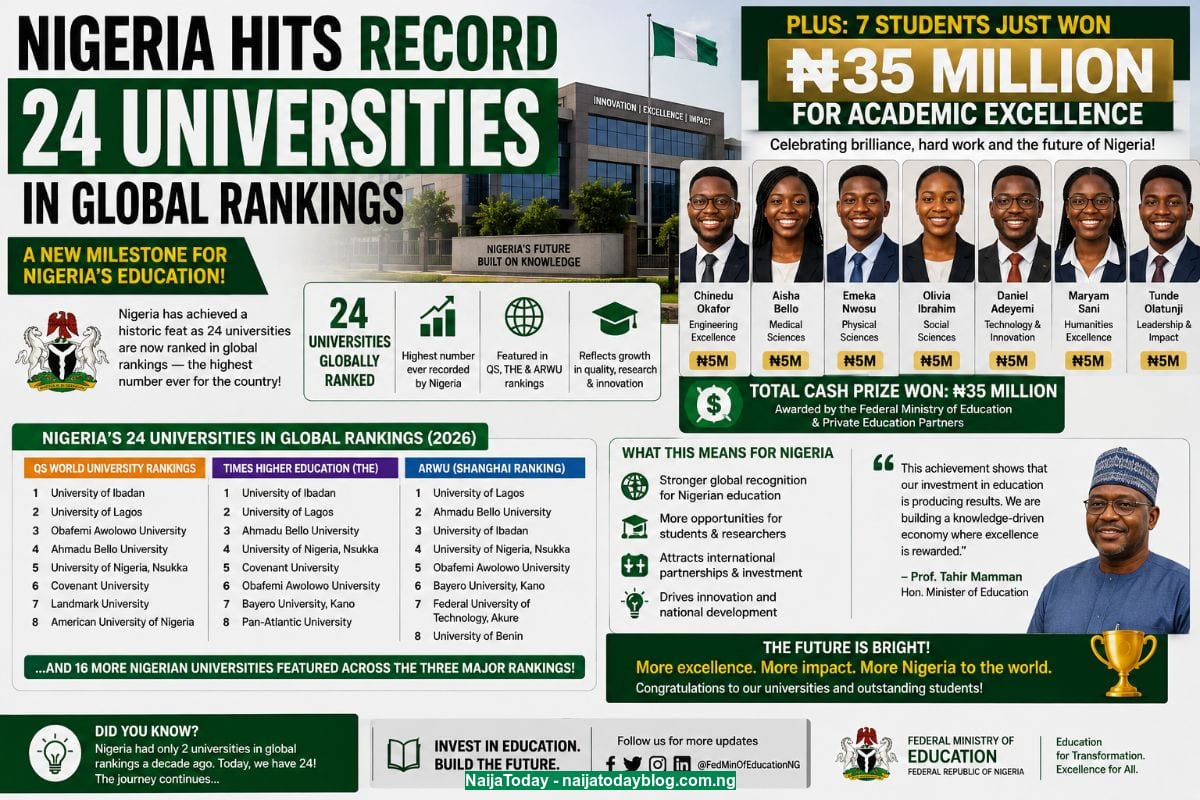
Nigeria just posted its best-ever performance in the Times Higher Education World Rankings with 24 universities now globally recognised, while JAMB and Rite Foods reward seven brilliant undergraduates with ₦5 million each. Here's the full story.
#nigeria university rankings 2026#times higher education nigeria#ui unilag ranking#jamb academic excellence award#best universities nigeria 2026#nigeria education news#bayero university ranking#nigerian education reform
How does this story make you feel?
No account or sign-in needed. You can react instantly.
Share:
NaijaToday Desk
The NaijaToday newsroom
More Stories to Explore
More reporting selected from NaijaToday, based on topics and categories.