The Certificate Trap:
Why the Four-Year Nigerian University Degree Is Losing Its Monopoly, and the
Rise of the New Skill Guilds
Consider two young Nigerians living in the same neighbourhood
in Ibadan, Enugu, or Kaduna.
The first is 26-year-old Chidi. Four years ago, after three
attempts at passing the Unified Tertiary Matriculation Examination (JAMB),
Chidi gained admission to a public university to study Political Science. Over
the course of his degree, he endured an eight-month faculty strike, lived
through endless power outages in overcrowded hostels, and memorized textbooks
published in the late 1980s.
Today, Chidi holds a Bachelor of Science degree printed on
high-grade paper. He has completed his National Youth Service Corps (NYSC)
year, worn the green khaki uniform, and posted a triumphant graduation photo on
social media captioned "B.Sc in the bag!" Yet, two years after
returning from his service year, Chidi sits at home submitting dozens of PDF
resumes every week into a void of corporate silence, or working an entry-level
customer service job that barely pays for his monthly transportation.
Now look at the second young person: 24-year-old Amina.
Amina did not gain admission to university after secondary
school. Instead of sitting at home waiting for another JAMB cycle, she spent
eighteen months at a local technical institute learning two practical trades:
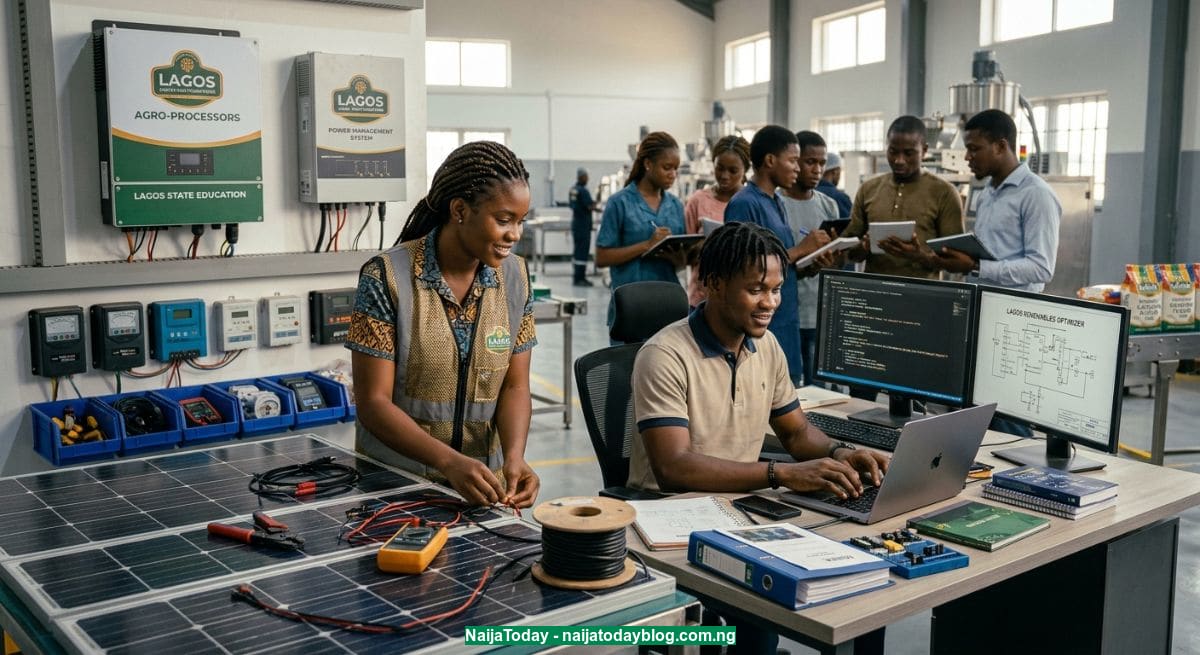
solar inverter installation and digital system diagnostics. By her second year
of apprenticeship, Amina was installing rooftop solar systems for residential
estates, wiring inverter banks for small businesses, and managing her service
appointments through WhatsApp Business.
Today, Amina earns three to four times the entry-level
salary offered to corporate graduates. She drives a reliable work vehicle,
employs two apprentices of her own, and has a backlog of clients booked three
weeks in advance.
This contrast is playing out across all 36 states of Nigeria
every day.
For over half a century, the four-year university degree was
viewed as the unquestioned ticket out of poverty in Nigeria. It was the sacred
holy grail of middle-class social mobility. Parents sold family land, took out
high-interest loans, and sacrificed their savings to ensure their children
obtained a B.Sc. or HND.
That monopoly is breaking down.
A quiet, profound revolution is reshaping how young
Nigerians approach work, education, and career development. Faced with a
changing economy, an outdated university curriculum, and a fast-moving digital
world, Nigeria is witnessing The Fall of the Certificate Trap—and the rapid
rise of the new skill guilds.
1. The Anatomy of the
Certificate Trap: How Paper Credentials Lost Their Value
To understand why the four-year university degree is losing
its hold on the Nigerian imagination, one must examine how the
"Certificate Trap" was created.
In post-independence Nigeria, formal higher education was a
direct bridge to immediate socio-economic elevation. The university graduate of
1975 was recruited straight from campus, handed a official car, assigned a
government flat, and guaranteed a stable corporate or civil service career for
life.
Because higher education delivered on its promise during
that era, Nigerian society built an unhealthy obsession with paper credentials.
We became a nation that valued the title over the technique, the certificate
over the competence, and the degree over the delivery.
|
| THE CERTIFICATE TRAP
CYCLE |
|||
|
|||
|
stagnate;
strikes disrupt calendars. |
|||
|
3. Graduate Inflation ---> Employers receive 5,000
applicants |
|||
|
for 2
entry-level office slots. |
|||
|
4. The Reality Shock ---> Paper degree fails to
guarantee |
|||
|
employment
or market value. |
|||
|
5. Skill Pivot ---> Youth turn to practical
trades, |
|||
|
tech
skills, and TVET. |
As the population exploded and public universities expanded
without matching infrastructure or industry partnerships, the quality of
instruction degraded. Higher institutions became paper factories—producing
hundreds of thousands of graduates every year into a formal job market that was
shrinking rather than expanding.
Worse still, the academic curriculum in many institutions
remained trapped in a time capsule.
Students sitting in computer science lecture halls were
taught programming languages that had been retired globally a decade prior,
writing code on paper blackboards because the department lacked functional
computer labs. Students in agricultural science departments spent four years
reading theoretical textbooks without ever managing a commercial green farm,
operating a modern tractor, or understanding automated irrigation systems.
When these graduates entered the real world, they discovered
a harsh truth: The market does not pay for what you spent four years
memorizing; the market pays for the specific problems you can solve today.
2. The Rise of the
New Skill Guilds
Faced with structural unemployment, young Nigerians did not
throw in the towel. Instead, they pioneered an alternative path to financial
independence by building a modern, skill-driven economy outside the traditional
university system.
These are the "New Guilds"—specialized, practical
training networks that focus on high-demand technical, digital, and vocational
skills.
|
THE MODERN NIGERIAN SKILL
GUILDS |
|
[DIGITAL & CREATIVE] ---> UI/UX, Software, Data, Video
Editing |
|
[ENERGY & INFRASTRUCTURE]--> Solar
Installation, Inverter Micro-Grids |
|
[AUTOMOTIVE & MECHATRONICS]->
Computer Diagnostics, EV Assembly, Hydraulics |
|
[FASHION & INDUSTRIAL] ---> Automated Apparel, Leatherworks,
CAD Furniture |
|
[BEAUTY & WELLNESS] ---> Advanced Cosmetology,
Aesthetics, Skincare |
A. The Tech &
Digital Creators Guild
In hubs across Yaba, Ikeja, Enugu, Kaduna, and Port
Harcourt, coding bootcamps, online academies, and peer-to-peer developer hubs
replaced traditional lecture halls. Young people realized that a six-month
intensive bootcamp in full-stack web development, UI/UX design, or data
analytics—combined with a strong online portfolio on GitHub or Behance—could
secure a high-paying remote global job faster than a four-year university
degree.
B. The Renewable
Energy Technicians
As households and businesses across Nigeria transition to
solar energy and inverter backup systems, a new class of highly respected
technical experts has emerged. These are not old-fashioned, untrained
apprentices; they are certified solar installation engineers, electrical technicians,
and battery system managers who combine physical craftsmanship with digital
system diagnostics.
C. The Mechatronics
& Modern Automotive Engineers
The modern automobile is a rolling computer. The era of the neighbourhood
mechanic who diagnoses engine faults by guesswork or smelling exhaust fumes is
drawing to a close. Today's automotive technicians use OBD-II diagnostic
scanners, computer software, and specialized electronic tools to service
high-tech vehicles, electric tricycles, and industrial generators.
D. The Fashion
Engineers and Industrial Designers
In garment hubs across Aba, Lagos, and Ibadan, fashion
design has evolved from basic tailoring into industrial apparel production.
Young designers are using Computer-Aided Design (CAD) software, automated
cutting equipment, and digital patternmaking to run fashion houses that ship
custom African apparel globally.
3. The Math: B.Sc.
vs. Practical Upskilling
To understand why parents and young people are shifting
their perspectives, let us do a realistic financial and opportunity cost
comparison between the traditional four-year degree path and a high-demand
skill acquisition route in Nigeria today.
|
THE PATHWAY COMPARISON
(4-YEAR HORIZON) |
|
METRIC | TRADITIONAL B.Sc ROUTE | HIGH-DEMAND SKILL ROUTE |
|
Time to Market | 4–6 Years (plus strikes) | 6–18 Months |
|
Initial Cost | ₦1.5M – ₦4M (Tuition/Rent) |
₦200k – ₦600k |
|
Portfolio at Finish |
Paper Certificate | Real Projects & Clients
|
|
Earning Capability | Dependent on Job Market | Immediate (Freelance/ |
|
| Business/Job) |
|
Geographic Flexibility| Bound by Local
Office |
Remote Global / Local |
|
| |
Mobile Demand |
Consider the timeline:
A student admitted for a four-year degree program in a
public university routinely faces calendar disruptions due to industrial
actions, administrative delays, and NYSC posting schedules. By the time they
step into the job market, 5 to 6 years have elapsed. During those six years,
they have spent significant money on tuition, accommodation, handouts, and
living expenses—yielding a paper certificate and zero practical portfolio.
In contrast, a young person who invests 12 to 18 months
acquiring a specialized skill—such as solar engineering, video editing, or
industrial machine maintenance—enters the commercial market in their second
year. By their fourth year, while their peers are still writing final-year
university projects, the skilled professional has built four years of real
customer experience, developed a commercial network, and established a steady
income stream.
This comparison is not an argument against higher education;
it is a reality check on the sequence of education.
In the modern world, competence must precede credentials.
Having a practical skill gives a young person the financial stability to afford
university education on their own terms, making them far more purposeful
students when they do enter higher institutions.
4. The ASUU Question
& The Failure of Public Higher Education
It is impossible to discuss the decline of the university
monopoly in Nigeria without addressing the institutional crises that have
crippled public higher education for thirty years.
The Academic Staff Union of Universities (ASUU) strikes,
infrastructural decay, overcrowded lecture theatres, and underfunded research
facilities are symptoms of a fundamentally broken funding and operational
model.
|
THE PUBLIC UNIVERSITY
OPERATIONAL BOTTLENECK |
|
OLD MODEL THE CRISIS RESULT |
|
• 100% Federal/State funding dependency •
Frequent industrial strikes |
|
• Outdated, rigid national curricula • Unprepared, theoretical grads |
|
• Zero industry integration • Disconnect
from market needs |
|
• Focus on paper examination passing • High rate of post-grad shock |
When a public university system closes its doors for months
at a time, it does not just delay graduation dates; it destroys the momentum
and youth of a generation.
Every long strike action force thousands of young people to
ask themselves a critical question: "If the formal system can freeze my
life for eight months without notice, why am I trusting my entire future to a
paper certificate?"
It was during these prolonged strikes that many students
discovered online skill bootcamps, learned practical trades, launched digital
businesses, or joined local apprenticeships. When the university gates
eventually reopened, many returned not because they believed the degree would
save them, but simply to fulfill their parents' wishes and collect the paper
document.
The crisis of public higher education unintentionally
accelerated the rise of the skill economy. It proved to young Nigerians that
self-reliance is superior to institutional dependence.
5. Reimagining
Education: The TVET Revolution and the Hybrid Future
Does this shift mean that universities are useless and
should be abandoned? Absolutely not.
No nation can develop without high-level theoretical
research, doctors, civil engineers, structural architects, legal minds,
scientists, and humanities scholars. The world needs universities.
However, what Nigeria desperately needs is The Great Hybrid
Shift—a complete integration of Technical and Vocational Education and Training
(TVET) with traditional academic learning.
|
THE HYBRID EDUCATIONAL
MODEL |
|
THE FUTURE NIGERIAN GRADUATE |
|
▼ ▼ |
|
ACADEMIC KNOWLEDGE PRACTICAL APPLIED SKILL |
|
(Critical thinking, (Solar, coding, CAD design, |
|
research, theory, mechatronics, financial |
|
management logic) execution) |
In industrial powerhouses like Germany, Switzerland, and
South Korea, technical vocational education is not treated as a
"second-class option for poor students." It is celebrated as a
prestige career track. A master technician in Germany undergoes rigorous
apprenticeship programs (the Duale Ausbildung system), earning high wages and
enjoying immense professional respect.
Nigeria must build a similar dual-track educational
framework:
1. University
Curricula Modernization
Universities must dismantle outdated, theoretical syllabi
and replace them with project-based, industry-aligned learning. Every
undergraduate student—whether studying Sociology, History, or Physics—should be
required to master at least one functional digital or technical skill before
graduation.
2. Upgrading
Technical Colleges and Polytechnics
Polytechnics in Nigeria were originally designed to produce
practical, high-level technicians and technologists. Tragically, a societal
obsession with "B.Sc vs. HND" discrimination degraded polytechnics
into second-tier degree imitators. Polytechnics must return to their founding
vision: equipping students with high-end, practical engineering, manufacturing,
and technical capabilities.
3. Industry-Led
Certification Frameworks
Professional bodies, tech hubs, and trade associations must
create standardized skill certifications that carry real weight in the market.
When an employer knows that a "Certified Solar System Installer" or
"Certified Cloud Administrator" badge represents real-world testing,
the reliance on generic B.Sc degrees for hiring will plummet.
6. The Action
Blueprint: How Parents, Youth, and Policy Makers Must Adapt
The transition from a certificate-obsessed society to a
skill-powered economy requires a conscious mindset shift across all levels of
society.
Here is the strategic blueprint for households, young
people, and policy makers:
|
THE SKILL ECONOMY
BLUEPRINT |
|
[PARENTS] ---> Stop pressuring kids for
"B.Sc at all costs"; |
|
encourage early skill
acquisition. |
|
[YOUTH] ---> Build a real portfolio of
projects; combine |
|
practical skills with soft
communication. |
|
[EMPLOYERS] ---> Shift from credential-based
hiring to skill-based |
|
portfolio testing. |
|
[GOVERNMENT] ---> Fund TVET centers; dismantle
HND/B.Sc dichotomy; |
|
provide single-digit
equipment loans. |
For Parents: End the
"Degree at All Costs" Pressure
Stop measuring your child's intelligence or future success
by whether they gain admission to a traditional university at age 17. Encourage
your children to acquire a practical skill—coding, design, solar technology,
fashion production, or video editing—alongside or even before their tertiary
education. A child with a high-demand skill will never be stranded, regardless
of economic challenges.
For Young Nigerians:
Build a Portfolio, Not Just a Resume
If you are currently in university or freshly graduated,
understand that your certificate is only an entry document; it is not a
guarantee of success. Build a visible portfolio of work. Create a GitHub
profile, a digital design showcase, a Instagram business catalog, or a video
reel of your technical installations. Prove your competence before you present
your credentials.
For Employers: Adopt
Skill-Based Hiring
Corporate organizations must lead the way by removing
arbitrary B.Sc. requirements from job descriptions where practical skills are
what truly matter. Use real-world practical tests, portfolio reviews, and
problem-solving assessments during recruitment rather than relying on class of
degree.
For Government and
Policy Makers: Invest in Grassroots Skill Infrastructure
State governors and local government chairmen must build
modern, fully equipped vocational training hubs in every local council area.
Partner with private tech firms, solar companies, and industrial associations
to manage these hubs. Provide single-digit micro-loans for certified vocational
graduates to purchase their initial toolkits and equipment.
Conclusion: The True
Meaning of Intellect
A nation’s true wealth is not measured by the number of
paper certificates hanging on the walls of its citizens. It is measured by what
its citizens can build, repair, manufacture, code, grow, and solve.
For decades, we trapped our young people in a system that
valued the shadow of education (the degree) over the substance of education
(the skill). We created an environment where a young person felt ashamed to
become an expert electrician, a master carpenter, a solar installation
engineer, or a skilled fashion producer, preferring instead to sit idle with an
unemployed university degree.
That illusion has shattered.
The young Nigerians building the future today—the solar
engineers powering off-grid communities, the software developers writing code
for global markets, the fashion designers shipping garments worldwide, and the
technical experts keeping our industries moving—are teaching us a vital lesson:
True intellect is the ability to transform knowledge into
value.
It is time to dismantle the Certificate Trap once and for
all. It is time to Honor the dignity of Labor, celebrate technical mastery, and
build a nation where every young person—equipped with functional skills—holds
the key to their own destiny.
What Is Your Take?
Did your university degree prepare you for the real job
market, or did you have to learn a fresh skill to survive? If you have children
today, would you encourage them to learn a practical trade before applying for
university?
Share your personal experiences, thoughts, and advice in the
comments section below!
Help us spark this vital conversation across Nigeria! SHARE
this article with parents, students, youth groups, and educational forums.
Follow naijatodayblog.com.ng for daily verified news, deep socio-economic
analysis, and citizen-focused reporting across Nigeria.