On a Tuesday
afternoon in a hospital in Houston, Texas, a Nigerian doctor named Chukwuemeka
performs a surgery that will save a life. He trained at the University of
Lagos. He completed his residency in Ibadan. He moved to the United States
twelve years ago when the gap between what he could earn and what he needed to
live a stable life became too large to bridge on a Nigerian public hospital
salary.
Every month, without fail, he sends money home. To his mother in Enugu. To his
sister's children's school fees. To the community development project in his
hometown that is building a health centre. Last year, he sent the equivalent of
₦18 million.
Multiply him by six million. That is approximately the size of Nigeria's
diaspora — Nigerians living outside the country, on every continent, in
virtually every country with a functioning economy. And the money they send
home — remittances — has become one of the most significant financial flows in
the entire Nigerian economy.
The Numbers Are Staggering
In 2025, Nigeria received approximately $20 billion in remittances from its
diaspora. That figure places Nigeria among the top five remittance-receiving
countries in the world, and it is the largest single source of foreign exchange
inflows into the Nigerian economy — larger than oil revenues in some quarters,
larger than all foreign direct investment combined.
Twenty billion dollars. Sent home by Nigerians abroad, in amounts ranging from
a few hundred dollars to tens of thousands, through bank transfers and mobile
money platforms and the informal hawala networks that predate the modern
financial system. Sent to pay school fees, to fund medical treatment, to
support aging parents, to invest in small businesses, to build houses, to keep
families afloat in an economy that has made keeping afloat genuinely
difficult.
The World Bank ranks Nigeria as the largest remittance recipient in Sub-Saharan
Africa and the sixth largest in the world. By some estimates, remittances
account for more than five percent of Nigeria's GDP — a contribution that
appears in no government budget, is claimed by no ministry, and yet reaches the
households that need it most with a directness and efficiency that formal aid
flows rarely achieve.
Why They Left
To understand the diaspora, you have to understand the departures. And the
departures tell a story about Nigeria that is, in many ways, more honest than
official economic statistics.
The doctors left because Nigerian public hospitals could not pay them salaries
that reflected the value of their skills, and because working in those
hospitals — with their persistent shortages of drugs, equipment, and
electricity — had become professionally demoralising as well as financially
inadequate. The United Kingdom, Canada, Australia, and the United States have
systematically recruited Nigerian medical professionals for decades, offering
salaries, working conditions, and career development opportunities that the
Nigerian health system cannot match.
The engineers left for similar reasons. The teachers. The accountants. The
technology professionals — increasingly in demand in international markets that
will pay premium salaries for talent that Nigeria trained.
The artists and musicians left — or rather, they built international careers
while sometimes maintaining Nigerian bases — because the global market for
their work was larger than the domestic one, and because the Nigerian
entertainment industry, for all its dynamism, still struggles to monetise its
output at the scale that the talent deserves.
The students left — for universities in the UK, USA, Canada, and increasingly
in continental Europe — and many of them stayed. Because the career
opportunities on the other side of the degree were simply better than what
Nigeria offered. Because the infrastructure of daily life — reliable
electricity, functional healthcare, safe roads — made staying abroad a rational
choice even for those who would have preferred, in some ideal world, to come
home.
This is brain drain. And Nigeria has been experiencing it, at significant
scale, for at least four decades.
What Brain Drain Actually Costs
The conversation about Nigerian brain drain often focuses on the loss of
trained professionals — and that loss is real and significant. A doctor trained
in Nigeria at public expense, who then practises in the UK for thirty years,
represents an enormous transfer of human capital from a poor country to a rich
one.
But the full cost of brain drain goes beyond the professionals who leave. It
includes the institutional knowledge that does not accumulate, because the
people who would have accumulated it are not there. The mentorship that does
not happen, because the senior professionals who would have provided it are in
Toronto or London. The innovation that does not occur, because the critical
mass of talent required to generate it has dispersed.
Nigeria's universities, research institutions, and public service agencies have
been hollowed out, in part, by the consistent departure of talented people to
better opportunities elsewhere. The effects are cumulative and compound over
time in ways that are difficult to measure but not difficult to observe.
But the Diaspora Is Also an Asset
The brain drain narrative, while accurate, is incomplete. Because the same
people who left have also built connections, accumulated capital, developed
skills, and created networks that, under the right conditions, can flow back
into Nigeria in forms that generate enormous value.
The remittances are the most visible form of this. Twenty billion dollars a
year, reaching Nigerian households directly, represents a welfare transfer of
extraordinary scale and efficiency. No government programme, no foreign aid
initiative, delivers resources to Nigerian families with the speed, specificity,
and accountability of a son or daughter abroad sending money home to people
they love.
Beyond remittances, the diaspora represents potential investment capital.
Nigerians abroad hold significant wealth — in savings, in real estate, in
equity, in retirement accounts — and many of them have strong motivations to
invest in Nigeria if the environment makes that investment viable. Diaspora
bonds, real estate development, startup funding, franchise businesses — these
are channels through which diaspora capital can re-enter Nigeria
productively.
The diaspora also represents knowledge and network capital. A Nigerian engineer
who has spent fifteen years working at a technology company in Silicon Valley
has access to technical knowledge, professional networks, and global business
relationships that have value far beyond anything that can be captured in a
remittance figure.
Some of this is already flowing back. The wave of Nigerian tech entrepreneurs
who built successful companies in Europe and North America and then launched
Nigeria-focused startups or invested in Nigerian technology companies has been
one of the driving forces behind the Lagos startup ecosystem. Nigerian doctors
who trained abroad have returned to build private hospitals. Nigerian academics
who earned PhDs overseas have returned to take up faculty positions.
But the flow is far smaller than it could be, and far smaller than Nigeria
needs it to be.
What Prevents the Return
The reasons why diaspora Nigerians do not return — or return briefly and then
leave again — are not mysterious. They are the same reasons that drive people
to leave in the first place: unreliable electricity, inadequate healthcare,
security concerns, poor infrastructure, institutional dysfunction, and the
difficulty of conducting business in an environment where the rules are unclear
and enforcement is unpredictable.
A Nigerian cardiologist in Chicago who is considering returning to Nigeria to
set up a private cardiac centre needs to know that the electricity will be
reliable enough to run her equipment. She needs to know that importing medical
devices will not take six months and require payments she would rather not
think about. She needs to know that if she has a contractual dispute, the
courts will resolve it in a timeframe that does not outlast the dispute's
practical relevance.
These are not exotic requirements. They are the basic conditions of a
functioning business environment. And Nigeria's consistent failure to provide
them is the most significant barrier to diaspora investment.
What Nigeria Must Do
The Nigerian government has, at various points, articulated policies designed
to engage the diaspora more effectively. The Nigerians in Diaspora Commission
(NiDCOM) was established to coordinate engagement with diaspora communities and
facilitate their contribution to national development.
But institutional existence is not the same as institutional effectiveness.
NiDCOM requires the political backing, the budget, and the cross-ministry
coordination to actually implement programmes that make diaspora investment
viable — streamlined property registration for diaspora investors, faster and
cheaper remittance channels, diaspora bond programmes with credible governance,
and a genuine effort to address the infrastructure and institutional barriers
that make sustained return difficult.
More broadly, the most effective diaspora policy Nigeria could pursue is simply
to fix what is broken at home. Every improvement in electricity reliability,
every reduction in bureaucratic friction, every strengthening of contract
enforcement is, among its many other benefits, a signal to diaspora Nigerians
that the conditions for return and investment are improving.
The diaspora is not separate from Nigeria. It is Nigeria — dispersed, adapted,
successful in conditions that rewarded talent, and still connected to home by
bonds of family, culture, and identity that no amount of time abroad can fully
dissolve.
Treating it as an asset rather than a loss is not just sentiment. It is
strategy.
Final Word
Chukwuemeka in Houston sends his money home every month. He follows Nigerian
news. He argues passionately with his colleagues about Nigerian politics. He
has plans — vague, hopeful, conditional — to return someday and build the
cardiac centre his hometown needs.
He is not exceptional. He is representative of millions of Nigerians abroad who
carry Nigeria with them and who have not stopped caring what happens to it.
Nigeria needs to meet that care with the conditions that make return and
investment viable. Not with speeches. With electricity. With roads. With
functional courts. With the basic infrastructure of a country that takes its
citizens — including the ones who left — seriously.
The diaspora is ready to invest in Nigeria. Nigeria needs to be ready to
receive that investment.
*NaijaToday celebrates Nigerians at home and abroad.*
📍
naijatodayblog.com.ng*
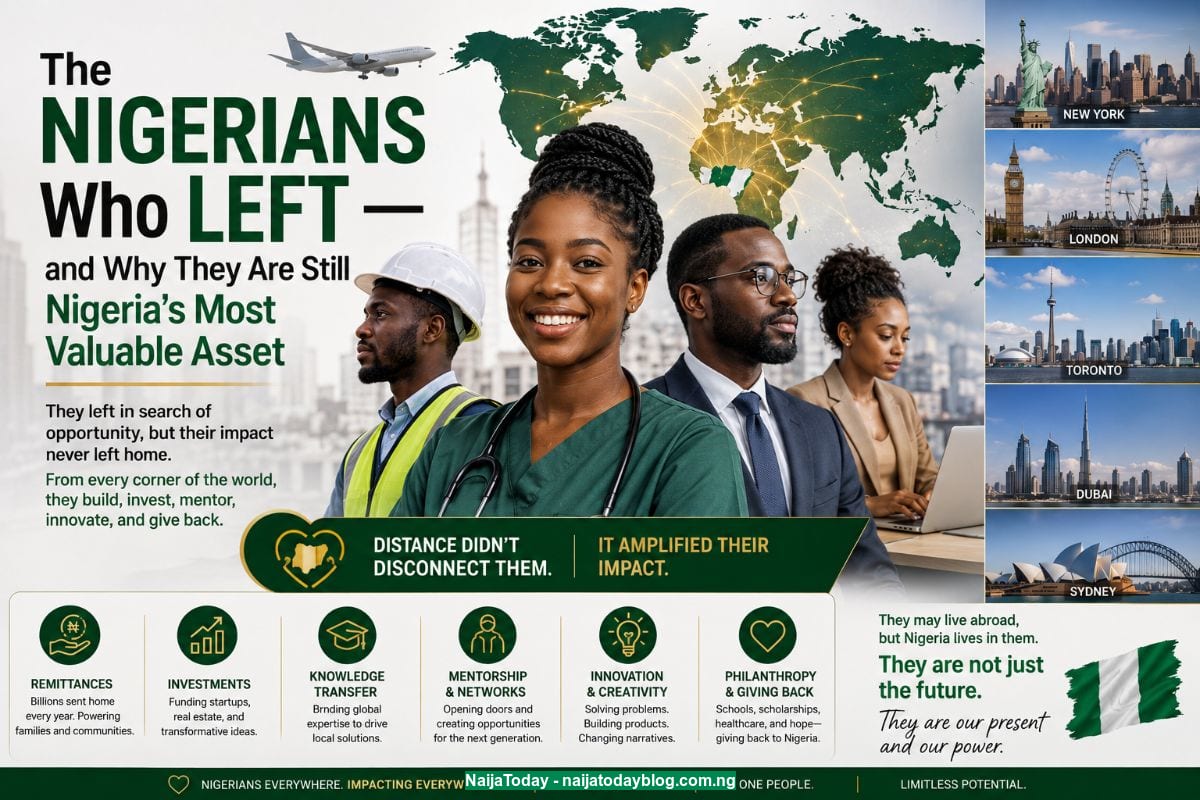
The Nigerians Who Left — and Why They Are Still Nigeria's Most Valuable Asset
By NaijaToday Features Desk | June 21, 2026 · 22 June 2026 · 6 min · 👁 15
On a Tuesday afternoon in a hospital in Houston, Texas, a Nigerian doctor named Chukwuemeka performs a surgery that will save a life. He trained at the University of Lagos. He completed his residency in Ibadan. He moved to the United States twelve years ago when the gap between what he could earn and what he needed to live a stable life became too large to bridge on a Nigerian public hospital salary.
How does this story make you feel?
No account or sign-in needed. You can react instantly.
Share:
More Stories to Explore
More reporting selected from NaijaToday, based on topics and categories.