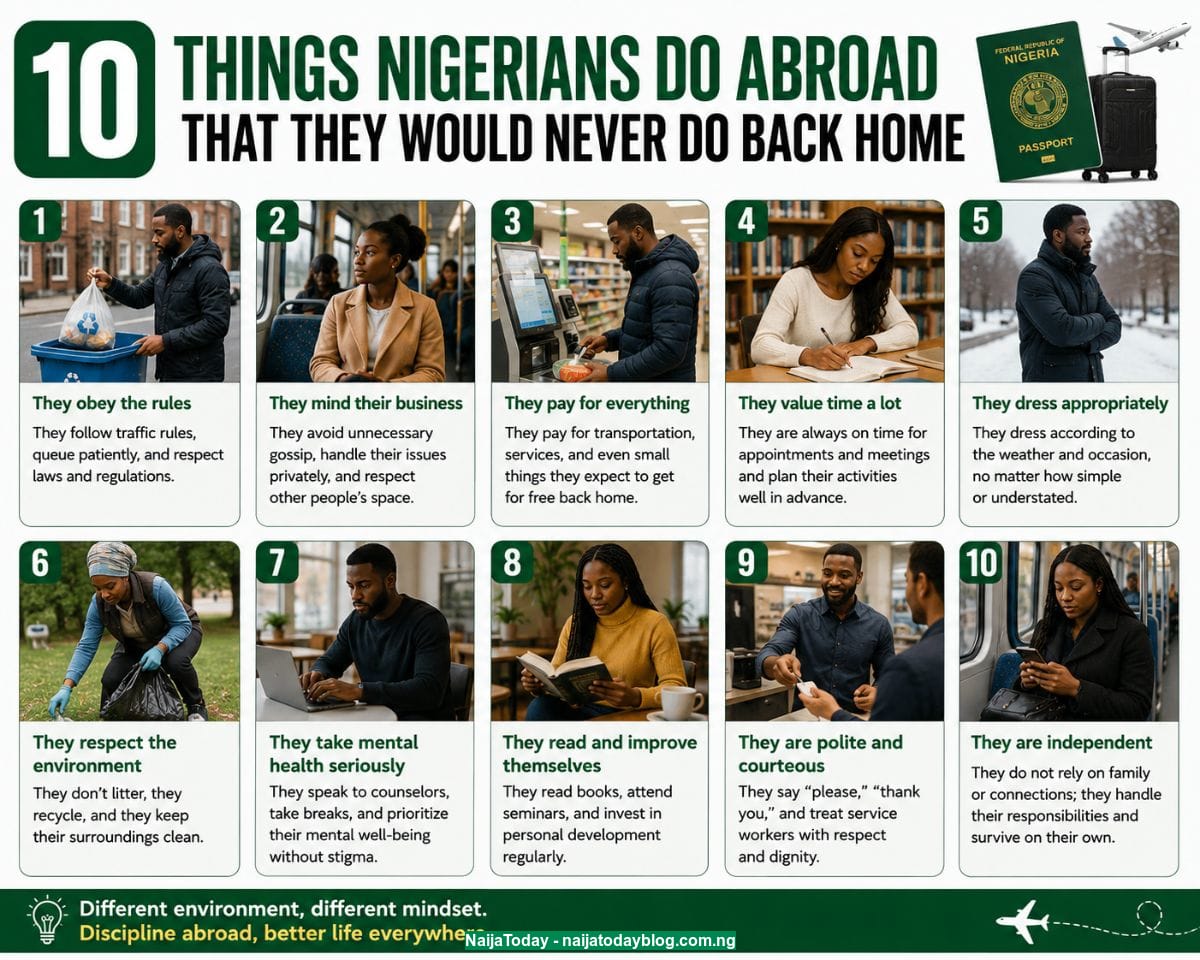
There is a transformation that happens to Nigerians the moment the aircraft wheels lift off the tarmac at Murtala Muhammed International Airport. Something shifts. Behaviours that would have been unthinkable back home in Lagos, Abuja, or Enugu suddenly become not just possible but enthusiastically practised. The Nigerian who would never form an orderly queue at a bus stop in Ikeja becomes a fierce defender of queue integrity at a Sainsbury's checkout in London. The person who drove on the wrong side of the road in Lekki develops a sudden and passionate respect for traffic regulations in Toronto.
This is not hypocrisy — or at least, not only hypocrisy. It is a fascinating window into human behaviour, institutional trust, and the relationship between people and their environment. We behave differently when systems work, when rules are enforced, when the consequences of misbehaviour are real, and when the social culture around us sets a different standard.
Here are ten things Nigerians do abroad that they would never do back home — observed with love, laughter, and a little bit of uncomfortable self-recognition.
1. Form a Queue and Defend It With Their Lives
Back home in Nigeria, a queue is more of a suggestion than a structure. Bus stops, bank teller lines, government offices — in these spaces, the queue is a loose aggregation of bodies that is subject to negotiation, personal connection exploitation ("abeg, na my person"), and the simple physical principle that whoever pushes hardest gets served first.
Abroad, the same Nigerian will stand in a queue for forty-five minutes without complaint, will shoot a withering glare at anyone who attempts to jump it, and will deliver a quiet but firm "excuse me, there's a queue" to offenders with the confidence of someone who grew up respecting lines their entire life.
The queue is not the issue. The system that enforces the queue is the issue. When jumping a queue has real social and sometimes legal consequences, queueing becomes second nature remarkably quickly.
2. Separate Their Rubbish
In Nigeria, the concept of separating waste into recyclables, general waste, and organic matter is not part of most households' daily practice. Rubbish goes into a bag. The bag goes — eventually — somewhere. The sorting is someone else's problem.
Arrive in Germany, the Netherlands, or the UK, and that same Nigerian is diligently washing out yogurt pots before putting them in the recycling bin, carefully flattening cardboard boxes, and agonising over whether a greasy pizza box counts as card recycling or general waste. Not because their values about the environment changed on the flight — but because the system is clear, the bins are provided, the council collects them, and fines exist for those who do not comply.
3. Call the Emergency Services
In Nigeria, calling the police is not instinctively the first response to an emergency for many citizens. Historical and ongoing issues with police conduct have created a culture in which many Nigerians would rather handle a problem through community networks, personal connections, or private security than dial 911 or 112.
Abroad, the same person becomes a reliable 999 caller. See a car accident — call 999. Smell gas — call the emergency line. Witness a crime — report it immediately. The transformation is not about the individual's values changing. It is about institutional trust. When you believe the emergency services will help rather than complicate your situation, you call them.
4. Read and Follow Instructions
Nigerians abroad develop a sudden and sincere relationship with instruction manuals, terms and conditions, and official guidelines. Tax forms are read carefully. Council letters are not thrown in a drawer. IKEA assembly instructions — notoriously icon-only and baffling — are followed step by step.
At home, instructions are often ignored because the consequences of ignoring them are frequently non-existent. The form that requires ten documents gets processed with three. The sign that says no parking gets ignored because the warden rarely comes. When systems are inconsistently enforced, rational people stop following them. When systems are consistently enforced, those same people become diligent rule-followers.
5. Complain Formally
The Nigerian back home who would swallow a terrible customer service experience — or express displeasure through dramatic venting to friends and family without any formal follow-up — becomes a formal complaints writer of formidable skill abroad.
Letters to the managing director. Reviews on Trustpilot. Formal complaints to the ombudsman. Escalation emails with "COMPLAINT" in the subject line and "I expect a response within 14 working days" in the body. The transformation is remarkable and entirely logical — because abroad, formal complaints actually produce results. Regulatory bodies have teeth. Consumer protection laws are enforced. Companies respond to reviews.
Imagine if Nigerian companies faced the same accountability. The complaint letters would flow.
6. Maintain Absolute Silence in Public Spaces
On a bus in Lagos, social rules about public noise are flexible at best. Phone calls are taken at full volume. Music plays from speakers without headphones. Conversations between people sitting three rows apart are conducted at levels that ensure the entire bus participates. This is not rudeness — it is simply a different set of social norms around public space.
On the London Underground, the same Nigerian sits in absolute silence, headphones in, eyes trained on the middle distance, performing the time-honoured British ritual of pretending that the forty other people in the carriage do not exist. A phone rings and they answer it in a whisper, cupping their hand over the mouthpiece, eyes darting apologetically around the carriage.
The social pressure of a culture that enforces quiet in public spaces is remarkably powerful. It turns even the most sociable Nigerian into a temporary introvert.
7. Exercise Regularly
The gym culture among Nigerians abroad is a genuine phenomenon. Park runs, cycling clubs, swimming sessions, yoga classes — Nigerians abroad embrace exercise routines with an enthusiasm that can surprise friends and family back home.
This is partly economic — gym memberships in Nigeria are expensive relative to average incomes. It is partly infrastructural — jogging along a Lagos road requires a risk tolerance that most people reasonably lack. And it is partly cultural — the fitness culture of Western countries, where colleagues discuss their marathon training over lunch and gyms are on every high street, creates a social environment in which exercise is normalised and expected.
8. Trust Strangers
Nigerians are, by cultural inheritance and practical experience, cautious about strangers. "Shine your eye" is not just a saying — it is a survival philosophy developed in response to genuine risks. Stranger danger in Nigeria is not a children's safety programme — it is wisdom accumulated through experience.
Abroad, many Nigerians discover a capacity for trusting strangers that surprises them. Leaving a bag unattended at a café to visit the bathroom. Asking a stranger on the street for directions and believing the answer. Lending a phone charger to a fellow passenger on a train. Small acts of social trust that feel enormous by Nigerian standards but are unremarkable in societies where social trust is higher and theft is rarer.
9. Observe Smoking and Drinking Regulations
The transformation of many Nigerians into rule-following citizens in regulated environments extends to areas of personal behaviour that might seem more resistant to external influence.
The same person who might drink in any location and in any setting at home overseas diligently goes outside the designated smoking area without complaint, does not drink in public spaces where it is prohibited, and checks the local regulations before any social event. Not because they personally agree with every regulation, but because the enforcement is real and the consequences are not worth risking over a matter of principle.
10. Say "Excuse Me" and Mean It
Perhaps the most telling transformation of all. In the chaos of Nigerian public life — markets, bus parks, government offices — physical contact and navigation through crowds is handled with elbows, body momentum, and a general acceptance that personal space is a luxury item.
Abroad, the Nigerian discovers "excuse me" — and not just as a phrase but as a genuine social ritual of acknowledgment, apology, and spatial negotiation. Said before reaching past someone. Said when accidentally making eye contact in a corridor. Said when a shopping trolley gets too close to another person's feet.
The ritual is small. But what it represents is significant: the recognition that other people in a shared space have rights to their comfort and attention that deserve acknowledgment.
What Does It All Mean?
The pattern running through all ten of these observations is the same: Nigerian behaviour changes abroad not because Nigerians are incapable of the behaviours they display abroad — but because the systems, institutions, and social cultures of those countries make those behaviours both natural and necessary.
This is simultaneously a critique and a hope. A critique because it reveals how much of Nigeria's dysfunction is structural rather than personal — how many Nigerians are capable of orderly, accountable, civic behaviour but are operating in systems that provide neither reward for it nor punishment for its absence.
And a hope because it shows that the capacity is there. The Nigerian who separates rubbish in London, calls the police in Toronto, and queues patiently in Dublin is the same person who grew up in Lagos. Give that person functioning institutions, enforced rules, and a social culture that expects civic behaviour — and they will deliver it.
Nigeria does not need different people. It needs different systems. And different systems are built by citizens who demand them.
Published by NaijaToday Lifestyle Desk. Which one of these did you recognise yourself in? Share in the comments or join the discussion in our Forum.