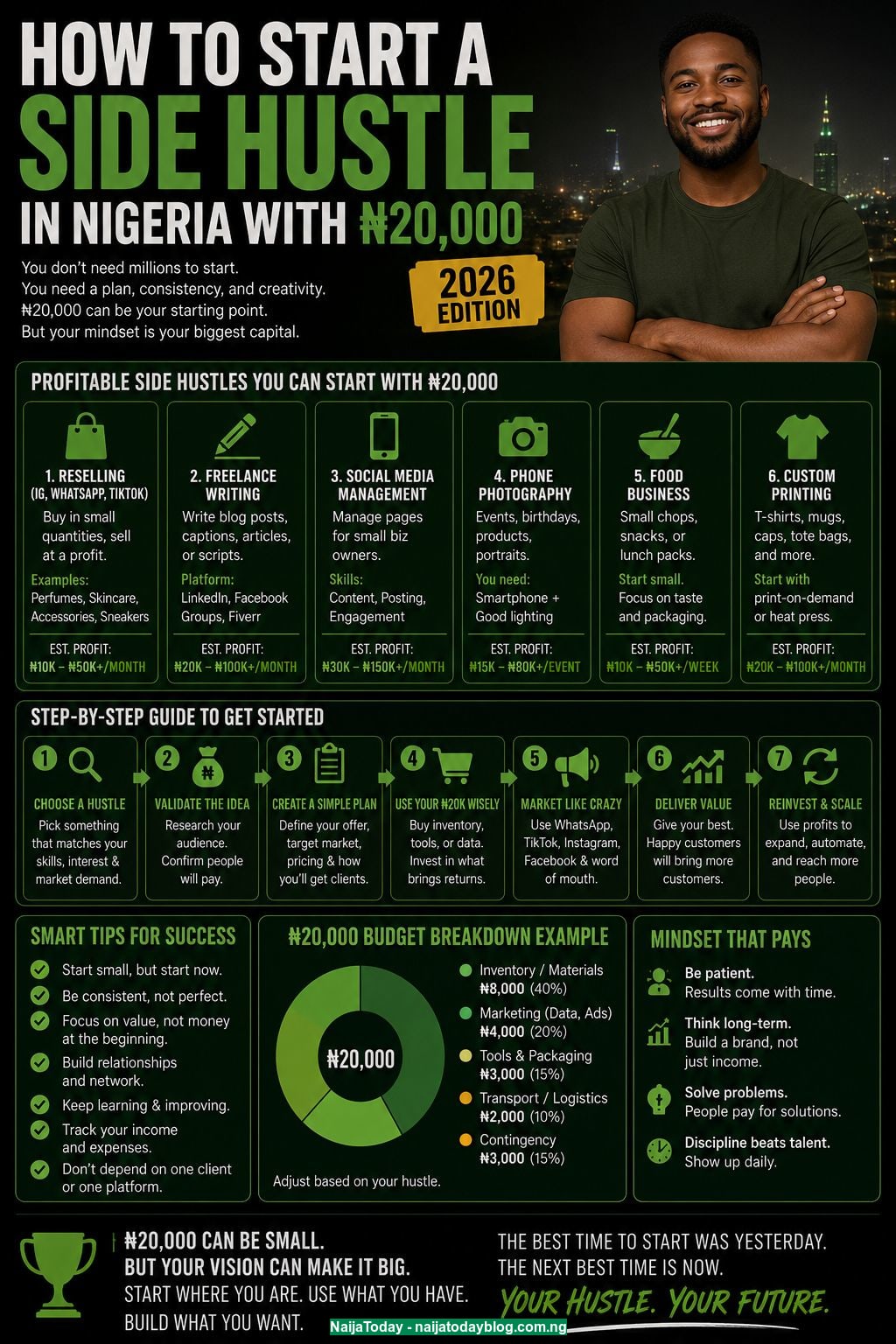
How to Start a
Side Hustle in Nigeria With ₦20,000 in 2026
You don't need millions sitting in your account. You need a plan, ₦20,000, and
the discipline to actually start.
One of the most persistent myths about business in Nigeria is that you need
serious capital before you can begin. It isn't true, and it's never really been
true — but it's especially untrue in 2026, when many of the tools that used to
require real money (a website, payment processing, order tracking, customer
communication) are now free or nearly free. What follows are genuine, currently
viable options for turning ₦20,000 into a real income stream — not vague
motivational advice, but actual numbers and actual starting points.
1. Homemade Snacks (Chin-chin,
Puff-puff, Small Chops)
Startup cost: ₦20,000–₦70,000
Daily sales potential: ₦5,000–₦20,000
This remains one of the most consistently profitable small-capital businesses
in Nigeria, and for good reason — the ingredients are cheap, the skill is
learnable, and the demand never disappears. Start by supplying offices during
lunch hours or taking orders for weekend events and parties. Word of mouth does
most of your marketing for you if the product is genuinely good.
2. Phone Accessories Reselling
Startup cost: ₦20,000–₦30,000 (basic stock)
Markup: Typically 50–100%
Position yourself near phone repair shops, computer villages, or busy markets.
Chargers, earphones, screen protectors, and phone cases have consistent demand
and healthy margins for the capital required. If you eventually learn basic
phone repair — screen replacement, charging port fixes — you add a second,
higher-value revenue stream on top of the accessories.
3. Content Writing / Freelance
Writing
Startup cost: ₦0 (using an existing phone or laptop)
Earning potential: ₦10,000–₦150,000 per article or project, depending on niche
and experience
If you can write clearly, you're sitting on a business that requires no capital
beyond what you already own. Nigerian businesses and international clients on
platforms like Upwork and Fiverr consistently need blog posts, product
descriptions, and social media copy. The 2026 market outlook here is genuinely
strong — AI tools have changed parts of the industry, but clients still pay
well for writers who understand Nigerian context and cultural nuance, which
generic AI output doesn't reliably capture.
4. Social Media Management for Small
Businesses
Startup cost: ₦0–₦20,000 (a phone and free tools like Canva)
Monthly retainer potential: ₦40,000–₦150,000 per client
Most small Nigerian businesses know they need a consistent online presence but
don't have the time or skill to manage it. If you can post consistently, engage
with followers, and build a coherent brand look using free tools, this is a
genuinely zero-to-low-capital business. Start with one client — even a friend's
business — to build a portfolio before pitching others.
5. Breakfast or Lunch Delivery
Startup cost: ₦20,000–₦50,000
Daily income potential: ₦10,000–₦25,000
Akara and pap, yam and egg, bread and beans, or packaged office lunches all
work because people rushing to work or stuck in offices will consistently pay
for convenience. Operate from a strategic corner or build a regular delivery
route to nearby offices. This is a business where reputation compounds fast — a
good product spreads by word of mouth quickly.
6. Home Tutoring / Exam Prep Coaching
Startup cost: ₦0 (just your existing knowledge)
Earning potential: Charge per session or monthly, varies widely by subject and
location
Nigerian parents consistently pay for extra academic help, especially around
JAMB, WAEC, and NECO preparation. If you're strong in Mathematics, English, or
the sciences, this business requires nothing but your ability to teach and a
willingness to market yourself locally — through WhatsApp groups, church or
mosque community boards, or word of mouth among parents.
7. Digital Products (Templates, Short
Courses, eBooks)
Startup cost: ₦0–₦20,000 (your time to create the first product)
Profit margin: Near 100% after creation, since there's no per-sale cost
If you have expertise in something — a skill, a process, a body of knowledge —
packaging it into a downloadable product (a template pack, a short guide, a
mini-course) means your cost per sale drops to essentially zero after the
initial work. Platforms like Gumroad let you sell and receive payment in naira
or dollars, which matters given how much the naira has moved in recent
years.
What Actually Determines Whether You
Succeed
Across every idea on this list, the businesses that survive share the same
traits — and the ones that fail usually share the opposite:
- They solve a real, specific problem for a specific group of people, not a
vague general audience
- They start small and reinvest rather than trying to look "big"
before there's revenue to justify it
- They stay consistent — a food business that shows up every day beats one
that's brilliant twice a month
- They build trust through reliability, not through flashy marketing with
nothing behind it
A Word of Caution
Not every business idea circulating online is honest about the real economics
involved. Be skeptical of anything promising huge daily returns for near-zero
effort, and be especially careful with import/mini-importation businesses —
naira depreciation has squeezed margins here more than a lot of older guides
account for, so go in with updated, realistic numbers rather than figures from
two or three years ago.
Quick Reference
| Idea | Startup Cost | Time to First Income |
||--|-|
| Homemade snacks | ₦20,000–₦70,000 | Days |
| Phone accessories | ₦20,000–₦30,000 | Days |
| Freelance writing | ₦0 | Weeks (building clients) |
| Social media management | ₦0–₦20,000 | Weeks |
| Breakfast/lunch delivery | ₦20,000–₦50,000 | Days |
| Home tutoring | ₦0 | Days–weeks |
| Digital products | ₦0–₦20,000 | Weeks (building first product) |
₦20,000 isn't a lot of money in 2026 — but it's genuinely enough to start, if
you pick something that matches your actual skills and stay consistent past the
first slow week. The Nigerians building real income from these ideas right now
aren't doing anything mysterious. They just started, and kept going after the
first attempt didn't immediately blow up.
Published on NaijaToday — naijatodayblog.com.ng😀