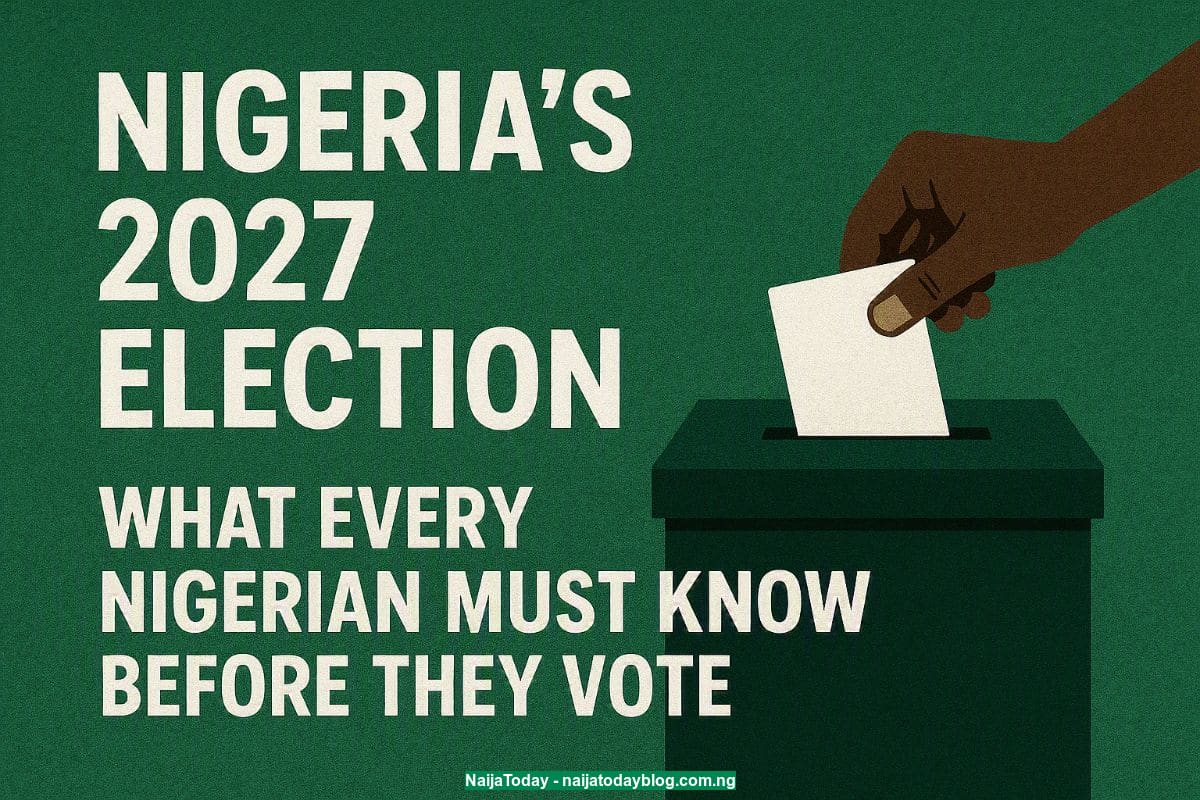
Nigeria's 2027
Election: What Every Nigerian Must Know Before They Vote
There is a particular kind of tension that settles over Nigeria in the years
before a general election. It arrives quietly — in whispered conversations at
beer parlours, in the restless energy of party meetings, in the way newspapers
suddenly find their voices on topics they spent the previous year tiptoeing
around.
That tension is here again. And with the 2027 general elections now less than a
year away, Nigeria finds itself at one of those defining crossroads that come
along only once in a generation.
This is not just another election. This is an election that will answer
questions that have been building for years — about the direction of the
country's economy, about who holds power and how they use it, about whether the
democratic experiment Nigeria launched in 1999 is deepening or hollowing
out.
Every Nigerian who cares about what this country becomes owes it to themselves
— and to the generations coming behind them — to understand what is actually at
stake.
The Political Landscape as It Stands
The ruling All Progressives Congress (APC) goes into the 2027 cycle in a
complicated position. President Bola Tinubu, who came to power in May 2023 on a
platform of economic renewal, has pursued an aggressive reform agenda —
including the removal of the petrol subsidy and the unification of the naira
exchange rate — that has generated both macroeconomic improvements and severe
short-term pain for ordinary Nigerians.
Inflation, which reached historic highs in 2024, has begun to ease. The naira
has found a measure of stability. The Dangote Refinery, long delayed, has
expanded processing capacity in ways that are beginning to affect domestic fuel
supply. These are genuine achievements, and they will be part of the argument
the APC makes to voters.
But arguments do not pay school fees. They do not fill the gaps where small
businesses used to stand. And they do not explain to a family in Kano or
Abeokuta or Calabar why their purchasing power has collapsed even as government
officials talk about reforms.
The Peoples Democratic Party (PDP), meanwhile, remains fractured — a coalition
of interests that has struggled to find a unifying candidate or message since
its 2015 defeat. Internal disputes, defections, and the enduring question of
zoning continue to define a party that once governed Nigeria for sixteen
years.
New entrants and third-force movements are positioning themselves for
relevance, inspired by the Labour Party's striking 2023 performance under Peter
Obi, which demonstrated that Nigerians — particularly young, urban Nigerians —
are prepared to vote outside the traditional duopoly if they believe the
alternative is credible.
The Economy Will Decide Everything
If there is one variable that will determine the 2027 outcome above all others,
it is the economy.
Nigeria's proposed 2026 federal budget stands at approximately ₦58.18 trillion.
Of that, ₦15.52 trillion — roughly 27 percent — is allocated to debt servicing.
That single number captures the bind Nigeria's government is in: enormous
ambition, constrained resources, and an inherited debt burden that crowds out
spending on the things ordinary citizens actually need.
Nigeria's public debt stood at ₦152.4 trillion as of mid-2025. That is not an
abstraction. That is money that cannot go to schools, hospitals, roads, or the
power infrastructure that businesses need to survive.
The government's defenders will point to structural reforms — and some of those
reforms are real. But the test that voters apply is not macroeconomic. It is
personal. It is whether life feels better or worse than it did before. By that
measure, the government enters 2027 with a significant deficit to overcome.
Inflation in May 2026 stood at 15.93 percent, according to the National Bureau
of Statistics. That number is better than the peak of 2024. But for a family
whose income has not grown at the same rate, it represents an ongoing erosion
of everything they have worked for.
Security: The Question Nobody Has Answered
No issue cuts across Nigeria's political landscape more deeply than security —
and no issue has proved more resistant to solution.
In the north-east, the Boko Haram insurgency, which many believed had been
largely contained after the death of Abubakar Shekau in 2021, has shown
troubling signs of resurgence. The JAS faction of Boko Haram has resumed
targeted attacks on civilians. In June 2026, Nigerian forces rescued 360
captives — including women and children — from a Boko Haram hideout in the
Mandara mountains in Borno State. Two infants did not survive the harsh
conditions of captivity.
In the north-central states, intercommunal violence between herder and farming
communities continues to claim lives and displace thousands. In April, attacks
on six villages in Bokkos LGA, Plateau State killed 52 people. In June, an
attack on a farming community in Benue State killed 59 people, with residents
suggesting the actual toll was higher.
In the north-west, banditry and mass kidnapping remain endemic. Between
November and December 2025, hundreds of schoolchildren were abducted in Kebbi
and Niger states — echoes of Chibok that should have been impossible a decade
later.
And in the south-east, the unresolved question of Igbo political representation
and the activities of armed groups continue to create instability that has
economic consequences far beyond the region.
Every political party competing in 2027 must be asked: what is your actual
plan? Not your press release. Not your statement of condemnation. Your plan —
specific, funded, accountable.
The State Police Question
One of the most significant governance conversations happening in Nigeria right
now involves the creation of state police forces.
Currently, the Nigeria Police Force is federally controlled — a centralised
structure that many argue is structurally incapable of responding to the
diverse security challenges of a country as large and varied as Nigeria.
Governors, community leaders, and security analysts have long argued that
decentralised policing would allow faster, more contextually appropriate
responses to local threats.
In early June 2026, the Presidency, the National Assembly leadership, and the
Inspector-General of Police held high-level consultations to finalise a
framework for state policing. This is one of the most substantive governance
reform discussions in years — and its outcome will have real consequences for
communities across the country.
The risks are real: state police in poorly governed states could become
instruments of oppression rather than protection. But the status quo — a
federal force stretched across 923,768 square kilometres, understaffed,
underfunded, and often outgunned — is also failing.
This is a debate Nigerians need to follow closely, because whichever party wins
in 2027 will inherit the consequences of whatever framework is or is not put in
place now.
The Youth Question
Nigeria's population is young — extraordinarily so. The median age is
approximately 18 years. Over 60 percent of Nigerians are under 25. This is not
a demographic footnote. It is the defining political reality of the country's
future.
The 2023 election demonstrated both the potential and the limits of youth
political energy. Peter Obi and the Labour Party mobilised unprecedented
enthusiasm among young, educated, urban voters. But voter suppression,
logistical failures, and the enduring machinery of the established parties
ultimately determined the outcome.
The lesson drawn by many young Nigerians was a painful one: that participation
without structural change is not enough. That voting is necessary but
insufficient if the system surrounding the vote is not also reformed.
Going into 2027, the question is whether that disillusionment hardens into
permanent withdrawal — or whether it sharpens into a more sophisticated,
sustained engagement with the political process. The Independent National
Electoral Commission (INEC) and its credibility in conducting a free and fair
election will be central to the answer.
What Vote-Buying Has Become
One of the most alarming developments heading into 2027 is the evolution of
vote-buying strategies.
Reports from election observers ahead of the 2026 Ekiti governorship election
documented what they described as new tactics: digital transfers rather than
physical cash, making transactions harder to trace and easier to scale. The
Nigerian Situation Room noted that vote-buying has adapted to the cashless
policy environment — finding new channels precisely because the old ones became
too visible.
This matters enormously. Vote-buying does not just corrupt individual electoral
outcomes. It corrupts the entire relationship between citizens and the state,
turning what should be a civic act into a transaction — and rewarding the
parties with the most money rather than the best ideas.
What You Must Do Before 2027
The stakes are too high for passivity. Here is what every Nigerian should be
doing now:
**Check your voter registration.** The window for voter registration and
transfer of registration opens periodically. Make sure you are registered at
your current address and that your Permanent Voter Card reflects where you will
vote.
**Follow the money.** Every political party seeking your vote should be able to
explain where their funding comes from and what they plan to do with government
resources. Ask the question. Demand the answer.
**Look beyond the personality.** Nigerian politics is dominated by personality
cults — powerful individuals who command loyalty regardless of policy. The
question to ask is not who the candidate is, but what they will actually do in
office, and how they will be held accountable if they do not.
**Resist the transaction.** Taking money to vote is not just illegal — it is
self-defeating. A politician who buys your vote has already told you everything
you need to know about how they will govern: that you are a commodity, not a
citizen.
**Talk to your community.** Political change in Nigeria will not come from
social media timelines alone. It will come from the hard, unglamorous work of
community-level political education and organisation.
Final Word
2027 is not just an election. It is a referendum on what Nigeria believes it
deserves.
The country has the demographics, the natural resources, the human talent, and
— in its finest moments — the democratic spirit to be something genuinely
extraordinary. What it has consistently lacked is the institutional discipline
and civic accountability to translate those assets into outcomes that reach
ordinary people.
That gap will not be closed by one election. But every election either narrows
it or widens it.
Vote like your country depends on it. Because it does.
*NaijaToday covers Nigeria's politics, economy, and society with depth and
honesty.*
*📍
naijatodayblog.com.ng*
Nigeria's 2027 Election: What Every Nigerian Must Know Before They Vote
By By NaijaToday Politics Desk | June 21, 2026** · 21 June 2026 · 6 min · 👁 4
There is a particular kind of tension that settles over Nigeria in the years before a general election. It arrives quietly — in whispered conversations at beer parlours, in the restless energy of party meetings, in the way newspapers suddenly find their voices on topics they spent the previous year tiptoeing around.
How does this story make you feel?
No account or sign-in needed. You can react instantly.
Share:
More Stories to Explore
More reporting selected from NaijaToday, based on topics and categories.