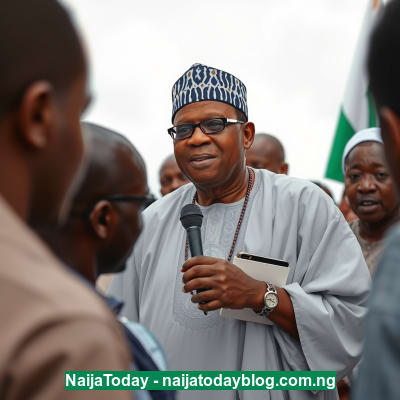
Nigeria does not wait for election season. Politics in this country is a permanent condition — a round-the-clock negotiation of power, loyalty, betrayal, and survival that never truly pauses between cycles. By the time a president is sworn in, the next election has already begun. And so it is today: with the 2027 general elections still over a year away, the chess pieces are already moving, the alliances are already shifting, and Nigerians who are paying attention can already see the shape of what is coming.
This is not cynicism. This is simply how Nigerian democracy works — loudly, messily, and always earlier than the calendar suggests. Understanding what is happening right now, in the political underground of Abuja and the public declarations of state capitals across the country, is essential for any Nigerian who wants to be an informed participant in their own democracy rather than a passive spectator.
The Incumbent's Position
President Bola Tinubu's administration entered 2026 having survived one of the most turbulent first years of any Nigerian presidency in recent memory. The removal of the petrol subsidy — a policy that economists had demanded for decades but politicians had always feared — detonated a cost-of-living crisis that hit ordinary Nigerians with brutal force. The naira's freefall against the dollar erased purchasing power for millions of families. Food prices climbed to levels that made daily meals a genuine calculation for households across the country.
The administration's argument is straightforward: the pain is real, but it is the pain of necessary medicine. The petrol subsidy was costing Nigeria billions of dollars annually — money that was being siphoned by a subsidy regime riddled with fraud and inefficiency, money that could have been building roads, schools, and hospitals. Without removing it, the argument goes, Nigeria was mortgaging its future to subsidise the present.
Whether Nigerians accept this argument by 2027 will depend almost entirely on one thing: whether they can see, feel, and touch tangible improvements in their lives before they enter the polling booth. Nigerians are pragmatic voters. They respond to results.
The Opposition Landscape
The opposition in Nigeria has rarely been more fragmented — or more energised.
The Peoples Democratic Party, Nigeria's largest opposition party, is engaged in the kind of internal warfare that has historically prevented it from mounting a coherent challenge at the presidential level. Factions compete for control. Former governors and senators jockey for position. The party's capacity to unite around a single candidate capable of defeating an APC incumbent remains an open and genuinely uncertain question.
Atiku Abubakar, who has contested the Nigerian presidency more times than perhaps any other individual in the country's democratic history, remains a force — but a force whose moment many political analysts believe has passed. His networks are real, his resources are significant, but the appetite of the Nigerian electorate for a familiar face presenting a familiar promise appears to be diminishing.
Peter Obi and the Labour Party represent the most intriguing wildcard in the 2027 equation. The 2023 election demonstrated something that had not been demonstrated before: that a third-party candidate could generate genuine mass enthusiasm, particularly among young, urban, educated Nigerians who had previously either not voted or voted along ethnic and regional lines. Whether that enthusiasm can be sustained and converted into a winning coalition remains to be seen. Labour Party's organisational infrastructure is still far weaker than that of either the APC or PDP.
The Governors to Watch
In Nigerian politics, governors are kingmakers. They control state party machinery, they command loyalty networks, and they have the financial resources to mobilise voters in ways that national party structures often cannot. The alignment of governors going into 2027 will be as important as any presidential candidate's popularity in the polls.
Several governors are already quietly positioning themselves — either for a presidential run of their own or as power brokers who will extract maximum concessions in exchange for delivering their states. Rivers State, Kano, Lagos, and Kaduna remain the key battleground states whose political directors will have outsized influence on the final outcome.
The defection of governors from one party to another — a Nigerian political tradition as reliable as the rains — has already begun. Each defection reshuffles the deck slightly, and by the time the formal campaign season begins, the party structures of 2023 may look significantly different from those of 2027.
The Youth Factor
Nigeria has one of the youngest populations on earth. More than 60 percent of Nigerians are under the age of 30. This is a demographic fact with enormous political implications — implications that Nigerian politicians are only beginning to fully reckon with.
The #EndSARS protests of 2020 demonstrated that Nigerian youth could organise, mobilise, and sustain mass action in ways that previous generations had not. The 2023 election demonstrated that young Nigerians would come out to vote in numbers, stand for hours in queues, and defend their votes with a tenacity that surprised even the most optimistic electoral observers.
What remains unclear is whether young Nigerian voters can convert their energy into actual political power — the kind of power that changes who wins, who loses, and ultimately who governs. The machinery of Nigerian electoral politics — the godfathers, the money, the ethnic arithmetic — is deeply entrenched, and enthusiasm alone has historically not been enough to dismantle it.
But 2027 is different in one important respect: the young Nigerians who voted in 2023 are now more experienced, more organised, and more politically sophisticated. Civil society organisations are already conducting voter registration drives. Digital platforms are facilitating political education at a scale never before possible in Nigeria. The youth factor in 2027 will be larger, louder, and more strategically deployed than it was in 2023.
The Economy as Ballot Paper
If there is a single issue that will determine the 2027 election, it is the economy. Not in the abstract, macroeconomic sense that politicians and commentators discuss — but in the lived, daily sense that ordinary Nigerians experience every time they go to the market, pay school fees, or fill a generator with petrol.
The question Nigerians will be asking in 2027 is simple: am I better or worse off than I was in 2023? If the answer for a majority of voters is worse off, incumbency becomes a liability regardless of the APC's organisational strength. If the answer is better off — if inflation has been tamed, if the naira has stabilised, if the lights come on more reliably, if roads have been built — then Tinubu's re-election prospects improve significantly.
The honest assessment as of mid-2026 is that Nigeria is somewhere between these two poles. There are genuine macroeconomic improvements that economists point to — foreign exchange reform, subsidy savings, improved investor sentiment. But these macro improvements have not yet translated into the micro-level relief that changes how a market woman in Onitsha or a civil servant in Ibadan experiences their daily life. That translation — or its failure — is what 2027 will ultimately be decided on.
What You Can Do Right Now
Political commentary is easy. Political participation is harder but more consequential. If you are a Nigerian who wants to influence the outcome of 2027, here is what actually matters:
Register to vote — INEC voter registration exercises are conducted periodically. If you are not on the register, your opinion about who should govern Nigeria is constitutionally irrelevant. Check INEC's website for the next registration window in your state.
Verify your PVC — Having registered is not enough. Your Permanent Voter Card must be collected and your details verified. Millions of registered voters in 2023 could not vote because they had not collected their PVCs.
Engage local politics — Presidential elections capture attention, but local government elections, state assembly elections, and governorship races shape daily life more directly than Aso Rock ever does. The quality of your roads, your schools, your primary healthcare — these are determined at the state and local level.
Resist vote buying — The monetisation of Nigerian elections is one of the most corrosive forces in the country's democratic development. When a voter accepts money in exchange for their vote, they surrender the most powerful tool they have. The short-term gain of a few thousand naira is purchased at the long-term cost of accountable governance.
The Bigger Picture
Beyond the personalities, the parties, and the predictions, there is a bigger question that 2027 asks of Nigeria: what kind of democracy do we want to be?
Every election is a choice — not just between candidates, but between versions of ourselves as a nation. Nigeria has the demographics, the resources, the talent, and the institutional frameworks of a country that could achieve extraordinary things. What it has often lacked is the political will — at every level, from the voter to the president — to demand and deliver genuine accountability.
2027 is another opportunity. It will not be the last opportunity, but the window of genuine democratic possibility — in which citizens still believe their votes matter, in which courts still occasionally rule against the powerful, in which civil society still functions — is not guaranteed to remain open forever.
Pay attention. Register. Vote. And hold whoever wins to account every single day of their tenure.
That is not just civic advice. In Nigeria, it is a survival strategy.
Published by NaijaToday Politics Desk. Share your views on the 2027 election in our Forum section.