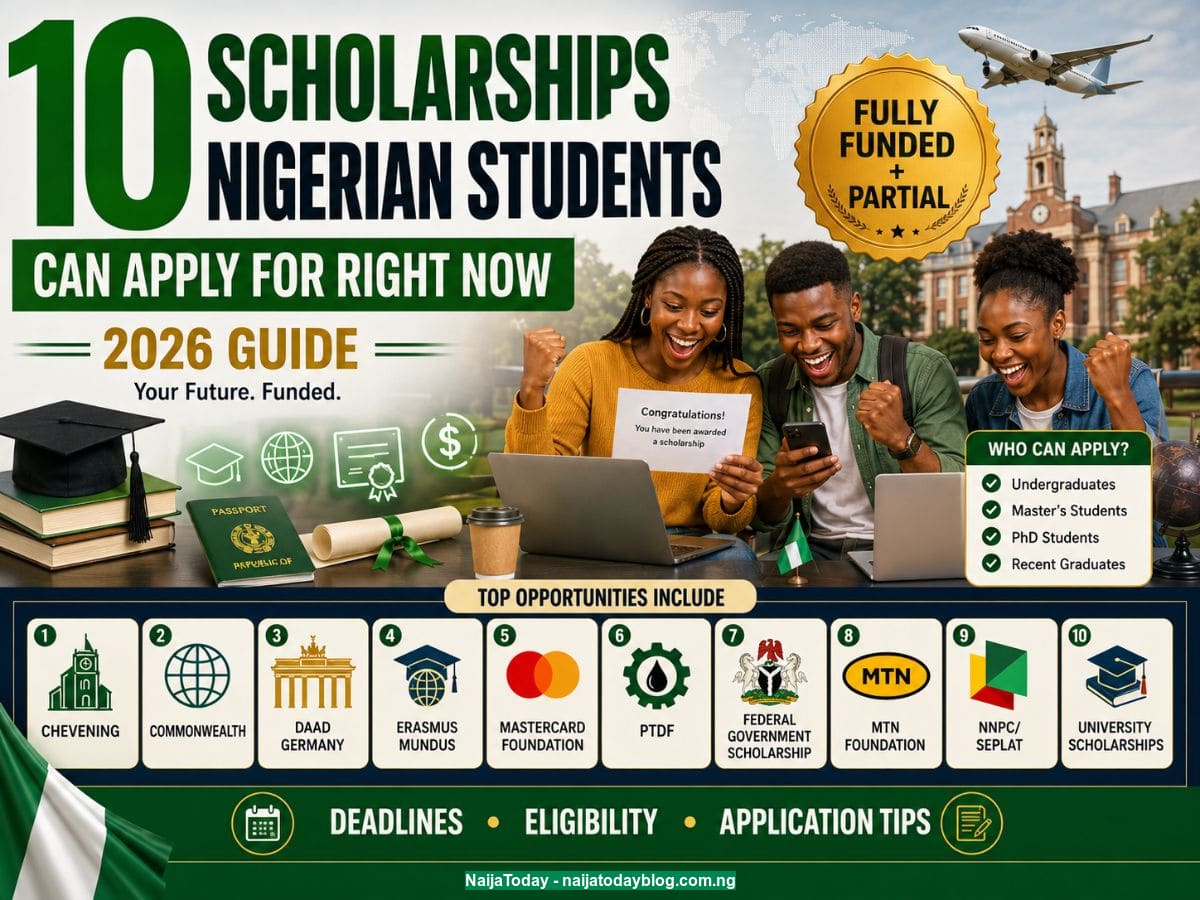
If you're a Nigerian student hoping to fund your education without going into debt or draining your family's savings, you're not short of options — you're short of information. Every year, scholarship money goes unclaimed simply because students don't know these programmes exist, don't know how to apply properly, or find out about a deadline the day after it closes.
This guide brings together ten scholarships currently open or opening soon to Nigerian students — covering undergraduate study in Nigeria, and fully funded postgraduate study abroad. For each one, we explain who qualifies, what it covers, and how to actually apply.
Why Most Nigerian Students Miss Out on Scholarships
Before we get into the list, it's worth understanding why so many qualified students never win a scholarship they were eligible for. It usually comes down to one of three things: they apply too late because they only heard about the programme close to the deadline; they submit incomplete documentation because they didn't prepare transcripts and reference letters in advance; or they simply never apply because they assumed the process was too complicated or too competitive for them.
None of these are things you can't fix. The rest of this guide gives you a concrete list to work from, plus a preparation checklist at the end.
1. NNPC/Renaissance/TotalEnergies Joint Venture University Scholarship
This is one of the most well-known undergraduate scholarships in Nigeria, sponsored by the NNPC-Renaissance Joint Venture (formerly associated with the old NNPC/Total scholarship scheme). It targets students already enrolled in accredited Nigerian universities, particularly in science, engineering, and technical fields relevant to the oil and gas sector. The scholarship typically covers tuition-related costs and provides an annual stipend.
Who qualifies: Nigerian undergraduates in relevant technical and science-based disciplines, usually from 200 level upward, though exact year requirements can shift each cycle.
How to apply: Applications open through the company's official careers or scholarship portal. Because timing changes yearly, the most reliable approach is to set a Google Alert for "NNPC Renaissance scholarship" and check the official portal directly rather than relying on third-party recruitment sites, some of which post outdated information.
2. PTDF In-Country Scholarship Scheme
The Petroleum Technology Development Fund (PTDF) is a Federal Government agency whose mandate includes building indigenous capacity in petroleum-related technology. Its In-Country Scholarship Scheme is one of the more generous Nigerian scholarships, supporting postgraduate study within Nigerian universities in courses relevant to the oil and gas industry — including engineering, geosciences, and related technical fields.
Who qualifies: Nigerian citizens with a first degree who intend to pursue a relevant Master's programme within Nigeria. Some cycles of the scheme also support overseas postgraduate study, so always check the specific scheme being advertised in the year you apply.
How to apply: Applications go through the official PTDF scholarship portal (ptdf.gov.ng). PTDF has consistently run this scheme, but application windows are limited, so check the portal at the start of each year and prepare your documents (transcripts, degree certificate, valid means of identification) well ahead of time.
3. Federal Government Scholarship Board (FGSB) Scholarship
The Federal Government Scholarship Board runs an annual undergraduate scholarship scheme open to Nigerian students studying in federal and state universities across the country. It is one of the more accessible national scholarships because it isn't tied to a single company or industry — it's open across disciplines.
Who qualifies: Nigerian undergraduates already admitted into accredited federal or state universities, evaluated primarily on academic merit.
How to apply: Watch the Federal Ministry of Education's official scholarship portal, which coordinates this and several other national schemes. Because this scholarship is administered federally, publicity can be inconsistent — following the ministry's official channels directly is more reliable than depending on secondhand blog posts.
4. NLNG Scholarship (Nigeria LNG Limited)
Nigeria LNG runs one of the most respected corporate-sponsored undergraduate scholarships in the country, specifically for fresh 100-level students newly admitted into federal and state universities. It is a renewable award, meaning that if you maintain the required academic standard, you continue to receive it through your years of study rather than it being a one-off payment.
Who qualifies: Newly admitted 100-level students in federal or state Nigerian universities. NLNG scholarships tend to open later in the year compared to most other schemes, so students should specifically watch for announcements in the final quarter.
How to apply: Applications are typically processed through an online application system linked from NLNG's official corporate site. Because this scholarship is aimed strictly at first-year students, it's worth telling younger siblings, cousins, or students you mentor who have just gained admission — timing matters enormously here.
5. Shell/SNEPCo National Merit Scholarship
Shell and its subsidiary SNEPCo run a merit scholarship aimed at undergraduates in engineering and geoscience-related fields — again reflecting the oil and gas sector's ongoing investment in Nigerian technical talent. It provides an annual award intended to support tuition and study-related costs.
Who qualifies: Undergraduates in relevant engineering and geoscience disciplines at recognised Nigerian universities, usually assessed by academic performance.
How to apply: Monitor Shell Nigeria's official corporate social responsibility or careers pages for the scholarship application window, which tends to open annually but on a schedule that can shift from year to year.
6. Chevening Scholarship (United Kingdom)
Chevening is the UK government's global scholarship programme, and Nigeria has consistently been one of its largest applicant pools. It funds a fully-funded one-year Master's degree at any UK university, covering tuition, a monthly living stipend, and return airfare. Unlike the corporate scholarships above, Chevening is aimed at working professionals rather than fresh graduates — it specifically looks for future leaders with some post-graduation work experience.
Who qualifies: Nigerian citizens with at least two years of relevant work experience and an undergraduate degree that would qualify them for UK Master's admission. Chevening explicitly looks for evidence of leadership potential and a clear plan for how the qualification will be used back in Nigeria or in a relevant field.
How to apply: Applications open through the official Chevening website (chevening.org) once a year, usually in the third quarter, with a deadline typically falling in early November. The application itself involves several essay-style questions — start drafting these well ahead of the deadline, since strong essays are what separate successful applicants from the much larger pool of rejected ones.
7. Commonwealth Shared Scholarships / Commonwealth Scholarships (United Kingdom)
As a Commonwealth member country, Nigerian students are eligible for various Commonwealth-funded scholarship schemes for Master's study in the UK, particularly the Commonwealth Shared Scholarships aimed at students from lower-income backgrounds studying subjects related to development. These scholarships cover tuition, a stipend, and travel costs.
Who qualifies: Nigerian citizens applying for a Master's degree in a development-relevant field at a participating UK university, typically demonstrating financial need alongside academic merit.
How to apply: Applications generally open mid-year with a deadline around December, processed through the Commonwealth Scholarship Commission's official portal. Because the pool of eligible courses is specific, check which UK universities are participating for the year you intend to apply before committing to a course choice.
8. Mastercard Foundation Scholars Program
The Mastercard Foundation Scholars Program partners with a growing number of African and international universities to fund undergraduate and postgraduate study for young Africans facing financial or socio-economic barriers, with a strong focus on students who intend to use their education to contribute to their communities. In Nigeria, this includes partnerships with institutions like Pan-Atlantic University, among others.
Who qualifies: Academically strong Nigerian students facing genuine financial constraints, assessed not only on grades but on demonstrated community impact and leadership potential.
How to apply: Because this scholarship is delivered through specific partner universities rather than a single central portal, check both the Mastercard Foundation's website and the admissions pages of partner universities directly, since application windows and requirements can differ by institution.
9. Federal Character-Based State Bursaries and Scholarship Boards
Many Nigerian states run their own bursary and scholarship schemes for indigenes of that state — often less competitive than national or corporate scholarships simply because fewer students actively look for them. States including Delta, Lagos, and others have running programmes (such as the Delta State Special Assistance Scheme bursary) that provide direct financial support to state indigenes in tertiary institutions.
Who qualifies: Varies by state, but generally requires proof of state indigeneship (local government identification) and current enrollment in a tertiary institution.
How to apply: Check your specific state's Ministry of Education or Scholarship Board website. If you don't know whether your state runs such a scheme, a direct call or visit to your state's Ministry of Education can clarify this faster than searching online, since many state schemes have limited web presence.
10. Corporate Foundation and NGO Scholarships (FATE Foundation, David Oyedepo Foundation, and Similar)
Beyond the well-known national and corporate names, a growing number of private foundations run scholarship and mentorship programmes for Nigerian students — including the FATE Foundation's scholar programme (which combines funding with mentorship and internship access) and various faith-based and family foundation scholarships. These tend to be less publicized, which paradoxically makes them less competitive for students who do find out about them.
Who qualifies: Varies significantly by programme — some focus on entrepreneurship potential, others on pure academic merit or specific demographic criteria (gender, state of origin, subject of study).
How to apply: These scholarships are best tracked through dedicated scholarship-listing platforms that update regularly, since they don't always have the marketing budget of corporate-sponsored schemes. Bookmark two or three reliable scholarship-tracking sites and check them monthly rather than relying on one-off social media posts.
How to Prepare Before You Even Start Applying
Regardless of which scholarship you're targeting, there are documents almost every one of them will ask for. Prepare these now, before a deadline is looming:
- Certified academic transcripts from your current or most recent institution
- A copy of your degree certificate or admission letter, depending on your stage
- A valid means of identification (National ID, international passport, or student ID)
- A well-written personal statement or motivation letter — this is often the single biggest differentiator between candidates with similar grades
- Contact details for two or three referees who know your academic or professional work well, so you can request reference letters with enough notice
Final Word
Scholarship funding for Nigerian students has genuinely expanded in recent years, both from Nigerian corporate sponsors and international government programmes actively looking for strong African applicants. The students who benefit aren't necessarily the most brilliant on paper — they're the ones who prepare early, apply to multiple programmes rather than pinning hopes on just one, and take the application essays as seriously as their coursework.
Bookmark this page, revisit it each application season, and always verify current deadlines directly on the official portal of whichever scholarship you're pursuing before submitting anything — programme details and timelines shift from year to year.