Fully Funded
Scholarships for Nigerian Students in 2026/2027: A No-Nonsense Guide
Every year, thousands of Nigerian students miss out on fully funded
scholarships — not because they weren't qualified, but because they either
didn't know the opportunity existed or found out about it two weeks after the
deadline closed. With more than 80 international scholarships currently open to
Nigerians across undergraduate, master's, and PhD levels, the real skill in
2026 isn't just being a strong student — it's being an organised one.
Start at home before you look abroad
It's tempting to jump straight to Chevening or Fulbright, but some of the most
generous, least competitive-per-capita scholarships available to Nigerians are
Nigerian.
The PTDF Scholarship, run by the Petroleum Technology Development Fund,
remains the largest fully funded programme run by the Nigerian government
itself, covering undergraduate through PhD study and open only to Nigerian
citizens — which immediately narrows the competition pool compared to a global
scholarship with applicants from 190 countries. Nigeria LNG also funds a UK
master's degree annually for outstanding candidates. If you're a Nigerian
citizen with strong grades, these two alone are worth investigating before you
spend weeks polishing an application for a scholarship with ten times the
applicants.
The major international scholarships open to Nigerians right now
Here's the practical shortlist, organised by what they actually cover and
roughly when they open:
- Chevening Scholarship (UK) — the UK government's flagship award, funding
a one-year master's at any UK university of your choice. Applications for the
2026/2027 cycle typically open later in the year, so this is one to calendar
now rather than search for later.
- Commonwealth Scholarships, including the Queen Elizabeth Commonwealth
Scholarships — Nigeria's Commonwealth membership makes this a standing option most
Nigerian graduates overlook simply because they assume it's more competitive
than it is.
- DAAD (Germany) — Germany funds a wide range of master's and PhD
scholarships, including newer AI-focused tracks, and many German public
universities charge little to no tuition even outside scholarship funding,
making it one of the more realistic routes to a European degree.
- Fulbright Foreign Student Program — processed through the US Embassy in
Abuja, for master's and PhD study in the United States.
- Mastercard Foundation Scholars Program — aimed specifically at preparing
young Africans to return and drive change in their communities, with partner
universities across the continent and abroad.
- Islamic Development Bank (IsDB) Scholarship and the Joint Japan/World
Bank Graduate Scholarship Program (JJ/WBGSP) — both fund postgraduate study
and tend to draw fewer Nigerian applicants than the UK/US options, simply
because they're less talked about locally.
- Australia Awards and various Canadian and Irish university-specific
scholarships (Trinity College Dublin's Global Excellence award, for instance,
offers partial tuition reductions for postgraduate students) round out the
options for students open to destinations beyond the traditional UK/US
route.
Deadlines are scattered across the year rather than clustered — some as early
as January, others stretching into March and beyond — which is exactly why a
scattergun, last-minute approach fails most applicants. A student aiming for
three or four scholarships in a single cycle needs a personal deadline
calendar, not a mental list.
Where Nigerian applicants consistently lose points
Having strong grades gets you through the first filter. What separates the
students who actually get funded from the ones who get quietly rejected usually
comes down to a handful of avoidable mistakes:
1. A generic personal statement. Scholarship committees read thousands of
essays that all say "I want to give back to my community." The ones
that stand out are specific: naming an actual problem, a specific project, a
concrete plan for what happens after the degree — not just why the applicant
deserves funding.
2. English proficiency scores treated as an afterthought. IELTS or TOEFL
requirements catch people out every cycle, either because they didn't book
early enough to get results back before the deadline, or because they assumed a
Nigerian English-language education would automatically satisfy the requirement
(it usually doesn't, without the test itself).
3. Weak or last-minute recommendation letters. Asking a lecturer for a
reference two days before a deadline produces a generic, forgettable letter.
The strongest letters come from people who've actually supervised real work and
are given enough notice to write something specific.
4. Applying to only one scholarship. Even outstanding candidates get
rejected from highly competitive programmes for reasons that have nothing to do
with merit — funding caps, regional quotas, an unusually strong applicant pool
that year. Treating scholarship applications like a job search, with five or
six applications in motion, dramatically improves the odds that at least one
comes through.
A realistic example
Consider a Nigerian final-year student studying public health, aiming for a
fully funded master's abroad. Rather than fixating on Chevening alone — a
highly competitive, single-shot option — a stronger strategy spreads effort
across three or four aligned programmes: Chevening as the reach option, a
Commonwealth Scholarship as a strong parallel bet, DAAD for a
public-health-adjacent programme in Germany, and the Mastercard Foundation
Scholars Program given its explicit interest in candidates with community
health impact plans. Each application shares roughly 70% of its material —
transcripts, core statement themes, recommendation letters — with the remaining
30% tailored to what each specific scholarship actually values. That's a
realistic, achievable weekly plan across a single application season, not a full-time
job.
What to do this month
If you're serious about a 2026/2027 scholarship, the actionable next steps are
boring but effective:
- Build a single spreadsheet listing every scholarship you're eligible for,
with deadline, requirements, and application status.
- Book your IELTS or TOEFL test now if any target scholarship requires one —
slots fill up and results take weeks.
- Request recommendation letters at least a month before you need them, from
people who can speak to specific work you've done.
- Draft one strong "master" personal statement, then adapt it per
scholarship rather than starting from scratch each time.
Scholarships aren't handed out for being the best student in your class —
they're handed out to students who present themselves as the clearest, most
specific answer to a specific programme's goals, and who apply to enough of
them that the odds work in their favour. That part is entirely within your
control.
🎓 Scholarships🔥 HOT
Fully Funded Scholarships for Nigerian Students in 2026/2027: A No-Nonsense Guide
By NaijaToday Desk · 31 July 2026 · 6 min · 👁 20
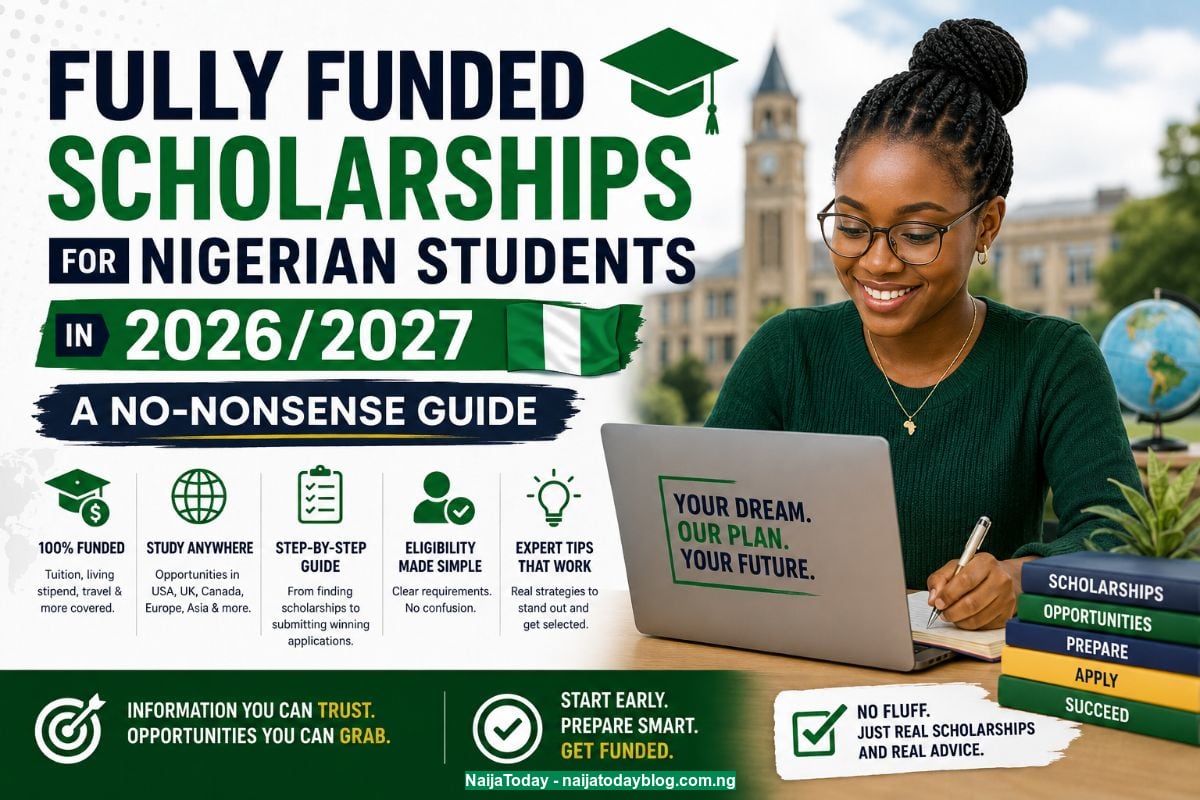
From PTDF to Chevening, DAAD, and Mastercard Foundation — a practical guide to fully funded scholarships open to Nigerian students in 2026/2027, plus the mistakes that cost applicants the most points.
How does this story make you feel?
No account or sign-in needed. You can react instantly.
Share:
NaijaToday Desk
The NaijaToday newsroom
More Stories to Explore
More reporting selected from NaijaToday, based on topics and categories.