Eric Chelle's New
₦150m-a-Year Deal: Can Nigeria Afford Its Most Expensive Coach Ever?
There is a peculiar kind of irony sitting at the heart of Nigerian football
right now. The Super Eagles are not at the 2026 FIFA World Cup. They missed out
after a heartbreaking penalty shootout defeat to DR Congo in November 2025,
their second consecutive World Cup absence. And yet, in the very same week that
the tournament's knockout rounds are gripping the world, the man who failed to
qualify Nigeria for it just got handed the richest contract any Super Eagles
coach has ever received.
Eric Chelle's monthly salary has doubled from $50,000 to $100,000 — roughly
₦138 million a year at current exchange rates — under a new four-year deal
confirmed by the Nigeria Sports Commission (NSC) and the Nigeria Football
Federation (NFF). The agreement was reached at a high-level meeting in Abuja
between NSC Chairman Shehu Dikko, NSC Director-General Bukola Olopade, NFF
President Ibrahim Musa Gusau, and Chelle himself. It is, by any measure, one of
the most consequential — and contested — decisions in recent Nigerian football
history.
Why Nigeria Is Paying More for a Coach Who Missed the World Cup
On paper, rewarding a coach for missing the World Cup looks absurd. But the
context tells a different story, and it is one that has earned Chelle genuine
goodwill from Nigerian football followers despite the disappointment of
November 2025.
When Chelle was appointed in January 2025, he inherited a campaign already in
ruins. Nigeria had collected just three points from a possible twelve in their
first four 2026 World Cup qualifying matches under previous coaches Jose
Peseiro and Finidi George. Chelle steadied the ship dramatically, winning four
of his first six qualifiers to drag Nigeria into a playoff spot as one of the
best runners-up across Africa's qualifying groups. He then guided the Super
Eagles past Gabon in the playoff semi-final before the painful 1-1 draw and
subsequent penalty shootout loss to DR Congo in the final.
Since taking charge, Chelle has overseen 16 wins, nine draws, and just two
losses from 27 senior international matches — a remarkable turnaround given
where he started. Nigeria remain unbeaten in regulation time in every
competitive fixture under his management. He also led the Super Eagles to a
third-place finish at the 2025 Africa Cup of Nations, scoring a tournament-high
14 goals along the way, and has delivered back-to-back Unity Cup titles in 2025
and 2026.
For a federation that has cycled through coaches with dizzying frequency in
recent years, that kind of consistency is rare and, officials clearly believe,
worth paying for.
What's Actually in the New Deal
Beyond the headline salary figure, the new contract restructures several
things. The NFF will now directly fund the salaries of Chelle's assistant
coaches and technical staff — a cost he had previously been covering from his
own pocket, a detail that surprised many Nigerians when it became public.
Chelle has also been handed an expanded role overseeing the Olympic Eagles,
Nigeria's U-23 national team, as the country builds toward qualification for
the 2028 Los Angeles Olympics. Nigeria has not appeared at the men's Olympic
football tournament since winning bronze at Rio 2016, and officials are framing
this dual role as part of a broader strategy to align the senior team's playing
philosophy with the pipeline feeding into it.
There is more. Reports from sources close to the negotiations indicate that
Chelle had actually pushed for an even higher figure — around $130,000 a month
— before both parties settled on the $100,000 compromise. He had also
reportedly submitted a detailed 19-point list of personal and operational
requests back in February 2026, covering everything from greater independence
in squad selection to uninterrupted electricity supply at his residence and
modern GPS performance-tracking equipment for the team. Many of those requests
are understood to have been approved as part of this new agreement.
From next season, the NPFL champions will also receive a record ₦1 billion
prize, part of a broader package of football reforms the NSC and NFF rolled out
alongside the Chelle announcement.
The Backlash: "Nigeria Cannot Sustain That Payment"
Not everyone is convinced this is money well spent. Former Super Eagles
midfielder Sunny Lawal has been one of the most vocal critics, questioning
whether the NFF can realistically sustain a $100,000 monthly commitment given
Nigeria's well-documented history of unpaid bonuses and allowances — the very
issue that triggered a player strike just days before the crucial Gabon playoff
match in November 2025.
Former interim coach Finidi George has raised a different concern: that
managing both the senior national team and the Olympic Eagles simultaneously is
simply too much work for one man, regardless of how talented he is.
Perhaps the sharpest criticism has come on the question of fairness. A former
NFF board member has publicly called on the federation to extend the same
financial respect to indigenous coaches that it has shown Chelle. "If you
are paying Chelle $80,000 or $100,000 per month, the day you are no longer
comfortable with him, or the day you fire him, I also want you to pay the same
thing to any local coach you want to take over," the former official
argued — a pointed reminder of the long-running tension in Nigerian football
between the premium placed on foreign coaching expertise and the comparatively
modest packages offered to homegrown talent.
There are also process concerns. Sports commentators have noted that the
strategic meeting which produced the new contract was held behind closed doors
with no media present — unusual for a decision of this magnitude and cost. As
of the latest reports, neither the NSC nor the NFF has officially confirmed the
exact financial terms in writing, with most of the figures emerging through
media sources rather than an official statement. Questions remain about whether
the agreement has actually been formally signed by all parties or remains, for
now, a verbal understanding.
What Chelle Does Next
Whatever the debate around the cost, Chelle's footballing priorities are
already set. His immediate task is preparing the Super Eagles for the start of
the AFCON 2027 qualifiers, which begin in September 2026. He has also confirmed
he intends to spend time in Nigeria scouting NPFL talent in person — a notable
departure from some of his predecessors, who treated the domestic league as a
secondary consideration when picking international squads.
Chelle has been candid in interviews about how he manages the different
personalities within his squad, revealing in a recent conversation with an
Algerian football influencer that he tailors his approach to individual
players' routines and mindsets ahead of matches — a glimpse into the
man-management style that many credit for Nigeria's renewed unity under his
leadership, even amid administrative chaos around him.
Why the Olympic Eagles Assignment Is a Bigger Deal Than It Sounds
It is worth pausing on just how significant the Olympic Eagles addition to
Chelle's portfolio actually is, because on first glance it can read as a minor
administrative footnote to the headline salary story. It is not. Nigeria's
Olympic football history is genuinely storied — the Olympic Eagles are the
first African football team to win a complete set of Olympic medals, claiming
gold at Atlanta 1996, silver at Beijing 2008, and bronze at Rio de Janeiro
2016. That golden generation, built around stars like Nwankwo Kanu, Celestine
Babayaro, and Daniel Amokachi, remains one of the most cherished chapters in
Nigerian sporting history.
But Nigeria has not qualified for the men's Olympic football tournament since
that 2016 bronze in Rio. Nearly a decade of absence from a competition the
country once dominated is a sobering statistic, and it reflects many of the
same structural problems that have plagued the senior team: inconsistent
coaching appointments, poor talent pipeline management, and a tendency to treat
youth and Olympic-level football as an afterthought compared to senior team
commitments. By placing Chelle in charge of both the senior Super Eagles and
the Olympic Eagles simultaneously, the NSC and NFF are explicitly betting that
a unified coaching philosophy across both levels will fix what siloed,
disconnected management failed to achieve. If it works, Nigeria could
realistically be targeting a return to the Olympic football stage at the 2028
Los Angeles Games with a squad that has grown up inside a single, coherent
system rather than being assembled at the last minute from disparate club
environments.
A History of Coaching Chaos That Makes This Deal Notable
To fully appreciate why Nigerian football stakeholders are treating contract
stability as such a precious commodity, it helps to remember just how chaotic
the senior coaching position has been in recent years. Chelle's predecessor,
Jose Peseiro, presided over a sluggish start to the very World Cup qualifying
campaign Chelle would later inherit, managing just three points from twelve
available in the opening four matches. After Peseiro's exit, Finidi George
stepped in as an interim solution before resigning after only two games in
permanent charge, reportedly overwhelmed by the demands of the role and the
administrative environment surrounding it. Augustine Eguavoen also served as
interim coach during this period of upheaval, adding yet another name to a
managerial merry-go-round that left Nigeria entering the most critical phase of
qualification with a fractured, unsettled technical setup.
Against that backdrop, a four-year contract — rather than the typical two-year
cycle tied narrowly to a single qualification campaign — represents a genuine
philosophical shift for Nigerian football administration. It suggests an
acknowledgment, however belated, that constant managerial turnover has been
actively corrosive to performance, and that sustained continuity, even after a
missed World Cup, may ultimately serve Nigerian football's long-term interests
better than another reactionary change at the first sign of disappointment.
The Bigger Picture
The Eric Chelle contract saga captures something true about Nigerian football
in 2026: genuine progress on the pitch, persistent dysfunction off it. A coach
who has rebuilt team morale and delivered real results is being rewarded — but
the manner of that reward, the lack of transparency around it, and the
unresolved questions about whether the federation can actually afford it all
point to structural issues that go far beyond one man's salary.
For now, Nigerian football fans have reason for cautious optimism. Chelle has
proven he can win matches and build a cohesive squad, and his expanded mandate
over the Olympic Eagles gives him a rare opportunity to shape Nigerian football
across two generations at once rather than just one tournament cycle. Whether
the NFF can build the financial and administrative foundation to match his
ambition — and avoid another bonus-related crisis on the eve of a major
qualifier — remains the open question hanging over Nigeria's road to AFCON
2027, the 2028 Olympics, and beyond.
⚽ Sports🔥 HOT
Eric Chelle's New ₦150m-a-Year Deal: Can Nigeria Afford Its Most Expensive Coach Ever?
By NaijaToday Desk · 30 June 2026 · 5 min · 👁 1
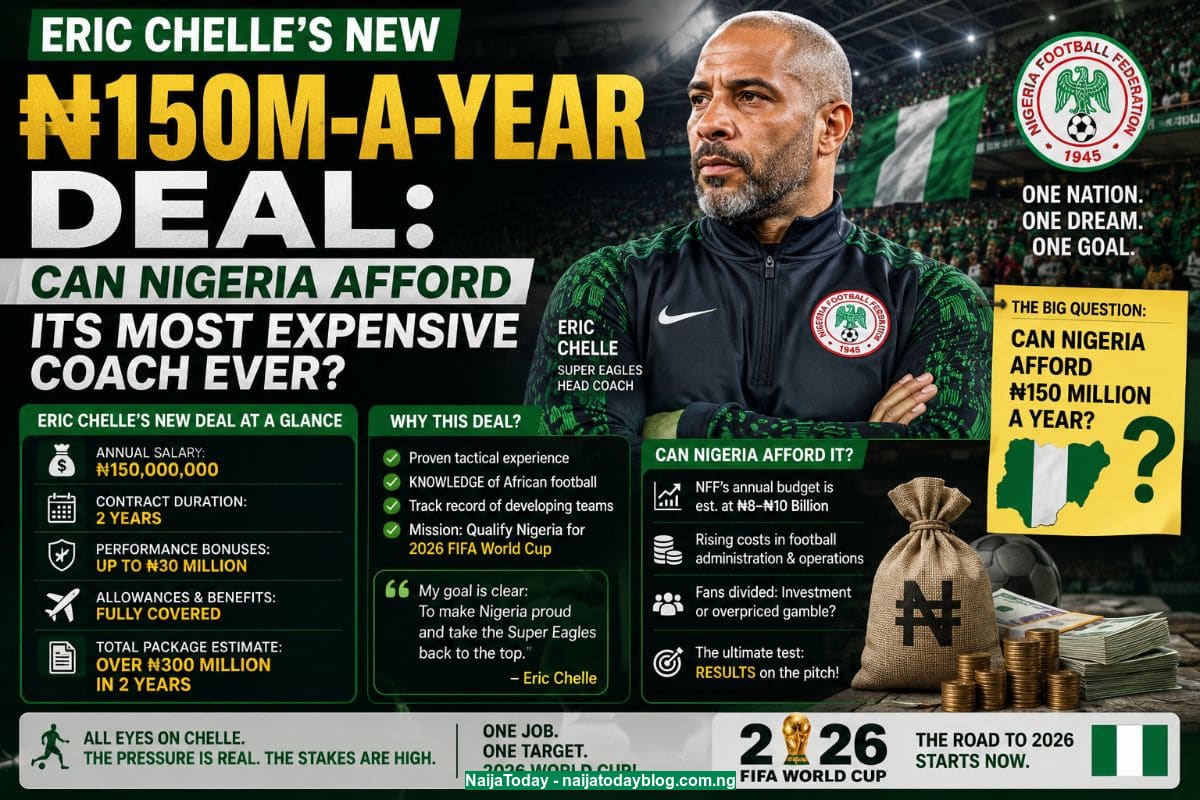
Eric Chelle just signed a new four-year deal that doubles his salary to $100,000 a month and hands him the Olympic Eagles too. Here's the full story, the backlash, and what it means for Nigerian football.
#eric chelle new contract#super eagles coach salary#eric chelle nigeria#nff contract 2026#olympic eagles chelle#super eagles news#nigeria football salary#nsc shehu dikko#afcon 2027 qualifiers
How does this story make you feel?
No account or sign-in needed. You can react instantly.
Share:
NaijaToday Desk
The NaijaToday newsroom
More Stories to Explore
More reporting selected from NaijaToday, based on topics and categories.