Nigeria and the
2026 FIFA World Cup: The Full Story of the Super Eagles' Painful Exit
The 2026 FIFA World Cup is currently ongoing across the United States, Canada,
and Mexico, and for Nigerian football fans, watching it from the sidelines is a
painful experience. The Super Eagles are absent from football's biggest stage
for the second consecutive time — a fact that stings all the more given the
sheer talent sitting at home right now.
This is the complete story of Nigeria's 2026 World Cup campaign: what happened,
where it went wrong, who was involved, and what the future holds for one of
Africa's most gifted football nations.
Nigeria Did Not Qualify for the 2026 World Cup
Let us address the big question directly: Nigeria is not at the 2026 FIFA World
Cup. The Super Eagles were eliminated in the CAF playoff final on November 16,
2025, losing to DR Congo on penalties after a 1–1 draw following extra time in
Rabat, Morocco. The final penalty shootout ended 4–3 in DR Congo's favour, with
two Nigerian kicks saved.
It marked the second consecutive World Cup that Nigeria has missed, following
their playoff defeat to Ghana on away goals ahead of Qatar 2022. This is the
first time in modern Nigerian football history that the Super Eagles have
missed back-to-back World Cups — a fact that shocked the nation and sparked
intense debate about the state of Nigerian football.
How Nigeria vs Morocco Became a Trending Story
Many Nigerians searching for "Nigeria vs Morocco World Cup 2026" are
likely referring to two separate moments. The first was the Africa Cup of
Nations semi-final on January 10, 2026, where Nigeria faced Morocco and lost on
penalties — 4–2 in the shootout after a goalless draw. Nigeria then recovered
to finish third at that AFCON, beating Egypt on penalties in the third-place
match.
The second reference is from the CAF World Cup qualifier playoffs, where
Nigeria were drawn in Rabat and faced Gabon before ultimately being eliminated
by DR Congo. Morocco, meanwhile, qualified for the 2026 World Cup and is
currently making waves at the tournament as one of Africa's ten
representatives.
What Went Wrong in Nigeria's Qualifying Campaign?
The story of Nigeria's failure to qualify for the 2026 World Cup is a
cautionary tale of administrative dysfunction, off-pitch drama, and coaching
instability.
A slow start:** Nigeria dropped critical points in early qualifying games
under head coach Jose Peseiro, collecting just three points from a possible
twelve in the first four matches. This put the Eagles in a desperate chase from
the beginning.
Coaching chaos:** Nigeria changed managers mid-campaign not once but twice.
Jose Peseiro gave way to Finidi George, who was himself replaced by Eric
Chelle, the Franco-Malian coach who took charge for the decisive playoff
matches. Three coaches in a single qualifying campaign is simply not a recipe
for consistency.
The bonus row strike:** Days before the crucial Gabon playoff match, the
Super Eagles squad downed tools and refused to train because of unpaid allowances
and bonuses. This kind of off-pitch chaos at the worst possible moment
reflected the deeper administrative problems in Nigerian football.
The penalty shootout:** Despite Eric Chelle steadying the ship and helping
Nigeria reach the playoff final, the decisive match against DR Congo ended 1–1
after extra time in Rabat. Two Nigerian penalties were saved in the shootout,
and DR Congo advanced to the inter-confederation playoff and ultimately to the
tournament.
The Talent That Stayed Home
What makes Nigeria's absence especially painful is the quality of the squad.
The 2026 World Cup is a tournament where you look at Nigeria's players and
genuinely believe they could have gone deep.
Victor Osimhen, who finished as the top scorer in Nigeria's qualifying group,
had another trophy-winning season with Galatasaray in Turkey. Ademola Lookman
was sensational for Atalanta in Serie A, scoring against the very best
defenders in Europe including in big European games. Samuel Chukwueze was solid
at Fulham, while Moses Simon, Alex Iwobi, Wilfred Ndidi, and Raphael Onyedika
all represent quality at their respective clubs.
Football analysts have argued that had Nigeria won their six games under their
initial coaches — the points they dropped before Chelle's arrival — they would
have qualified automatically and would have been drawn into a group they could
realistically progress from. Instead, a squad considered one of the most
talented in Africa spent June 2026 watching the World Cup on television.
Nigeria's Recent Form Going Into 2026
Despite missing the World Cup, the Super Eagles have been active in friendly
matches throughout 2026, preparing for future campaigns. Nigeria beat Iran 2–1
in a March 2026 friendly, drew 2–2 with Jordan, and has also been playing
tune-up games against Poland and Portugal ahead of the summer.
Interestingly, Victor Osimhen and Ademola Lookman were both rested for the
Portugal friendly following their gruelling club seasons, but the squad that
faced Portugal still showed strength in depth with Terem Moffi and Akor Adams
leading the attack.
What About the Africa Cup of Nations 2025 and 2027?
Nigeria's football journey continues. The Super Eagles finished third at the
2025 Africa Cup of Nations, and the next AFCON is scheduled for 2027. The 2030
World Cup qualifying campaign will also begin soon, giving Nigeria a fresh
opportunity to put the heartbreak of 2022 and 2026 behind them.
Eric Chelle remains in charge and has spoken positively about the talent
available to him. With most of the current squad — including Osimhen, Lookman,
Chukwueze, and others — expected to be in their prime for the 2030 World Cup
cycle, there is genuine reason for optimism once the administrative problems
that plagued this campaign are addressed.
The Bigger Picture: African Football at the 2026 World Cup
While Nigeria watches from home, African football is having a significant
moment at the 2026 World Cup. Africa has ten representatives at this edition —
Algeria, Cape Verde, Congo DR, Côte d'Ivoire, Egypt, Ghana, Morocco, Senegal,
South Africa, and Tunisia. Morocco in particular has continued their impressive
trajectory from the 2022 World Cup, while DR Congo — the team that eliminated
Nigeria — have also been making their presence felt.
For Nigerian fans, watching African rivals shine on the world stage while the
Super Eagles stay home is bittersweet motivation. The talent gap between
Nigeria and those qualifying nations is not significant — the difference is
largely administrative and organizational.
Conclusion: A Painful Lesson and a Path Forward
The Super Eagles' absence from the 2026 FIFA World Cup is a wake-up call.
Nigeria has some of the most talented footballers on the continent and arguably
the most passionate football fanbase in Africa. But talent and passion alone
are not enough. Consistent coaching, timely payment of players, stable football
administration, and long-term development planning are what separate the
nations that reach World Cups from those that watch them.
Nigerian football fans, despite the heartbreak, have not stopped believing in
the Super Eagles. The 2030 World Cup is the next major target, and with the
right structures in place, there is no reason Nigeria cannot be back on the
world stage and going further than ever before.
Nigeria vs Morocco & Super Eagles at the World Cup 2026 — What You Need to Know
By NaijaToday Desk · 29 June 2026 · 5 min · 👁 2
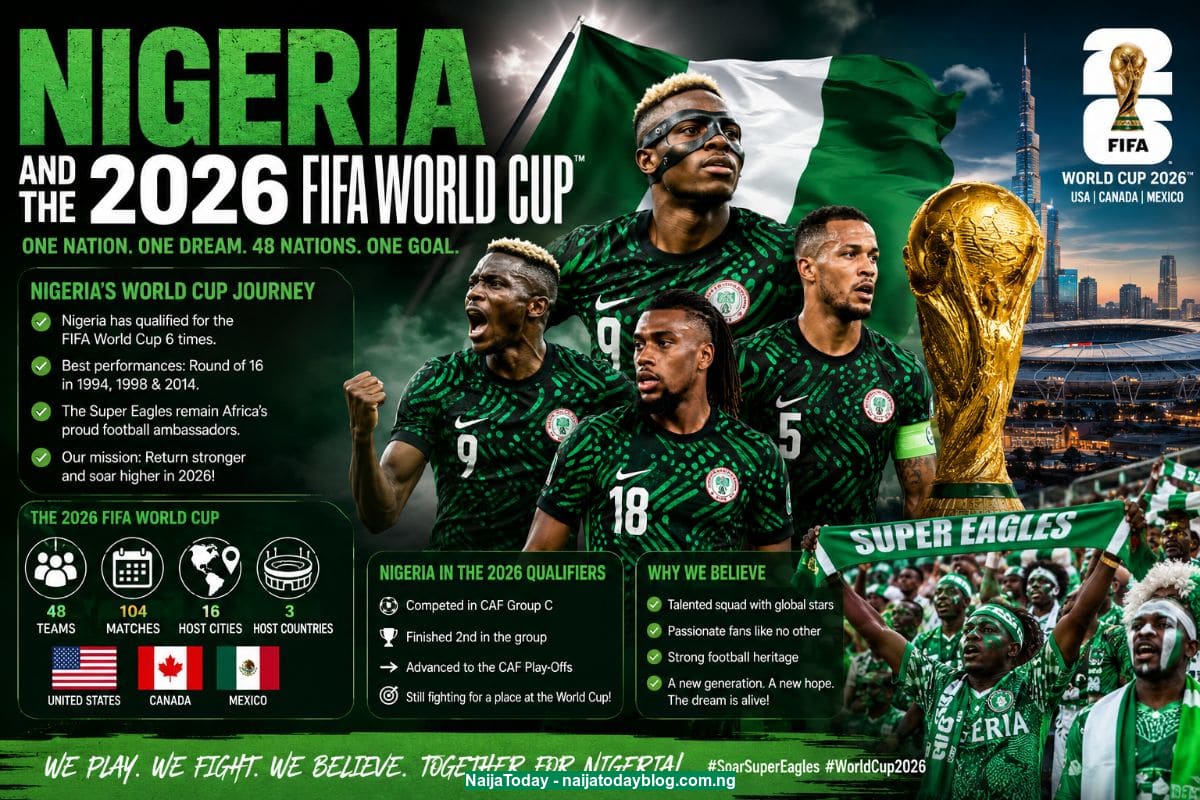
The Super Eagles missed the 2026 FIFA World Cup after a penalty shootout heartbreak against DR Congo. Here's the full story of Nigeria's World Cup 2026 campaign, what went wrong, and what happens next.
#super eagles world cup 2026#nigeria fifa world cup#nigeria vs morocco#victor osimhen 2026#super eagles#nigeria football 2026#caf world cup qualifier#nigeria dr congo#eric chelle#nigeria afcon
How does this story make you feel?
No account or sign-in needed. You can react instantly.
Share:
NaijaToday Desk
The NaijaToday newsroom
More Stories to Explore
More reporting selected from NaijaToday, based on topics and categories.