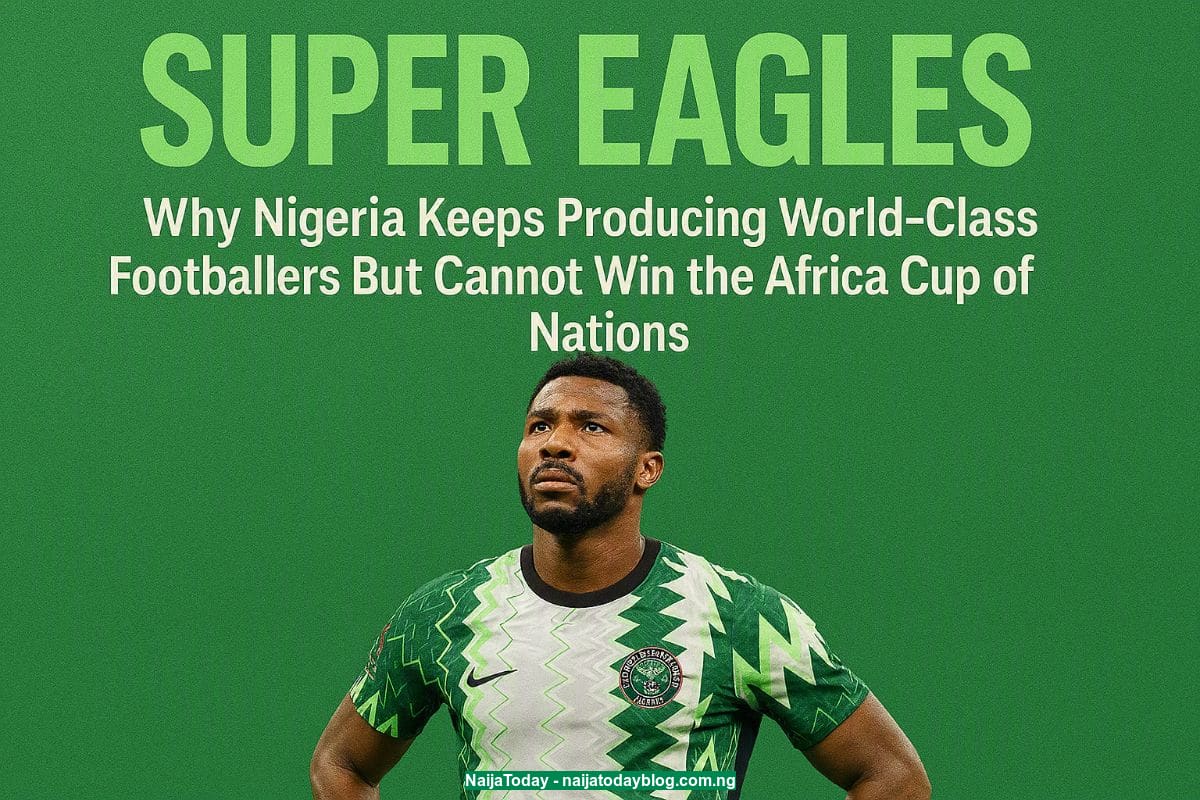
There is a particular kind of pain that only Nigerian football fans truly understand. It is not the pain of a bad team — Nigeria has never had a bad team. It is the pain of a great team that keeps falling short. The pain of watching players who perform brilliantly for their European clubs arrive at an Africa Cup of Nations and somehow produce performances that bear no resemblance to what their club managers see every week. The pain of potential — enormous, undeniable, world-acknowledged potential — that refuses to convert itself into the continental glory that Nigeria's football talent so obviously deserves.
Nigeria has won the Africa Cup of Nations three times: 1980, 1994, and 2013. For a country of 220 million people that has produced some of the finest footballers on the planet — players who have won Premier League titles, Champions League medals, and every individual honour European football offers — three AFCON titles in over 60 years of competition is a return that does not match the investment.
The question Nigerian football fans have been asking for decades, with increasing frustration, is why. Why does the talent pipeline keep producing world-class players while the national team keeps underperforming? The answer is complicated, uncomfortable, and important.
The Talent Is Real and It Is Extraordinary
Before examining the failures, it is worth pausing to appreciate just how remarkable Nigeria's football talent production has been and continues to be.
Victor Osimhen, before his move from Napoli, was for a period the most expensive African footballer in history and one of the most feared strikers in European football. His combination of pace, physicality, aerial ability, and finishing is genuinely world-class — the kind of player that top clubs across Europe compete fiercely to sign.
Victor Boniface at Bayer Leverkusen contributed to one of the most remarkable unbeaten league seasons in European football history. Wilfred Ndidi has been one of the Premier League's most reliable defensive midfielders for years at Leicester City. Samuel Chukwueze has played for AC Milan — one of football's most historic clubs. Calvin Bassey has established himself in top European competition.
Go deeper and the talent pool remains extraordinary. Nigerian players are scattered across the top five European leagues — Serie A, Premier League, Bundesliga, La Liga, Ligue 1 — in significant numbers. The raw material is there. It has always been there.
The Administration Problem
The most significant reason Nigeria underperforms at international level has nothing to do with the players. It has everything to do with how Nigerian football is administered.
The Nigeria Football Federation has been, for most of its existence, a poorly governed institution plagued by internal politics, financial mismanagement, and a leadership selection process that prioritises political connections over football competence. Coaches have been appointed, sacked, reappointed, and sacked again with a frequency that makes long-term tactical planning essentially impossible. Preparation for tournaments is routinely chaotic — flights delayed, bonuses unpaid, training camps underfunded, logistics in disarray.
Players have spoken about this publicly over the years. Stories of arriving at tournaments without proper training facilities, of bonus disputes erupting in the middle of a competition, of team harmony being shattered by off-pitch controversies that have nothing to do with football, are not rare exceptions in Nigerian football history — they are recurring patterns.
When Didier Deschamps prepares France for a major tournament, he knows exactly what his budget is, when his players will arrive, where they will train, and what they will be paid. When a Super Eagles coach prepares for an AFCON, none of those things can be taken for granted. The miracle, in some ways, is not that Nigeria underperforms — it is that Nigeria performs as well as it does given the administrative chaos that surrounds the team.
The Coach Carousel
Since Stephen Keshi's triumph at AFCON 2013, Nigeria has cycled through coaches at a rate that would be considered scandalous in any professionally run football federation.
Each new appointment brings initial optimism and a honeymoon period. Each dismissal brings post-mortem analysis and promises of reform. And then the cycle repeats. The lack of continuity in coaching means that there is no consistent tactical identity to the Super Eagles — no playing philosophy that is drilled into players from the youth teams upward, no recognisable style that opponents must prepare specifically for.
Contrast this with Senegal, which has emerged as Nigeria's chief rival for continental supremacy. Senegal's patient, long-term investment in a coherent football philosophy — combined with stable administration and a coaching setup that provides genuine continuity — has produced a team that won its first AFCON title in 2021 and backed it up with consistent performances. Senegal did not suddenly start producing better players than Nigeria. They simply started administering their football better.
The Psychological Weight of Expectation
There is another factor that receives less attention but may be equally significant: the crushing weight of Nigerian football expectation.
In most countries, making the national football team is the highest honour a footballer can receive. In Nigeria, it is also the beginning of an ordeal. Players are subjected to intense scrutiny, fierce criticism, and the kind of social media abuse that has driven some players to openly question whether representing Nigeria is worth the psychological cost. When performances disappoint — as they sometimes inevitably will — the backlash can be vicious and deeply personal.
This toxic environment around the national team creates a paradox: the players who most need to feel free, confident, and expressive on the pitch are instead playing under the weight of a nation's expectations and the fear of a nation's fury. Football is a confidence game. You cannot play your best football when you are terrified of making a mistake.
Some Nigerian players have been open about this tension. The joy that Victor Osimhen displays when scoring for his club — the freedom, the abandon, the sheer delight in the game — is not always visible when he plays for the Super Eagles. That difference is not physical. It is psychological. And fixing it requires a cultural shift in how Nigerians relate to their national team, not just a change of coach or formation.
The Youth Development Gap
Nigeria's talent production happens largely despite the domestic football system, not because of it. The Nigerian Professional Football League, which should be the foundation of the national team pipeline, has struggled for decades with poor pitches, low attendance, match-fixing allegations, and minimal investment from corporate sponsors.
The vast majority of Nigeria's best current players developed not in Nigeria's domestic league but in the academies of European clubs — or were spotted as teenagers and moved abroad before the Nigerian system could either develop or damage them. This is a functional model for producing individual talent, but it creates a team that lacks cohesion. Players who have spent their formative footballing years at different clubs, in different countries, playing different tactical systems, arrive at international camp as strangers to each other in a footballing sense — needing time to build the chemistry and understanding that winning teams require, time that the compressed international calendar does not provide.
Reasons for Hope
It would be wrong to leave this conversation without acknowledging genuine reasons for optimism.
The current generation of Super Eagles players is arguably the most talented since the Golden Generation of Jay-Jay Okocha, Nwankwo Kanu, Rashidi Yekini, and Sunday Oliseh. Osimhen, Boniface, Chukwueze, Lookman, Ndidi, Bassey — these are serious players at serious clubs, and when they are properly prepared and psychologically settled, they are capable of beating any team in Africa.
There is also growing pressure from Nigerian fans and civil society for genuine NFF reform — for a federation that is run with professionalism and transparency rather than political patronage. That pressure is not yet sufficient to force the transformation Nigerian football needs, but it is louder and more organised than it has been before.
And there is always, in Nigerian football, the possibility of the unexpected. The 1994 team that won AFCON and then reached the World Cup second round was not supposed to be that good. The 2013 team that won AFCON under Keshi defied expectations at every stage. Nigerian football has a habit of surprising people — including itself.
The Simple Truth
Nigeria keeps producing world-class footballers because Nigerians are athletic, competitive, passionate about football, and numerous. Talent at that scale is almost impossible to suppress entirely.
Nigeria keeps falling short at AFCON because the system around those talented players — the administration, the coaching continuity, the domestic league, the psychological environment — has not been good enough, consistently enough, to turn individual brilliance into collective triumph.
The gap between Nigeria's football talent and Nigeria's football results is not a mystery. It is a management problem. And management problems, unlike talent problems, are entirely solvable — if the people with the power to solve them ever decide that winning matters more than the political arrangements that currently govern Nigerian football.
That day cannot come soon enough.
Published by NaijaToday Sports Desk. Join the debate in our Forum — do you think Nigeria can win AFCON 2027?