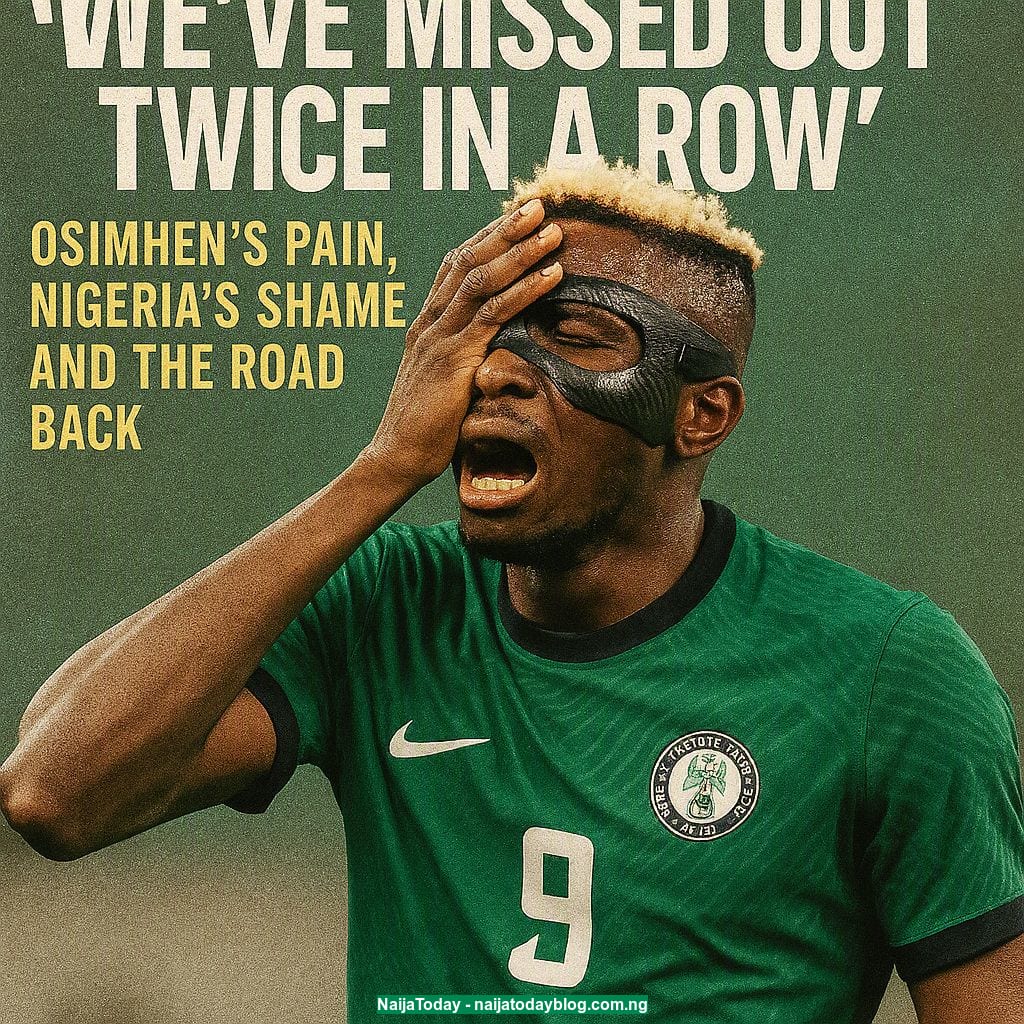
Somewhere in Istanbul, Victor Osimhen sat in front of a
camera, looked into the eyes of thousands of fans watching his livestream, and
said what every Nigerian already knew but nobody wanted to hear out loud.
"It's bad — not just for me but for the rest of the
guys. We've missed out twice in a row. Sometimes life happens, so we just have
to keep moving."
Simple words. Devastating words.
Because while the 2026 FIFA World Cup — the biggest, most
expanded edition in history, featuring 48 nations — thunders on across the
United States, Canada, and Mexico, Nigeria is not there. Again. For the second
consecutive time. For only the second time since 1994, the Super Eagles are
watching the World Cup from their living rooms, just like the rest of us.
And it stings in a way that is difficult to fully put into
words.
How We Got Here
Let's not pretend the pain arrived without warning. The
signs were there long before the final whistle blew on Nigeria's World Cup
dreams.
Africa received nine automatic qualification spots and an
additional playoff ticket for this tournament — the most generous allocation
the continent has ever been given. Nine slots. For a continent of 54 nations.
Nigeria, with her talent, her history, her three AFCON titles, and a squad
bursting with world-class players — could not claim one of them.
The Super Eagles finished second in their qualification
group, then faced DR Congo in the continental playoff. After a 1-1 draw across
two legs, it came down to penalties. And Nigeria, as they have done in some of
their most painful moments, lost the shootout.
DR Congo — a nation that had not appeared at the World Cup
since 1974 when the country was still called Zaire — went through. Nigeria
stayed home.
If you want to understand how much that hurts, consider
this: Victor Osimhen won the FIFA U-17 World Cup Golden Boot in 2015 as a
teenager. He went on to become one of the most lethal strikers in world
football — lighting up Serie A, breaking records at Napoli, becoming a
sensation at Galatasaray. He has done everything right at club level.
Everything.
He has never played a single minute at a senior World Cup.
Not in 2022. Not in 2026.
At 27 years old, his window is narrowing. The 2030 World Cup
— if Nigeria qualify — will come when Osimhen is 31. That is not a reason to
give up hope. But it is a reason to be honest about what has been lost.
Three Coaches. One Disaster.
If Osimhen's pain has a culprit, it wears a suit and sits in
the offices of the Nigeria Football Federation.
During the 2026 World Cup qualification campaign, the Super
Eagles were managed by three different coaches. Three. In one campaign. Any
football person will tell you that tactical consistency, squad unity, and a
defined style of play are built over months and years — not weeks. Each
coaching change meant a reset. New ideas. New formations. New politics.
The NFF's handling of the qualification campaign was, by any
honest assessment, a catastrophe of administration. While other African nations
built stable structures and trusted their processes, Nigeria lurched from one
managerial crisis to the next, burning goodwill, disrupting momentum, and
ultimately paying the highest possible price.
Many Nigerians have called for the resignation of NFF top
officials. It is hard to argue against that demand. Accountability is not
punishment — it is the minimum requirement for progress.
The Talent Was Never the Problem
Here is what makes this all so maddening: the Super Eagles
of this generation are genuinely talented.
Osimhen up front. Ademola Lookman, fresh off an
extraordinary season. Samuel Chukwueze providing width. Wilfred Ndidi anchoring
midfield. Alex Iwobi — just 100 caps deep — bringing composure and creativity.
Maduka Okoye commanding the goal. Frank Nnami and Dele-Bashiru adding energy
and dynamism.
This is not a squad that should be watching the World Cup
from home. On paper, on talent, on potential — Nigeria should be in this
tournament. The failure to qualify is not a talent problem. It is a structure
problem. A leadership problem. An administration problem.
That distinction matters enormously, because talent cannot
be manufactured. Structure can.
What Osimhen Said That Nobody Is Saying Enough
Beyond the headline quote, Osimhen said something else
during that livestream that deserves more attention.
He called on Nigeria to look forward. To use the pain as
fuel. He said it was not about dwelling on the past, but about making sure that
when the next opportunity arrives, the Eagles take it with both hands.
"Nigerian football is too big, too proud, and too
passionate to stay down for long," he said.
There is grace in those words from a man who, frankly, had
every right to be furious. A man who trained his entire life for the World Cup
stage and has been denied it twice by failures that were not his own. Instead
of bitterness, he chose vision.
That maturity — that refusal to collapse into blame — is
exactly the kind of energy Nigerian football needs right now from its players.
The players have done their part. It is the administrators who owe Nigeria an
answer.
Eric Chelle and the Rebuilding
There is, amid the pain, a small but genuine reason for
cautious optimism.
Under coach Eric Chelle, the Super Eagles are showing signs
of the identity that has been absent for years. A defined system. A sense of
shape. Players who understand their roles. The recent friendly performances,
including a competitive showing against World Cup-bound Portugal that ended
only 2-1, suggest a team that is growing in confidence and cohesion.
Chelle has not had long with this group. But what he is
building looks like something real — something with foundations. If the NFF can
resist the urge to destabilise him at the first sign of turbulence, there is a
genuine chance Nigeria can arrive at 2030 World Cup qualification in a
completely different posture.
The key word is if.
The Fans Deserve Better
Through all of this — the coaching chaos, the NFF failures,
the playoff heartbreak — Nigerian football fans have remained. Passionate,
loud, loyal, long-suffering.
They filled stadiums during qualification. They watched
every game. They wore the green and white. They believed, game after game, even
when the evidence made believing difficult.
They deserve better. Not someday. Now.
Better administration. Better planning. Better respect for
the enormous emotional investment millions of Nigerians make every time the
Super Eagles take the field. Football is not just sport in Nigeria — it is
identity. It is pride. It is community. To treat that investment with the
negligence that has defined the NFF's recent years is not just bad management.
It is a betrayal.
Final Word
The 2026 World Cup will go on without Nigeria. Forty-eight
nations will chase glory on that stage. Some will surprise us. Some will
disappoint. One will lift the trophy.
And Nigeria will watch.
That is the reality. It is painful, and it should be painful
— because pain, when channelled correctly, creates change.
Victor Osimhen is keeping it moving. The question is whether
the people responsible for this mess will do the same — or whether they will
continue to occupy positions they have proven they do not deserve, until the
next generation of Nigerian talent is robbed of the same dream.
The players are ready. They have always been ready.
Nigeria, it is your administrators who need to catch up.
Follow NaijaToday for the latest Super Eagles news,
Nigerian football analysis, and all things sport. 📍
naijatodayblog.com.ng