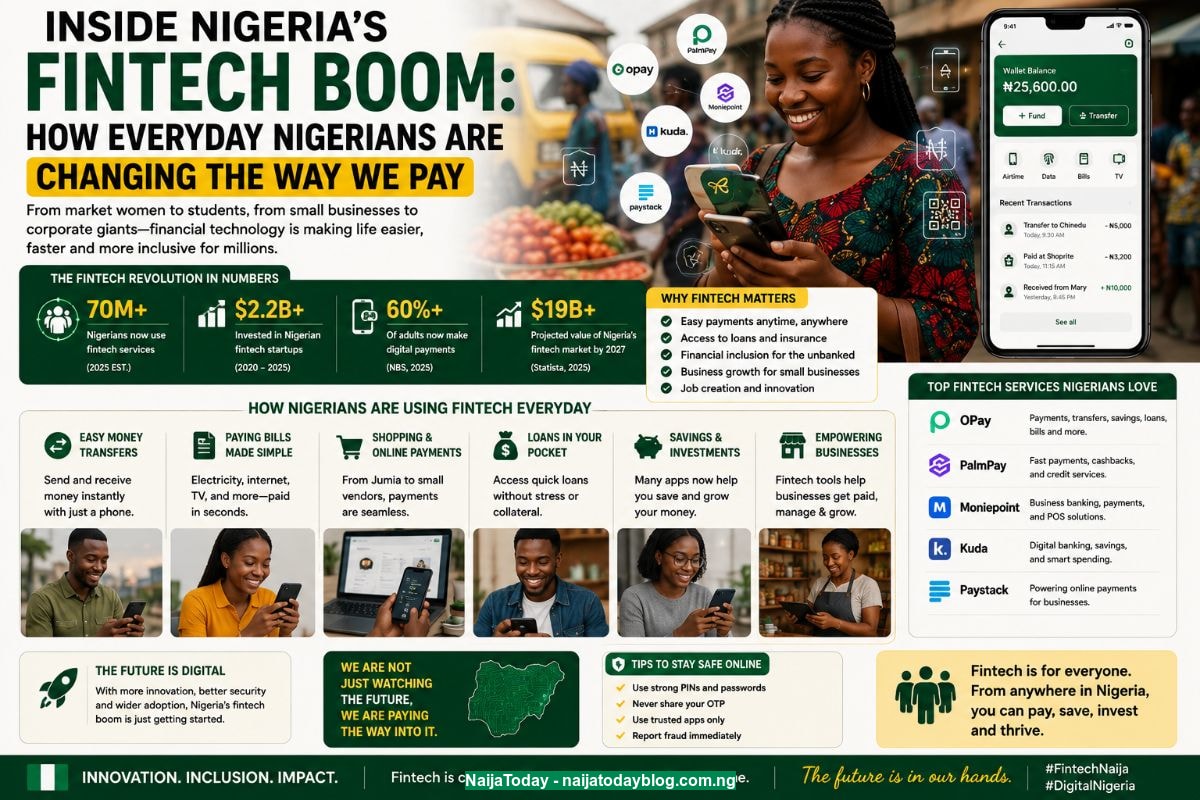
Inside Nigeria's
Fintech Boom: How Everyday Nigerians Are Changing the Way We Pay
A few weeks back, I watched my neighbour's teenage son pay for suya from a mai
suya using his phone, tapping a QR code taped to the man's wooden cart, no
cash, no change wahala, no "abeg you no get change." The suya seller,
who I'd guess is somewhere in his fifties, didn't even blink. He's been
accepting bank transfers and mobile wallet payments for at least two years now.
If you had told either of them ten years ago that this would be a normal
Tuesday evening on a random street in Lagos, they probably would have
laughed.
That small moment, honestly, tells you more about Nigeria's fintech revolution
than any report from McKinsey or PwC could. We've become a country where a
roadside food vendor is more digitally fluent with payments than some banks in
supposedly "developed" economies. And it didn't happen by
accident.
How We Got Here
Nigeria's fintech story didn't start with flashy apps. It started with
frustration. Anyone who banked in Nigeria before 2015 remembers the queues, the
network downtime right when you needed to send urgent money, the "please
try again later" messages that always seemed to arrive exactly when your
rent was due. Traditional banks, for all their history and buildings on every
major street, simply weren't built for the pace and informality of how most
Nigerians actually move money.
Interswitch quietly laid a lot of the groundwork years before
"fintech" was even a word Nigerians used casually. Then came
Paystack, co-founded by Shola Akinlade and Ezra Olubi, which made it possible
for even a small online shop selling ankara fabric to accept card payments
without needing a relationship with a bank's corporate team. When Stripe
acquired Paystack in 2020 for over 200 million dollars, it was less a surprise
to Nigerians in tech and more a confirmation of what we already knew, that this
space was going to explode.
And explode it did. Flutterwave, Moniepoint, OPay, PalmPay, Kuda, Chipper Cash,
the list keeps growing. Today, Nigeria's fintech sector makes up roughly a
third of Africa's entire fintech market, and the country accounts for nearly
half of all fintech transactions on the continent. That's not a small
statistic. That's Nigeria, despite everything, quietly becoming one of the most
important financial technology hubs in the world.
The Numbers That Actually Matter to You
Let's talk plainly. As of 2025, Nigeria recorded well over 100 billion mobile
money transactions in a single year, worth close to two trillion dollars in
total value moved. OPay alone has crossed 45 million users as of mid-2026, with
over 50 million downloads. PalmPay isn't far behind, sitting around 40 million
users and a million merchants. Moniepoint, the agency banking giant that most
Nigerians know from those distinctive blue POS terminals in every market and
roadside shop, processed something in the region of 412 trillion naira in
transactions in 2025 alone, and reportedly handles eight out of every ten
in-person digital transactions in the country.
These aren't abstract Silicon Valley-style vanity metrics. This is your local
provision store owner who now keeps a POS machine on her counter because
customers stopped carrying cash. This is your cousin in the village who
receives money from you in Lagos through an agent two streets away instead of
waiting for someone to travel down with cash wrapped in a handkerchief.
Financial inclusion numbers back this up too. The unbanked population in
Nigeria, once close to half of all adults just a few years ago, has fallen to
around a third, though the Central Bank still estimates that roughly a quarter
of adults remain financially excluded, with the gap far wider in rural areas
and parts of the north. Fintech has done a lot, but it hasn't closed the gap
entirely, and that's an important thing to be honest about.
Why Nigerians Trust These Apps More Than You'd Expect
I'll be honest, I was skeptical of digital-only banking for a long time.
Growing up, "bank" meant a physical building with a security guard at
the gate and a queue that tested your patience and your faith simultaneously.
The idea of trusting an app with your salary felt reckless to a lot of people
my parents' age, and even some in my own generation.
What changed things, from what I've seen and heard from friends and readers,
wasn't marketing. It was word of mouth and lived experience. Kuda's "zero
fee" promise actually held up for enough people that trust built
organically. OPay's aggressive agent network, the guy with the yellow umbrella
and the POS machine on almost every street corner, made cashing out or
depositing feel just as physical and trustworthy as walking into a bank branch,
minus the queue and the attitude of some bank staff we won't name.
There's also something distinctly Nigerian about how these platforms have
grown, they didn't just build apps, they built entire ecosystems around trust
at the community level. Agent banking, where a local shop owner becomes your
access point to a digital wallet, mirrors exactly how esusu and ajo, our
traditional cooperative savings systems, have worked for generations. Fintech
didn't invent trust-based community finance in Nigeria. It just digitized
something we already understood deeply.
The Small Business Angle
If you run a small business in Nigeria, and let's be honest, a huge number of
us either run one or are related to someone who does, fintech has quietly
reshaped how you operate, whether you've noticed it or not.
Paystack and Flutterwave gave small online sellers the ability to accept card
payments without needing to be a registered company with a corporate bank
relationship. A woman selling gele and asoke from her living room in Ibadan can
now receive payments from a customer in Abuja instantly, without either party
needing to trust each other with a bank transfer that might get flagged or
delayed. Moniepoint and similar platforms have started offering small loans
based on transaction history, which matters enormously in a country where
getting a traditional bank loan as a small trader has historically been close
to impossible without collateral most people don't have.
I spoke with a woman who runs a small provisions store near Yaba who told me
something that summed it up well: "Before, if customer come buy something
and no get cash, I go just lose the sale. Now, even if she no get up to hundred
naira in coin, she fit transfer to me sharp sharp." That's not a
headline-grabbing statistic, but multiply that across millions of small
transactions happening daily across every state in Nigeria, and you start to
understand the scale of what's actually changed.
What's Coming Next
The conversation in Nigerian fintech circles has shifted noticeably over the
past year or two. It's no longer just about who can move money fastest.
Industry watchers are increasingly talking about embedded finance, where
financial services get baked directly into non-financial apps and platforms,
and about AI being used more seriously for fraud detection, credit scoring, and
customer service, rather than being treated as a side feature. The Central
Bank's own fintech reporting has flagged this as a growing priority area.
Open banking is also inching forward, slowly but steadily, following the
regulatory framework the CBN put in place a few years ago. If it matures the
way regulators hope, it could mean even smoother, more interoperable
experiences where your data and transaction history can move between platforms
with your permission, potentially making it easier for everyday Nigerians and
small business owners to access credit based on their actual financial
behaviour rather than paperwork they may not have.
There's also a growing conversation about infrastructure that goes beyond
payments entirely, things like digital identity verification and security,
areas that international investors are starting to pay closer attention to as
underserved but critical parts of the ecosystem.
The Honest Take
I won't pretend this is all sunshine. Fraud remains a real and growing concern
as more Nigerians move their money online, and platforms are having to invest
heavily in biometric authentication and monitoring just to keep pace with
increasingly sophisticated scammers. Regulatory uncertainty still spooks some
investors, and the CBN's continued hard stance on cryptocurrency dealings by
banks remains a point of friction for a segment of young, crypto-curious
Nigerians. And despite all this growth, a meaningful chunk of the country,
particularly in rural and northern communities, still isn't fully plugged into
any of it.
But stepping back and looking at the bigger picture, what's happened in
Nigerian fintech over the past decade is genuinely remarkable. We went from
queuing for hours to withdraw our own salary to a suya seller casually
accepting a tap-to-pay QR code without a second thought. That shift didn't
happen because of government policy alone, though regulation has played its
part. It happened because millions of ordinary Nigerians, market women, okada
riders, small business owners, decided that a better way to move money was
worth trying, and then simply adopted it faster than almost anywhere else on
the continent.
That, to me, is the real story behind all the funding rounds and unicorn
valuations. It's not really about the apps. It's about us.
💻 Technology🔥 HOT
Inside Nigeria's Fintech Boom: How Everyday Nigerians Are Changing the Way We Pay
By NaijaToday Desk · 10 July 2026 · 8 min · 👁 2
A few weeks back, I watched my neighbour's teenage son pay for suya from a mai suya using his phone, tapping a QR code taped to the man's wooden cart, no cash, no change wahala, no "abeg you no get change." The suya seller, who I'd guess is somewhere in his fifties, didn't even blink. He's been accepting bank transfers and mobile wallet payments for at least two years now.
How does this story make you feel?
No account or sign-in needed. You can react instantly.
Share:
NaijaToday Desk
The NaijaToday newsroom
More Stories to Explore
More reporting selected from NaijaToday, based on topics and categories.