The Parallel Economy: How Nigeria’s Youth Are
Building Their Own Country Inside Nigeria
If you step into an
apartment in Yaba, Lagos, or an estate in Enugu, or a modern workspace in Kano,
you might witness a scene that seems to defy the conventional news headlines
about Nigeria.
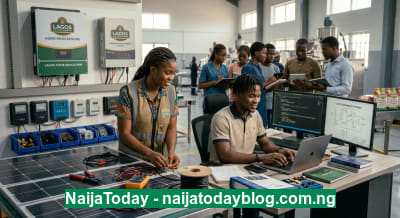
Inside, a 24yearold sits
at a desk. Outside the window, the public street might be unpaved, and the
municipal power line on the pole has been dead for eighteen hours. But inside
the room, bright LED lights illuminate the space. A silent solar inverter hums
in the background, a highspeed router delivers stable gigabit internet, and on
the screen, a video conference is underway with a software team based in
London, San Francisco, or Berlin.
By 2:00 PM, this young
worker orders lunch through a local delivery app, pays a neighbourhood vendor
via an instant digital transfer, and settles a subscription invoice using a
virtual card.
Without leaving their
room, this individual has bypassed nearly every traditional point of contact
with the Nigerian state infrastructure. They generated their own power, secured
their own highspeed communication network, sourced their own foreign income,
and transacted on a private, friction free digital financial layer.
This is not an isolated
story. It is the daily reality for millions of young Nigerians across the
country.
Faced with decades of
systemic infrastructure deficits, currency fluctuations, and bureaucratic
inertia, Nigeria’s younger generation has done something extraordinary: They
have built a functioning parallel economy.
They have constructed a
country inside a country. But as this self-reliant digital and informal
ecosystem expands, it brings us to a critical junction in our national history:
Can a private parallel economy sustain a nation forever, or is it time to
convert economic self-reliance into political and civic structural reform?
1. The Death of the Traditional Social
Contract
To understand why the
parallel economy emerged, one must look at the complete breakdown of the
traditional Nigerian dream that guided previous generations.
For those who grew up in
the 1970s, 1980s, or even early 1990s, the blueprint for success was
straightforward and linear:
1. Work hard in secondary
school and pass your WAEC/JAMB.
2. Secure admission into a
public university and graduate with a good degree.
3. Complete your National
Youth Service Corps (NYSC) year.
4. Get recruited by a
bank, an oil company, a multinational corporation, or the civil service.
5. Buy a car, take out a
mortgage or rent a flat, and work toward a predictable pension.
That blueprint is no
longer just broken; it is completely obsolete.
|
THE SHIFT IN THE NIGERIAN DREAM |
|
THE OLD BLUEPRINT (1980s–2000s) THE
NEW REALITY (Present) |
|
• Public University Degree • High
Demand Digital/Trade Skill |
|
• Local Corporate 9to5 Job •
Remote Global / Social Commerce |
|
• Reliance on State Power/Pensions •
Private Solar + Digital Assets |
|
• Local Currency Savings • Hedged Multicurrency Portfolio |
When hundreds of thousands
of university graduates emerge every year into a formal job market that can
only absorb a small fraction of them, the traditional pipeline collapses.
Furthermore, when inflation eroding local purchasing power makes conventional entry-level
salaries insufficient to cover basic urban rent and transportation, young
people are forced to adapt or perish.
The response of the
Nigerian youth was not to sit down and despair. Instead, they completely
bypassed the traditional pipeline. They stopped waiting for corporate
recruitment fairs and started teaching themselves coding, UI/UX design, digital
marketing, video editing, data analysis, foreign language translation, and
international trade on YouTube and specialized online academies.
They looked at the formal
economy, saw a system that offered low returns for high friction, and decided
to build their own.
2. The Four Pillars of the Parallel Economy
This parallel economy does
not rely on government subsidies, state-run utilities, or traditional corporate
bureaucracy. It rests firmly on four self built pillars:
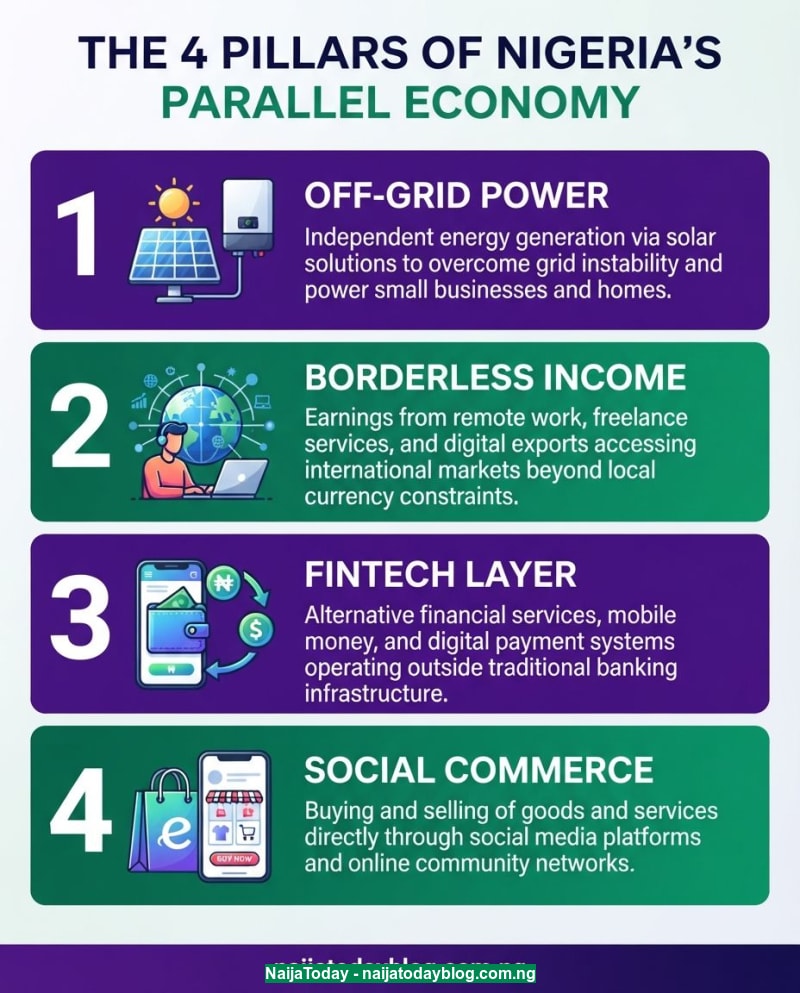
Pillar 1: Off Grid Power Independence
For decades, the inability
of the national grid to deliver consistent power was the single greatest killer
of small businesses in Nigeria. The parallel economy solved this through a
private energy transition.
The rapid drop in the cost
of solar panels, lithium-ion batteries, and smart inverters allowed households
and small businesses to decouple from the national grid. Today, from tech hubs
in Yaba to commercial shops in Aba and residential estates in Abuja, solar
installations have become the new status symbol of operational survival. If the
national grid collapses five times in a week, the parallel economy barely
blinks; the sun keeps shining, the batteries keep charging, and the work
continues.
Pillar 2: Borderless, Multicurrency Incomes
In a globalized digital
world, geography is no longer destiny. A 22yearold animator in Kaduna can
design graphics for a marketing agency in Toronto. A music producer in Enugu
can sell beats to an artist in Atlanta. A fashion designer in Ibadan can take
custom orders from clients in London via Instagram and ship them using international
courier services.
By earning in foreign
currency or foreign indexed digital assets while living in a local economy,
young Nigerians created an economic shock absorber. This foreign income flows
directly back into local communities—paying local rents, buying local
agricultural produce, funding family healthcare, and powering neighbourhood
real estate development.
Pillar 3: Next Generation Fintech
Infrastructure
If you want to see where
Nigeria genuinely leads the world, look at digital payments. When traditional
legacy banking systems struggled with slow settlement speeds and high
transaction failure rates, Nigerian fintech developers stepped in.
Today, Nigeria boasts one
of the fastest, most reliable instant interbank transfer networks on Earth.
From street vendors selling roasted corn to high-end boutiques in Victoria
Island, the physical handling of cash has been largely replaced by instant
transfers, QR codes, and agency banking POS terminals. The parallel economy
created a frictionless, Realtime transaction layer that keeps commerce moving
24/7.
Pillar 4: Social Commerce and Micro Logistics
Who needs an expensive
retail storefront in a high rent district when you have a smartphone? The rise
of "Social Commerce"—businesses operating entirely through Instagram,
WhatsApp, TikTok, and X (Twitter)—has decentralized Nigerian retail.
A young woman in Aba can
manufacture high-quality leather shoes, post a 15second video on TikTok,
receive orders from buyers in Abuja and Port Harcourt via WhatsApp, collect
instant digital payments, and dispatch the items through independent motorcycle
logistics services. No middleman, no corporate office, no state approval delays.
Pure, unadulterated micro-entrepreneurship.
3. The "Japa" Paradigm Shift: From
Desperate Flight to Strategic Positioning
For the past few years,
the dominant social narrative among young Nigerians was captured in a single
Yoruba word that became part of the national lexicon: "Japa" (to flee
or migrate).
The desire to leave the
country in search of better healthcare, security, and structured systems led to
an unprecedented emigration wave of skilled doctors, nurses, software
engineers, educators, and corporate professionals to the UK, Canada, the US,
and Europe.
However, as the global
economic landscape shifts—with rising living costs, high taxation, and
tightening immigration policies in Western nations—a new, nuanced trend is
quietly emerging within the parallel economy: Strategic Positioning (The
"Japada" Hybrid Model).
|
THE MIGRATION EVOLUTION |
|
THE OLD 'JAPA' PHAPE (2018–2023) THE HYBRID MODEL (Present) |
|
• Complete exit at all costs •
Global income + Local footprint| |
|
• High Western living expenses • Arbitrage: Earn foreign, spend |
|
• Local brain drains locally |
|
• Reinvesting capital into local |
|
assets & startups
|
Young professionals are
beginning to realize the power of economic arbitrage. Earning a Western grade
income while paying local operational costs in Nigeria allows an individual to
build capital, invest in local real estate, launch homegrown businesses, and
employ local talent at a speed that would be mathematically impossible while
paying high rent and taxes in London or Toronto.
Instead of desperate
flight, the modern parallel economy encourages global mobility with local
impact. Young Nigerians are building global footprints while keeping one foot
firmly planted in the Nigerian soil, building factories, launching tech
platforms, and funding creative industries right here at home.
4. The Self-reliance Trap: Why the Parallel
Economy Has a Ceiling
It is easy to look at the
success of Nigeria’s tech founders, Afrobeats stars, Nollywood filmmakers, and
digital hustlers and conclude that the state no longer matters. It is tempting
to say: "We have provided our own power, our own security, our own water,
and our own jobs. Let the government do whatever it wants."
This is a dangerous trap.
As impressive as the
parallel economy is, it has an absolute ceiling. Private self-reliance can
solve individual household problems, but it cannot build a civilization.
|
THE CEILING OF PRIVATE
SELFRELIANCE |
|
WHAT PRIVATE EFFORT CAN FIX WHAT ONLY THE STATE CAN PROVIDE |
|
| |
|
✔ Rooftop Solar Panels ✖ Interstate Highway Grids |
|
✔ Borehole Water Supply ✖ National Security & Rule of Law |
|
✔ Private Security Guards ✖ Public Primary Healthcare |
|
✔ Remote Dollar Jobs ✖ Port Efficiency & Trade Policy |
Consider the stark
limitations:
You can put solar panels on your roof, but you
cannot construct a 500kilometer dual carriageway interstate highway to
transport food from Northern farm belts to Southern coastal cities.
You can hire private security guards for your
residential estate, but you cannot deploy a national intelligence network to
defeat regional banditry, sea piracy, or agricultural terrorism.
You can buy private health insurance for your
immediate family, but if a viral pandemic or public health crisis hits, you
cannot replace a functional public primary healthcare system.
You can earn foreign currency on your laptop,
but if the local seaports remain congested with red tape and inefficient
clearance systems, your imported business equipment will rot at the docks for
months.
Private prosperity
surrounded by public infrastructure collapse is an illusion. Eventually, the
decay outside your estate gate will knock on your door.
If the road to the airport
is broken, your dollar earning tech talent will still miss their flight. If
local agricultural supply chains collapse due to rural insecurity, your high
salary will still be devoured by skyrocketing food prices.
The parallel economy is a
brilliant survival mechanism, but it is not a permanent destination. It is a
bridge—and that bridge must lead back to fixing the state.
5. How Policy Must Adapt: From Regulation to
Facilitation
If the Nigerian state
wants to capture the immense value generated by the parallel economy, its
mindset must fundamentally shift.
For too long, the default
reaction of regulatory agencies and government bureaucracies toward youth led
innovation has been suspicion, taxation, and restriction. Whenever a new
digital industry emerges—whether it is ride hailing apps, logistics startups,
digital assets, or social commerce—the first response from authorities is often
to invent new license fees, create new enforcement task forces, or impose
sudden bans.
This approach is
counterproductive. You cannot regulate an ecosystem into existence; you can
only facilitate it.
|
REGULATORY MINDSET
TRANSFORMATION |
|
OLD APPROACH (Friction) NEW REQUIRED APPROACH (Enabler) |
|
• Sudden bans and restrictions • Collaborative sandboxes |
|
• High upfront licensing fees • Tax holidays for early stage |
|
• Multiple taskforce harassment startups |
|
• Focus on immediate revenue extraction •
Focus on infrastructure enabling |
To harness the energy of
the parallel economy, government policy across federal, state, and local levels
must focus on three simple principles:
1. Radically Reduce Friction
Make it effortlessly
simple to register a business, clear goods at the ports, pay a single unified
tax, and obtain permits. The parallel economy exists precisely because formal
systems are too slow and painful. If you make the formal system fast and frictionless,
businesses will willingly enter it.
2. Protect Intellectual Property and Digital
Rights
Young Nigerians are
building intangible wealth—software code, media content, music catalogues,
fashion designs, and digital brands. State policy must provide ironclad legal
frameworks and specialized courts that protect intellectual property rights and
enforce commercial contracts swiftly.
3. Invest in Foundational Human Capital
While the private sector
can build apps and install solar panels, the government must focus on what only
it can do: mass primary education, vocational skill centres, basic healthcare,
and major transportation corridors. When the state provides the foundational
physical infrastructure, the creative genius of the youth will do the rest.
6. The Civic Awakening: Converting Economic
Hustle into Political Power
The ultimate evolution of
the parallel economy is not financial—it is civic.
The same generation that
taught themselves to code, built billion-dollar fintech platforms, took
Afrobeats to global stadiums, and created independent power networks must now
bring that same analytical rigor and organizing power to governance.
For too long, young,
productive Nigerians treated politics as a dirty, distant game played by older
men in Abuja. They believed that as long as they made their money
independently, politics didn't affect them.
That illusion has
shattered. Politics affects the exchange rate of the money you earn. Politics
affects the safety of the road you drive on. Politics affects the policy that
determines whether your Favorite app operates tomorrow morning or gets banned
by executive decree.
|
THE NEXT EVOLUTION OF
NIGERIAN YOUTH |
|
STAGE 1: Despair & Helplessness (Waiting
for government) |
|
▼
|
|
STAGE 2: Individual Survival (Building the
Parallel Economy) |
|
▼
|
|
STAGE 3: Civic & Political Mastery
(Organizing for Structural Change) |
Converting economic hustle
into political leverage means:
Participating in Local Ward Politics: Showing
up where political candidates are selected, not just where votes are cast on
election day.
Funding Civic Technology: Supporting platforms
that track public budgets, monitor legislative votes, and expose corrupt local
procurement.
Running for Local Office: Transitioning from
social media critique to stepping into local council seats, state assemblies,
and public policy advisory roles.
Conclusion: The Unstoppable Spirit of the
Nigerian
There is a unique,
indomitable quality to the Nigerian spirit.
When you place a barrier
in front of a Nigerian, they do not sit down and cry; they climb over it, dig
under it, or build a new road around it. When the traditional economy closed
its doors, our youth opened a digital window to the entire world.
The parallel economy is
proof of what Nigerians can achieve when their hands are untied. It is a
living, breathing demonstration that our people are not lazy, helpless, or
lacking in vision. We are a nation of builders, creators, and problem solvers.
Now, the task before us is
to take that same energy that built solar powered homes, global music brands,
seamless payment apps, and thriving online businesses, and apply it to the
rebuilding of our public space.
We have proven that we can
build a country inside a country. Now, it is time to unite our strength, step
out into the public square, and build the real Nigeria we all know is possible.
What Do You Think?
Are you currently part of
the parallel economy? Are you working remotely, running an online business, or
using off grid power to survive? How do you think we can bridge the gap between
private success and public infrastructure in Nigeria?
Share your thoughts,
experiences, and perspectives in the comments section below!
Don't forget to SHARE this
post across your network, WhatsApp groups, and social timelines. Follow naijatodayblog.com.ng
for daily verified news, deep economic analysis, and thought-provoking
perspectives on Nigeria’s future.