The news arrived
with the particular weight that only certain names carry in Nigerian public
life.
Diezani Alison-Madueke — former Minister of Petroleum Resources, former
President of OPEC, the most powerful woman in Nigerian government history — has
been acquitted of bribery charges in the United Kingdom.
For those who have followed her case across the better part of a decade, the
acquittal raises questions that go far beyond one woman's legal fate. It raises
questions about the nature of accountability, the limits of international legal
cooperation, and what it means to pursue justice for corruption when the
evidence, the money, and the accused are scattered across multiple
jurisdictions.
Who Is Diezani Alison-Madueke?
For younger Nigerians who may be less familiar with the history, a brief
account is necessary.
Diezani Alison-Madueke served as Nigeria's Minister of Petroleum Resources from
2010 to 2015 — the full duration of former President Goodluck Jonathan's
administration. In that role, she oversaw one of the most consequential and
controversial periods in the history of Nigeria's oil sector.
She was Nigeria's first female petroleum minister, and she brought to the role
a combination of professional polish, political savvy, and an appetite for the
kind of executive authority that made her simultaneously admired and feared
within the sector. She became President of the Organisation of the Petroleum
Exporting Countries (OPEC) — the first African woman and first Nigerian to hold
that position.
She was also, according to multiple investigations, at the centre of one of the
most significant corruption episodes in Nigerian history.
The Allegations
The Economic and Financial Crimes Commission (EFCC) has alleged that during her
tenure as petroleum minister, Diezani was involved in the diversion of billions
of dollars in oil revenues from the Nigerian National Petroleum Corporation
(NNPC). The figures cited in various investigations and legal proceedings have
ranged into the billions of dollars — money that should have entered Nigeria's
federation account and been available for schools, hospitals, infrastructure,
and the basic functions of government.
The UK National Crime Agency (NCA) arrested Diezani in London in October 2014,
shortly before the end of the Jonathan administration. She has been living in
the United Kingdom since then, the subject of ongoing legal proceedings in
multiple countries.
In the United Kingdom, the bribery charges related to allegations that she
received luxury properties and other benefits in exchange for the award of oil
contracts. The UK court has now acquitted her of those specific charges.
She still faces forfeiture proceedings in the United States, where the
Department of Justice has moved to seize assets allegedly connected to corrupt
proceeds. She also faces ongoing EFCC proceedings in Nigeria.
What the UK Acquittal Means — and Does Not Mean
An acquittal is not a declaration of innocence in the comprehensive,
biographical sense. It is a finding that the prosecution did not prove its
specific charges beyond the reasonable doubt standard required in criminal
law.
The UK bribery case concerned specific allegations about specific transactions.
The acquittal means that the prosecution could not establish those specific
elements to the required standard. It does not address the broader questions
about the management of Nigeria's petroleum revenues during her tenure, which
are the subject of separate proceedings in Nigeria and the United States.
This distinction matters enormously in how the acquittal is received and
interpreted. In Nigeria, where Diezani has become a symbol — for her
supporters, of the dangers of politically motivated prosecution; for her
critics, of the scale of oil sector corruption under the Jonathan
administration — the UK verdict will be weaponised by both sides.
Her supporters will argue that the acquittal vindicates her. Her critics will
argue that an acquittal on specific UK bribery charges says nothing about the
broader allegations of oil revenue diversion that are still the subject of
proceedings elsewhere.
Both of these positions contain truth and motivated reasoning in proportions
that vary by the speaker's political affiliation.
The EFCC's Long Road
The EFCC's pursuit of Diezani Alison-Madueke represents one of the most complex
and protracted corruption cases in the commission's history.
Securing her return to Nigeria for prosecution has been complicated by her UK
residency and by the concurrent legal proceedings in multiple jurisdictions.
International extradition and mutual legal assistance processes are slow,
expensive, and dependent on cooperation between governments that have their own
interests and timelines.
The EFCC has faced criticism — some of it fair, some of it politically
motivated — for the pace and effectiveness of the Diezani proceedings. A case
that has stretched over more than a decade, with the accused residing abroad
and the evidence scattered across international banking systems, tests the
institutional capacity of any anti-corruption agency.
What the EFCC requires, to prosecute cases of this complexity effectively, is
not just political will — though that is essential — but forensic financial
investigation capacity, robust international legal cooperation frameworks, and
the kind of sustained institutional attention that survives changes of
government.
That last requirement is the hardest. Anti-corruption investigations in Nigeria
have a troubling tendency to accelerate and decelerate in rhythm with political
cycles — pursued vigorously when the accused is out of favour with the current
administration, slowed or abandoned when political calculations change.
The Asset Recovery Question
Whatever the outcome of the criminal proceedings in various jurisdictions, the
asset recovery question is arguably more consequential for Nigeria.
If money was diverted from Nigeria's petroleum revenues — and the evidence
presented in various proceedings suggests that very large sums were — then the
return of those assets to Nigeria is more directly beneficial to ordinary
Nigerians than any criminal conviction.
The United States forfeiture proceedings are significant in this context. The
DOJ's asset forfeiture mechanisms are powerful and well-established. If the US
proceedings result in the forfeiture and return of assets to Nigeria, the
financial benefit is concrete and immediate — schools that can be built,
hospitals that can be equipped, debts that can be serviced.
Nigeria's track record on the repatriation and use of recovered assets is,
however, troubled. Assets recovered from former dictator Sani Abacha's regime
were repatriated to Nigeria over many years and in multiple tranches — some of
which were absorbed by the government with limited transparency about how they
were ultimately used.
Any assets recovered from the Diezani proceedings should be subject to robust
public tracking and accountability mechanisms. This is not a luxury. It is the
minimum requirement for recovery to serve its intended purpose.
What This Case Says About Accountability in Nigeria
The Diezani case is, in many ways, a mirror for Nigeria's relationship with
accountability for those at the highest levels of power.
The Jonathan administration presided over a period of enormous oil revenues —
and equally enormous questions about where those revenues went. The EFCC has
pursued multiple officials from that period. Some have been convicted. Others
remain in ongoing proceedings. Some appear to have escaped meaningful accountability
entirely.
The Tinubu administration's relationship with anti-corruption enforcement is
itself the subject of scrutiny. Selective prosecution — pursuing opponents
while protecting allies — is a pattern that has characterised multiple Nigerian
administrations, and that corrodes public confidence in the anti-corruption
enterprise regardless of any individual case's merits.
Building a credible anti-corruption system in Nigeria requires institutions
that are genuinely independent — not of government in the abstract, but of the
specific political interests of whatever government happens to be in power. The
EFCC, as currently constituted, does not fully meet that standard. Its
leadership is appointed by the President, and its priorities inevitably reflect
the political environment in which it operates.
This is not a counsel of despair. It is a description of the institutional
reform challenge. An EFCC with genuine independence, adequate resources, and
forensic capacity would be a transformative institution. Building it requires
political will that has, so far, not been sufficiently forthcoming.
Final Word
Diezani Alison-Madueke has been acquitted of specific bribery charges in the
United Kingdom. The proceedings in Nigeria and the United States continue.
The Nigerian people are still waiting for a full and transparent accounting of
what happened to their oil revenues between 2010 and 2015. They are still
waiting for a credible, sustained, politically independent anti-corruption
system that pursues accountability regardless of who the accused is or who
their political allies are.
The acquittal in London is a legal event. The accountability question it
touches is a political and institutional one — and it will not be resolved by
any single court verdict in any single jurisdiction.
Nigeria's oil belongs to Nigeria's people. Any money diverted from its proceeds
belongs to them too. Getting it back — and ensuring it is used for their
benefit — remains unfinished business.
*NaijaToday covers corruption, accountability, and governance in Nigeria.*
*📍
naijatodayblog.com.ng*
Diezani Acquitted in the UK. What Does It Mean for Nigeria's Fight Against Corruption?
By NaijaToday Investigative Desk | June 21, 2026 · 22 June 2026 · 7 min · 👁 4
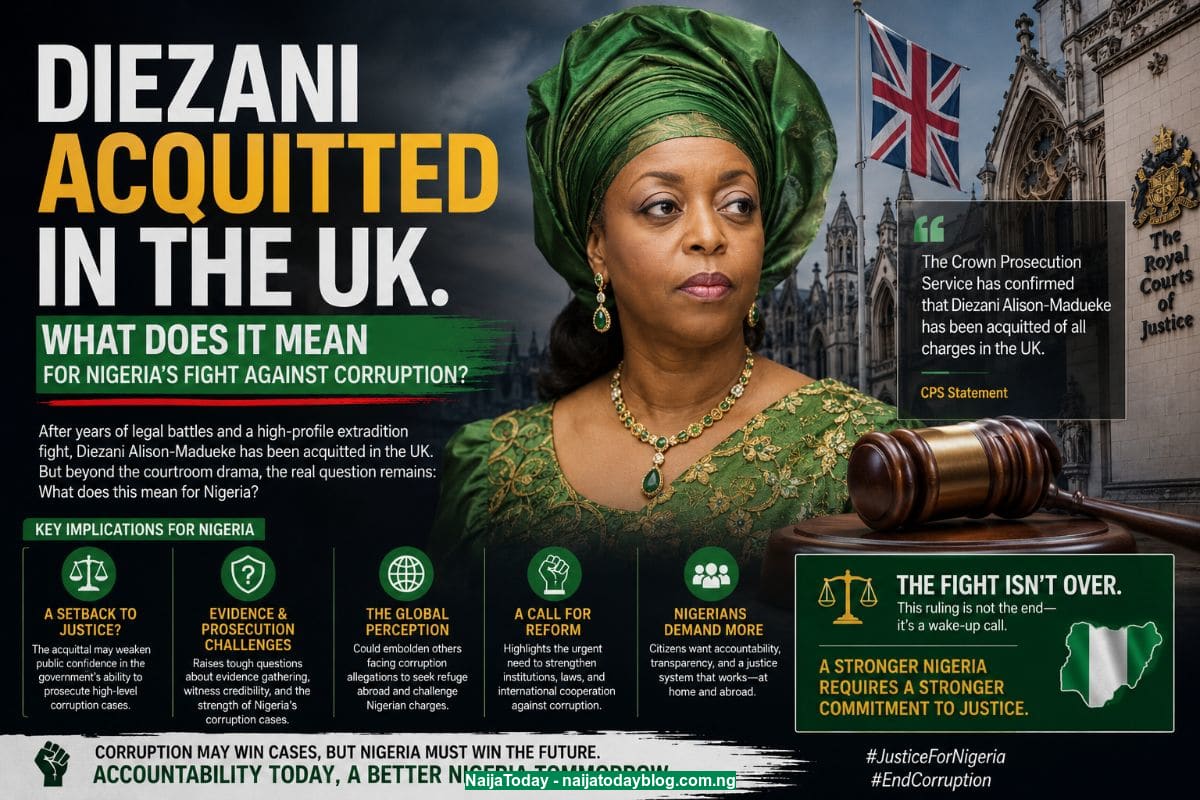
Diezani Alison-Madueke — former Minister of Petroleum Resources, former President of OPEC, the most powerful woman in Nigerian government history — has been acquitted of bribery charges in the United Kingdom.
How does this story make you feel?
No account or sign-in needed. You can react instantly.
Share:
More Stories to Explore
More reporting selected from NaijaToday, based on topics and categories.