How to Apply for
NELFUND Student Loan in 2026 — Complete Step-by-Step Guide
If you are a student in a Nigerian public university, polytechnic, or college
of education and you are struggling to pay your fees, there is a government
solution that many students are still not aware of — the NELFUND student loan.
In 2026, this scheme has already disbursed over ₦184 billion to more than 1.5
million students across 265 institutions in Nigeria, and it is still accepting
new applications.
This guide covers everything you need to know — what NELFUND is, who is
eligible, what documents you need, and how to apply step by step from your
phone or laptop today.
What Is NELFUND?
NELFUND stands for the Nigerian Education Loan Fund. It was established under
the Student Loans (Access to Higher Education) Act of 2023, signed into law by
President Bola Tinubu. The purpose of the fund is simple: to make sure that no
Nigerian student drops out of higher education because of money.
The NELFUND loan is completely interest-free. You borrow the money, use it to
pay your school fees and cover your living expenses, and when you graduate and
start working, you pay it back gradually from your salary. There are no hidden
charges, no interest accumulation, and no penalties as long as you follow the
repayment terms. This is arguably the most student-friendly financial product
the Nigerian government has ever launched.
What Does the NELFUND Loan Cover?
The loan covers two main things:
Institutional Charges (Tuition):** The fund pays your school fees directly
into your institution's bank account on your behalf. You do not have to
struggle to gather fees before resumption.
Upkeep Allowance:** In addition to tuition, NELFUND pays a monthly stipend of
₦20,000 directly into your personal bank account to help you cover
accommodation, feeding, transportation, and other daily living costs. This
allowance is paid for the duration of your academic session.
Note: There was a rumour circulating in early 2026 that NELFUND increased the
upkeep to ₦150,000 per month. This has been officially debunked by NELFUND and
the NELFUND Beneficiaries Association (NBAN). The current upkeep amount remains
₦20,000 monthly.
Who Is Eligible for the NELFUND Loan in 2026?
To qualify for the NELFUND student loan, you must meet the following
conditions:
You must be a Nigerian citizen. You must be currently enrolled in a federal or
state government higher institution — including universities, polytechnics,
monotechnics, colleges of education, or vocational schools. Your institution
must be registered with NELFUND and have submitted your verified student
records to the NELFUND Student Verification Portal. You must have a valid
National Identification Number (NIN). Your NIN must match the name on your
school records and your JAMB profile exactly. You must not have defaulted on
any previous government loan. You must not have any criminal record involving
fraud, forgery, examination malpractice, drug offences, or cultism.
Important:** Private university students are currently NOT eligible for
NELFUND loans. The scheme is exclusively for students in government-owned
public institutions. However, the government has indicated plans to extend
coverage to state institutions and private universities in future phases, so
always check nelf.gov.ng for the most recent updates.
Fresh students can apply using their JAMB registration number. Returning
students apply with their matriculation number. Part-time and full-time
students are both eligible. There is no household income restriction — any
student who meets the other criteria can apply regardless of family income.
Documents You Need Before Applying
Before you go to the portal, gather the following:
Your JAMB registration number (for fresh students) or your matriculation number
(for returning students). Your National Identification Number (NIN). A valid
email address. Your bank account number with a Nigerian bank. A scanned copy of
your admission letter. Your Student ID or any institution-issued
identification.
One critical point: your name must appear exactly the same on your NIN, your
JAMB profile, and your school records. Discrepancies in name spelling are one
of the most common reasons applications get stuck or rejected.
Step-by-Step Guide to Applying for NELFUND in 2026
Step 1: Confirm Your School Has Uploaded Your Records**
This is the most important step. Before you can apply on the portal, your
institution must have submitted your verified student data to the NELFUND
Student Verification Portal. If your school has not done this, you cannot
proceed — even if you meet all other requirements.
Contact your institution's bursary department, registry office, or ICT unit to
confirm whether your school has registered with NELFUND and uploaded student
records. Many students have wasted time trying to apply only to discover their
school hadn't uploaded their data yet.
Step 2: Visit the Official NELFUND Portal**
Go to portal.nelf.gov.ng. This is the only official portal. Do not use any
third-party website or agent claiming to assist with NELFUND applications.
There are no application fees. Anyone asking you to pay to apply is a
scammer.
Step 3: Answer the Preliminary Questions
The portal will ask you a few basic eligibility questions, such as confirming
you are a Nigerian citizen and that you are enrolled in a qualifying
institution. Answer honestly and click "Yes, I am a Nigerian."
Step 4: Select Your Institution and Verify Your Details
Select your institution from the dropdown list and enter your matriculation
number or JAMB registration number to confirm your school has submitted your
records. If your institution does not appear or your details are not found,
contact your school's bursary or registry immediately.
Step 5: Verify with JAMB and NIN
Click "Verify with JAMB" and enter your JAMB registration details. If
your NIN is not linked to your JAMB profile, you will need to provide it
separately for validation.
Step 6: Create Your Account
Enter your email address and create a secure password. This account will be
used to track your application status throughout the process.
Step 7: Complete Your Profile
Fill in all your personal details, including your name, date of birth, state of
origin, phone number, and bank account information. Double-check every field
against your official documents before proceeding.
Step 8: Upload Your Admission Letter
Upload a clear, legible scan of your admission letter. Make sure the file is
not blurry or cropped. Review all uploaded documents before submitting.
Step 9: Select Your Loan Type and Submit
Choose "Institutional Charges" for tuition payment and
"Upkeep" for the monthly allowance. Review your entire application
one final time. Click Submit.
Step 10: Track Your Application
Log into your dashboard regularly to check your application status. NELFUND
aims to disburse funds within 30 days of approval, but actual timelines depend
on how quickly your institution verifies your enrollment.
What If Your Application Shows "Pending"?
A pending status does not mean rejection. Common reasons include your
institution not completing verification on their end, bank information errors,
or a high volume of applications creating a processing backlog. If your status
has been pending for more than two weeks, contact your school's bursary first,
then reach out to NELFUND support through the official portal.
Repayment: When and How Do You Pay Back?
Repayment begins two years after you complete your NYSC service year. The
repayment is structured as a deduction from your monthly salary over time,
making it manageable for young graduates. If you are still unemployed two years
after NYSC, you must submit a sworn court affidavit to NELFUND every three
months notifying them of your employment status until you secure a job.
The loan may be written off entirely if the beneficiary passes away or suffers
a permanent disability that prevents them from working.
Final Words
The NELFUND student loan is one of the most important education finance
innovations Nigeria has seen in decades. It removes the financial barrier that
has forced millions of talented young Nigerians to drop out or never enroll in
the first place. If you are currently studying in a public tertiary
institution, there is absolutely no reason not to apply.
Visit nelf.gov.ng today and take advantage of this opportunity. Share this
guide with a fellow student who may not know about it.
🔥 Viral🔥 HOT
How to Apply for NELFUND Student Loan in 2026 — Complete Step-by-Step Guide
By NaijaToday Desk · 29 June 2026 · 5 min · 👁 10
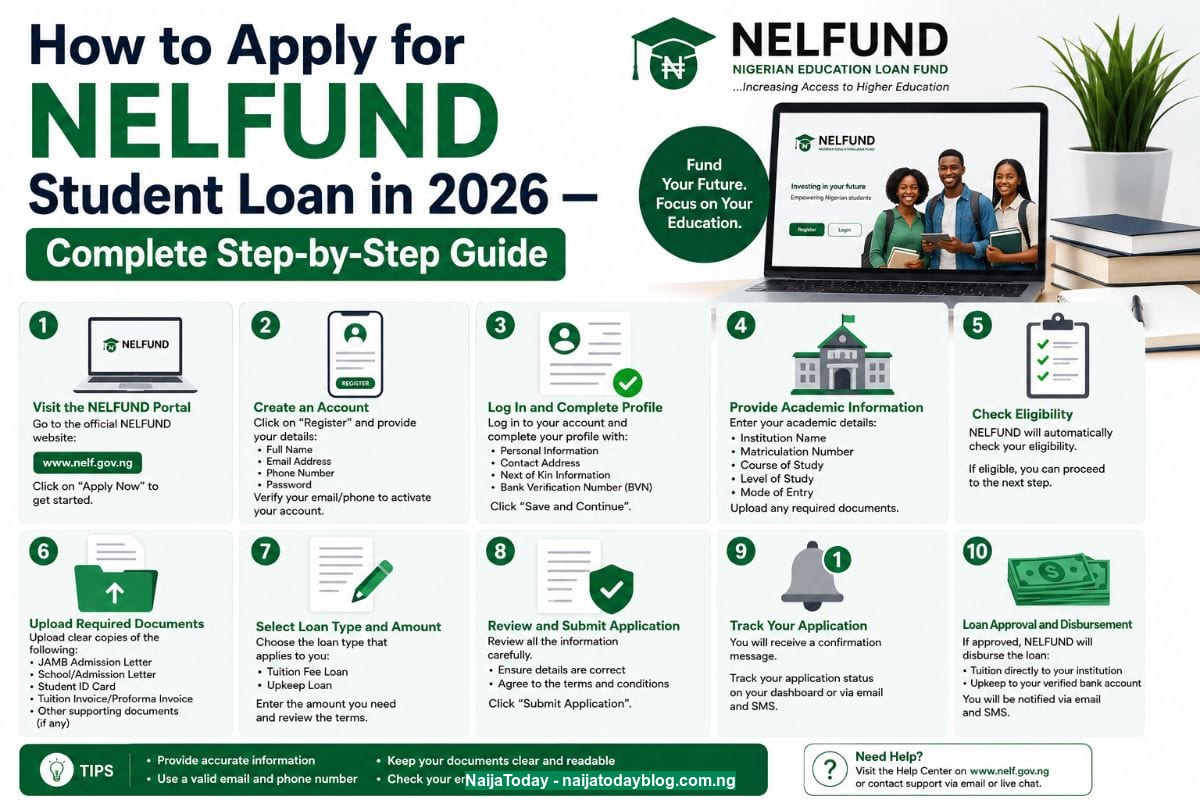
Everything Nigerian students need to know about the NELFUND student loan in 2026 — who qualifies, how to apply on portal.nelf.gov.ng, what documents you need, and when you get paid
#nelfund#student loan nigeria#nelfund 2026#how to apply nelfund#nigerian education loan fund#free student loan nigeria#nelf.gov.ng#jamb student loan#education loan nigeria#nelfund portal
How does this story make you feel?
No account or sign-in needed. You can react instantly.
Share:
NaijaToday Desk
The NaijaToday newsroom
More Stories to Explore
More reporting selected from NaijaToday, based on topics and categories.