At some point in
the last 24 hours, your electricity went out.🤔
If you are reading this in Lagos, Abuja, Kano, Port Harcourt, Enugu, or
virtually any other city in Nigeria, that statement is almost certainly true.
The only variable is how long the outage lasted, how many times it happened,
and what it cost you — in generator fuel, in spoiled food, in work interrupted,
in the particular low-grade exhaustion that comes from living in a country that
cannot reliably keep the lights on.
Nigeria has been having this conversation for decades. Every administration
since independence has promised to fix electricity. Every administration has
failed. The country that sits atop some of the world's largest natural gas
reserves — gas that could, if properly harnessed, generate electricity for the
entire continent — cannot reliably power its own homes.
This is not an accident. It is the accumulated result of specific decisions,
specific failures, and specific interests that have profited from the
dysfunction.
The Numbers That Should Shame Us🤔
Let us start with the facts, because the facts are extraordinary in what they
reveal.
Nigeria has an installed electricity generation capacity of approximately
13,000 megawatts. On a good day — and good days are rare — the national grid
delivers between 3,500 and 5,000 megawatts to consumers. That is less than 40
percent of installed capacity, on the best days.
South Africa, with a population roughly one-sixth of Nigeria's, generates over
40,000 megawatts. Egypt generates over 50,000 megawatts. Ghana — a country of
33 million people compared to Nigeria's 220 million — has achieved a level of
electricity reliability that Nigerian businesspeople openly envy.
The gap between Nigeria's installed capacity and its actual generation is
explained by a cascade of failures: gas supply constraints that mean power
plants sit idle because they cannot get fuel; transmission infrastructure so
old and poorly maintained that it cannot carry power from where it is generated
to where it is needed; distribution networks characterised by commercial
losses, technical losses, and the theft of electricity on a scale that would be
difficult to believe if the evidence were not so well-documented.
And at the base of all of this: decades of chronic underinvestment, compounded
by subsidy policies that kept electricity prices so low that the companies
responsible for generating, transmitting, and distributing it could not recover
their costs, let alone invest in expansion or maintenance.
The Privatisation That Did Not Work😀
In 2013, the Nigerian government privatised the electricity sector. The Power
Holding Company of Nigeria (PHCN) — the state monopoly that had delivered
consistently inadequate power for decades — was broken up and its components
sold to private investors.
The theory was sound. Private ownership would bring accountability, capital,
and the profit motive to an industry that government had shown it could not
manage. Competition, or at least private-sector discipline, would replace the
complacency of a state monopoly.
The practice has been disappointing.
The distribution companies (DisCos) that purchased PHCN's retail operations did
not, in most cases, bring the capital or the management quality that the sector
needed. Many were undercapitalised from the start. The electricity tariffs that
were supposed to make the sector financially viable were politically sensitive
— successive governments were reluctant to allow tariff increases that
reflected the actual cost of power — so the distribution companies operated
with revenues that did not cover their costs.
The generation companies (GenCos) faced their own challenges: insufficient gas
supply, ageing infrastructure, and the difficulty of collecting payment from
distribution companies that were themselves struggling to collect from
customers.
The transmission company remained in government hands — a single point of
failure in a system that needed redundancy — and continued to be managed with
the institutional effectiveness of a government agency rather than a
commercially driven enterprise.
The result is a sector that is neither properly public nor properly private:
one that lacks the accountability of genuine market competition and the
investment capacity of a well-funded state enterprise, while combining the
weaknesses of both.
Gas: The Cruelest Irony
Nigeria has an estimated 209 trillion cubic feet of proven natural gas reserves
— the largest in Africa and among the largest in the world. This is enough gas
to power Nigeria's electricity sector for generations.
Yet power plants across the country sit idle because they cannot get gas.
The reason is not physical scarcity. The gas is there, in the ground, in the
Niger Delta. The reason is infrastructure and commercial dysfunction: gas
pipelines that have been vandalised or are poorly maintained, gas pricing
arrangements that make it commercially unattractive for gas producers to supply
the domestic power market, and a web of contractual and regulatory failures
that have made domestic gas supply for power generation chronically
unreliable.
Nigeria exports liquefied natural gas to Europe and Asia while its own power
plants starve for fuel. This is, in every meaningful sense of the word, an
absurdity. It is also a policy choice — the result of arrangements that
prioritise export revenues over domestic energy security, and that have been
maintained by interests powerful enough to resist reform.
The Tinubu administration has made gas-to-power a stated priority. There have
been initiatives, announcements, and frameworks. Whether these will translate
into the actual, sustained gas supply that power plants need to run at capacity
remains to be seen. The history of such announcements in Nigeria is not
encouraging.
What Load Shedding Actually Costs
The conversation about Nigeria's electricity crisis is often conducted in
megawatts and generation capacity and tariff structures. These are important.
But they can obscure the human and economic reality of what load shedding
actually costs.
For a small business owner in Onitsha, a generator running 12 hours a day costs
approximately ₦15,000 to ₦20,000 per week in diesel — money that, in a properly
functioning electricity system, could be invested in stock, equipment, or
additional staff.
For a medical facility in Owerri, unreliable power means unreliable
refrigeration for vaccines, unreliable lighting in operating theatres, and
unreliable equipment for diagnostic procedures. People die because of Nigeria's
electricity crisis. Not dramatically, not in ways that make headlines, but
consistently and preventably.
For a student in Ibadan studying for examinations, load shedding means studying
by candlelight or phone torch, or paying for generator fuel that the family can
barely afford. The educational disadvantage compounds over years.
For a factory in Apapa, electricity costs are among the most significant
operating expenses — costs that make Nigerian manufactured goods less
competitive than imports from countries with reliable, affordable power.
De-industrialisation in Nigeria is partly a story about infrastructure
failure.
The aggregate economic cost of Nigeria's electricity deficit has been estimated
at hundreds of billions of naira annually — a drag on GDP growth that
represents the single largest infrastructure constraint on the Nigerian
economy. Every percentage point of economic growth that Nigeria fails to
achieve because of power unreliability is millions of people who do not move
out of poverty, who do not access opportunity, who do not build the futures
they could build in a country that worked.
---
The Renewable Energy Opportunity
Nigeria receives an average of 5.5 to 6.5 peak sun hours per day across most of
the country — exceptional solar resource by global standards. Wind resources,
particularly in the north, are significant. Hydroelectric potential, while
limited by environmental constraints, remains underutilised.
The global cost of solar photovoltaic panels has fallen by more than 90 percent
over the past decade. Battery storage technology is improving rapidly and
falling in cost. The economic case for distributed renewable energy — solar
panels and battery storage at the household, community, or commercial level —
has never been stronger.
And Nigerians are responding. The market for rooftop solar, solar home systems,
and mini-grids is growing rapidly, driven by entrepreneurs and investors who
see the gap in the market and the willingness of Nigerians to pay for reliable
power even when they cannot afford the grid tariff.
Companies like Lumos, Arnergy, Auxano Solar, and a growing ecosystem of smaller
installers are building a distributed energy market that bypasses the broken
grid entirely. Off-grid solar systems now power homes and businesses in
communities that have never had reliable grid electricity.
This is encouraging. It is also, in an important sense, a market solution to a
market failure — one that reaches those who can afford the upfront costs of
solar installation while leaving those who cannot, disproportionately the
poorest Nigerians, still dependent on the broken grid.
The federal and state governments need to create the policy environment —
feed-in tariffs, import duty exemptions for solar equipment, concessional
financing for low-income solar adoption — that can extend the benefits of
renewable energy to all Nigerians, not just those who can afford to pay market
rates for off-grid solutions.
What Must Change
The power sector crisis will not be solved by a single intervention or a single
administration. It requires sustained, consistent policy action across multiple
areas simultaneously:
Genuine gas supply reform, with commercial arrangements that make it attractive
for gas producers to supply the domestic power market at the volumes needed.
Without gas, the generating plants are expensive sculptures.
Tariff reform that reflects the actual cost of power while protecting the
poorest consumers through targeted subsidies — rather than the current system
of blanket low tariffs that are fiscally unsustainable and benefit the wealthy
disproportionately.
Transmission infrastructure investment, upgrading the single-buyer model and
the ageing transmission network to a system capable of carrying the power that
generation capacity can produce.
Distribution company accountability, with clear performance targets,
independent regulation with genuine enforcement powers, and consequences for
distribution companies that consistently fail to meet their obligations.
Renewable energy scaling, with a policy framework that accelerates off-grid and
embedded generation while working toward a future grid that can integrate
large-scale renewable generation.
None of this is technically complicated. The solutions are known. They have
been recommended by experts, documented in reports, and incorporated into
government plans — plans that have then failed to be implemented with the
consistency and political will required.
The question is not what to do. It is whether Nigeria's political system can
generate the sustained commitment to do it.
Final Word
Every Nigerian deserves electricity. Not as a luxury. Not as a privilege
reserved for those who can afford generators and solar panels. As a basic
condition of modern life, of economic participation, of human dignity.
The fact that this statement still needs to be made — 65 years after
independence, in Africa's largest economy, in a country with enormous natural
resources — is one of the most damning indictments of Nigerian governance that
exists.
Fixing the power sector will not be easy. It will require political courage,
sustained investment, and the willingness to make decisions that some powerful
interests will resist.
But the alternative — another generation of Nigerians studying by candlelight,
running businesses on diesel, and watching their country's economic potential
dissolve in the noise of generators — is not acceptable.
It never was.
NaijaToday covers the issues that shape Nigerian lives.*
📍
naijatodayblog.com.ng*
🔥 Viral🔥 HOT
Why Nigeria Still Has No Light: The Truth About the Power Crisis Nobody Wants to Tell You
By NaijaToday Investigative Desk | June 21, 2026 · 22 June 2026 · 7 min · 👁 6
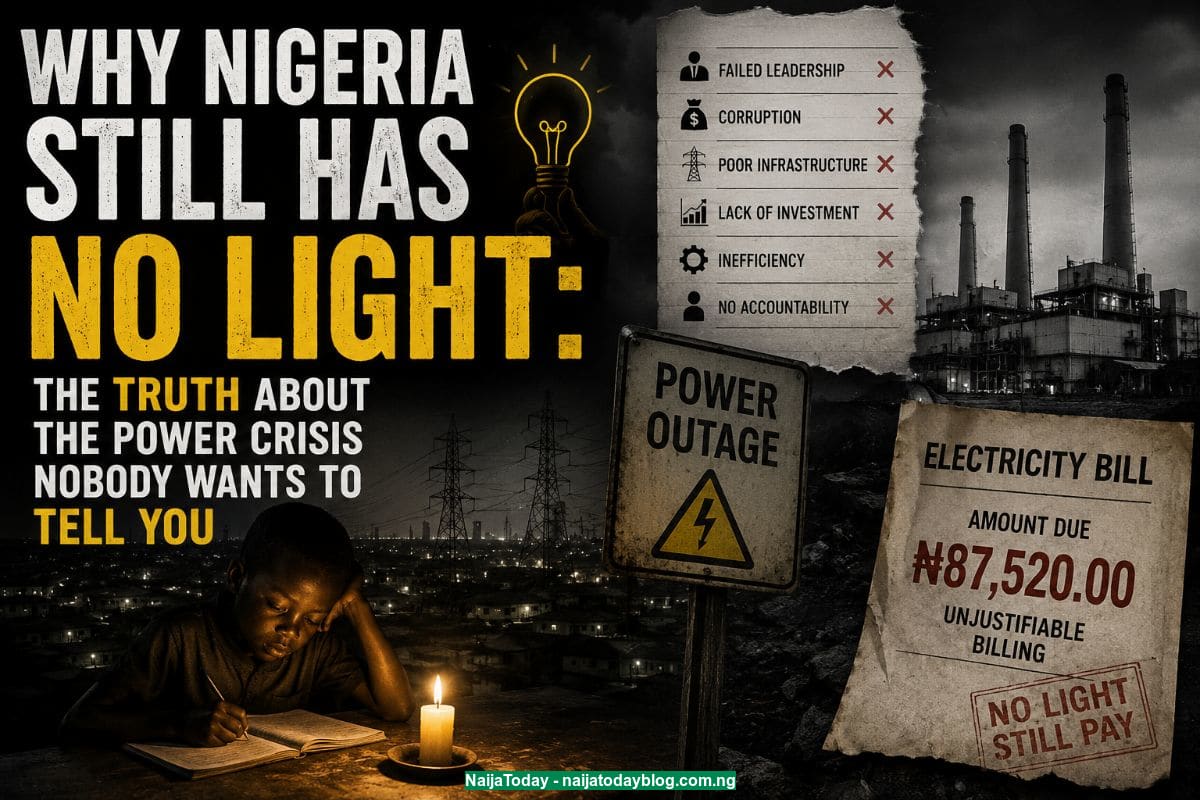
If you are reading this in Lagos, Abuja, Kano, Port Harcourt, Enugu, or virtually any other city in Nigeria, that statement is almost certainly true. The only variable is how long the outage lasted, how many times it happened, and what it cost you — in generator fuel, in spoiled food, in work interrupted, in the particular low-grade exhaustion that comes from living in a country that cannot reliably keep the lights on.
How does this story make you feel?
No account or sign-in needed. You can react instantly.
Share:
More Stories to Explore
More reporting selected from NaijaToday, based on topics and categories.