Dangote Refinery's Promise: Has It Really Lowered Pump Prices?
Category: Business | Author: NaijaToday Desk | Published: Sat Jul 18 2026
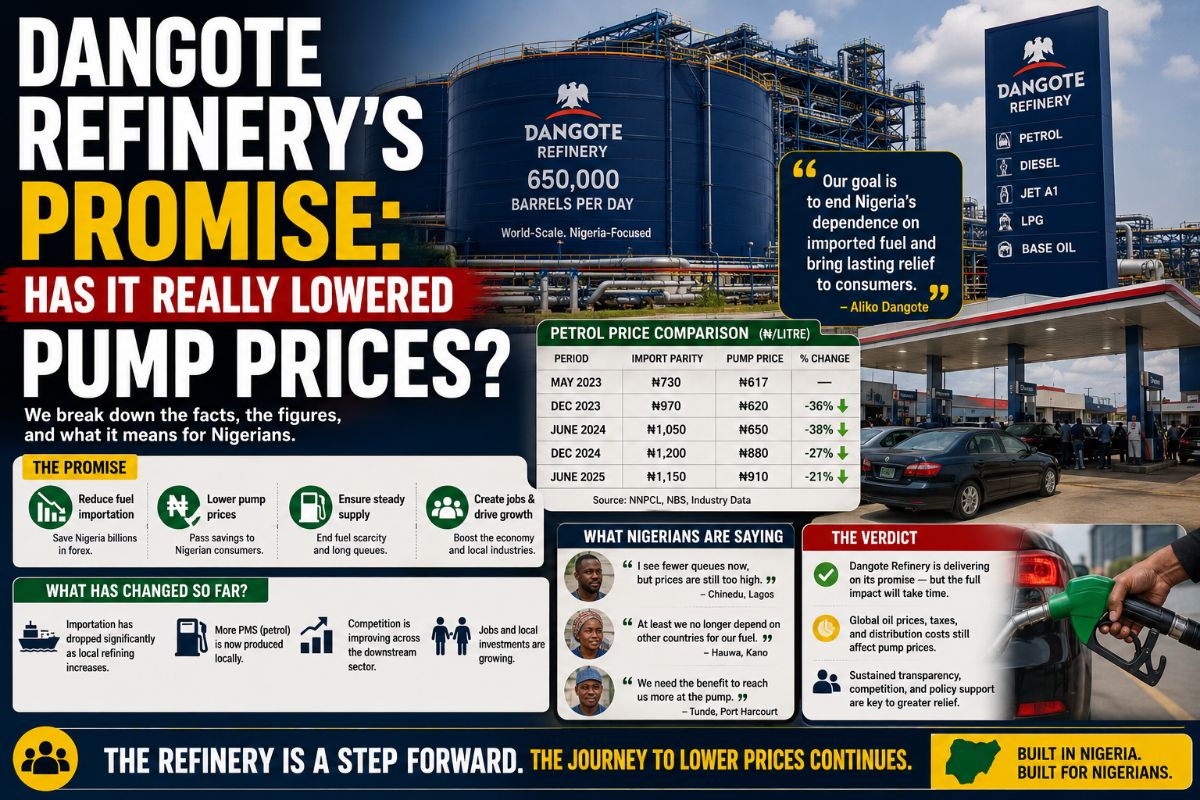
An honest assessment of how much the Dangote Refinery has actually brought petrol prices down, and where its impact still falls short. Category: Energy & Industry
When the Dangote Refinery began ramping up petrol production, it arrived wrapped in a promise that mattered enormously to a country still reeling from the 2023 removal of fuel subsidies: that local refining, at scale, would finally break Nigeria's decades-long dependence on imported petroleum products and, with it, ease the price pressure that had pushed petrol from roughly ₦185 per litre to well over ₦500 almost overnight when the subsidy came off. Three years into that transition, with a fresh price hike sweeping through the market in mid-July 2026, the honest answer to whether that promise has been kept is: partially, unevenly, and not yet enough to insulate Nigerians from the shocks that keep arriving from the import-dependent side of the market. The Case for Progress The clearest evidence of the refinery's effect shows up at the pump in Lagos and its surrounding states. As of early July 2026, stations supplied directly under the refinery's pricing were selling petrol at approximately ₦1,075 per litre, a figure that recent reductions in the refinery's ex-depot price had helped bring down, compared to ₦1,100 to ₦1,400 at many independent stations relying on imported cargoes. That gap — sometimes ₦200 or more per litre — represents real, measurable savings for motorists who know which stations draw from Dangote supply, and it has visibly reshaped competitive dynamics among marketers in the South-West, several of whom have had to adjust their own pricing downward to remain competitive with refinery-linked stations nearby. This dynamic reflects exactly what the refinery's backers argued it would deliver: a domestic supply source large enough to put competitive pressure on import-dependent pricing, gradually pulling the broader market toward lower numbers as more stations gain access to Dangote-refined product rather than relying on the more expensive, exchange-rate-sensitive alternative of shipping in refined fuel from abroad. Where the Promise Runs Into Reality But the mid-July price hike is a reminder of how much of the Nigerian fuel market still sits outside the refinery's direct reach. The increase that pushed depot prices from ₦1,230 to ₦1,350 per litre, with pump prices expected to follow toward ₦1,380 to ₦1,400, was driven by importers responding to the rising cost of imported fuel cargoes — a cost structure entirely separate from the Dangote Refinery's domestic production economics. In other words, even as the refinery's own gantry price held steady or fell, a large share of the market moved upward anyway, because import-dependent marketers still supply a substantial portion of the country's fuel, particularly outside the refinery's strongest distribution radius around Lagos. This split market — one segment tracking the refinery's increasingly competitive domestic pricing, another still tethered to the naira's exchange rate and global crude costs through imports — means the refinery's benefits have not yet reached every Nigerian motorist