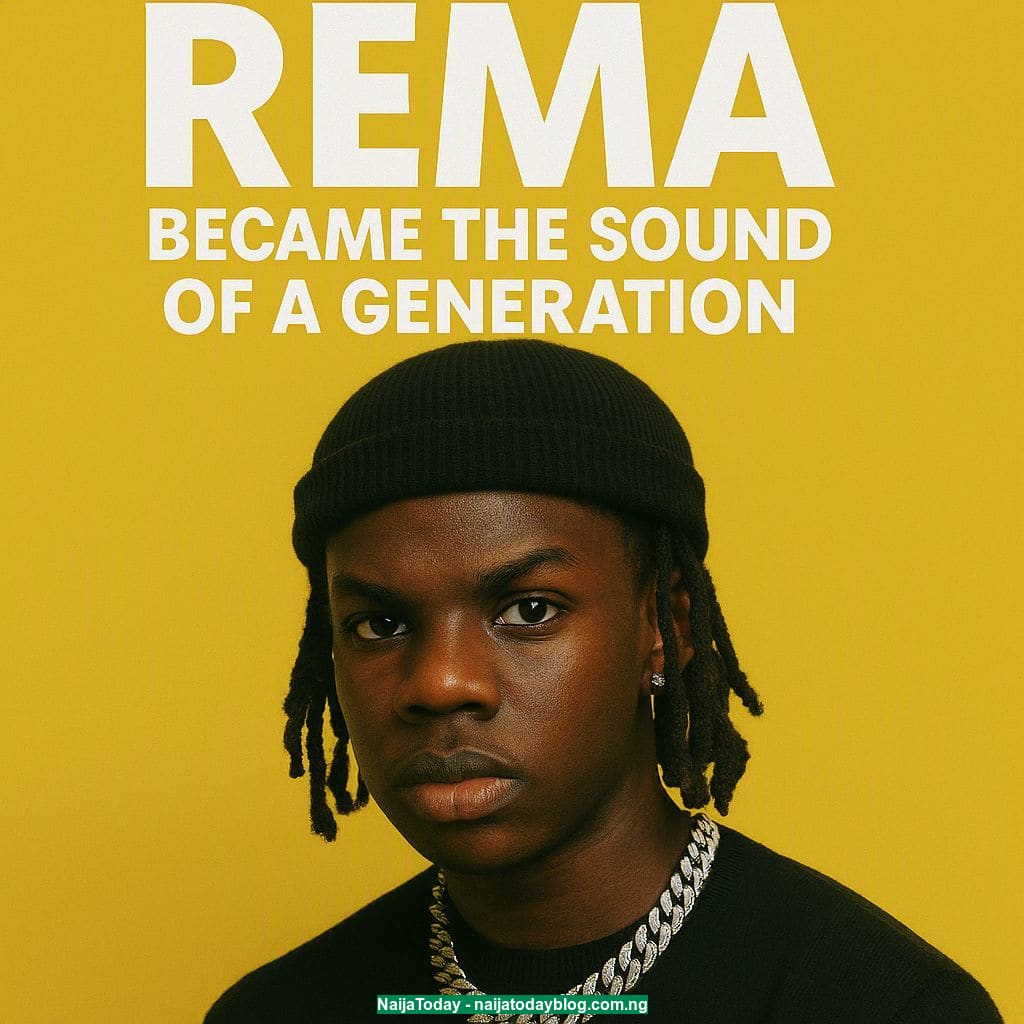
When the
organisers of the 2026 FIFA World Cup opening ceremony sat down to decide which
artist would represent the sound of the modern world to a global television
audience of over a billion people, they chose a young man from Benin City, Edo
State, Nigeria.
His name is Divine Ikubor. The world knows him as Rema.
That choice — Rema as a headline performer at the opening ceremony of the
biggest sporting event on the planet — is not just a music industry story. It
is a statement about where Nigerian music has arrived, and what it now means in
the global cultural conversation.
The Journey From GRA, Benin City
Rema's origin story has been told many times, but it bears retelling in this
context because it illuminates something important about the generation of
Nigerian artists who are now remaking global pop music.
Born in 1999, Divine Ikubor grew up in Government Reserved Area, Benin City — a
city with a rich cultural heritage and a music scene that has produced multiple
generations of Nigerian artists. He lost his father when he was nine years old.
He was raised by his mother and grandmother in circumstances that were not
easy. He was discovered after posting music on Instagram, signing with Jonzing
World — a record label founded by D'Prince, the brother of Don Jazzy — and then
with Mavin Records, one of Nigeria's most storied music houses.
His debut EP arrived in 2019 when he was 19 years old. It announced a
distinctive voice: melodic, unhurried, built on Afrobeats foundations but
reaching toward something more expansive — incorporating elements of Afropop,
R&B, and what he has described as "Afrorave," a genre he has
largely defined himself.
The international breakthrough came in stages. Critical acclaim in 2019 and
2020. A growing streaming presence. Then, in 2022, "Calm Down" — a
song that started as a straightforward Afrobeats track and became, after a
remix featuring American pop star Selena Gomez, one of the most-streamed songs
in the world. It spent over a year on the Billboard Hot 100. It introduced Rema
to audiences in the United States, Latin America, Europe, and Southeast Asia
who had never heard of him before.
By 2023 and 2024, Rema was no longer a rising star. He was a star. His debut
album "Rave & Roses" had cemented his artistic identity. His
tours sold out internationally. His name appeared alongside the established
giants of the Afrobeats generation — Wizkid, Burna Boy, Davido — while
representing something distinctly his own.
And now, in June 2026, he will stand on the opening ceremony stage of the World
Cup and perform for the entire world.
What the World Cup Moment Means
Let us be honest about what a World Cup opening ceremony performance means in
the hierarchy of global cultural moments.
This is not a festival slot. This is not a streaming milestone. This is not a
music award. The World Cup opening ceremony is one of the most-watched
television events on the planet — a broadcast that reaches audiences in every
country, in every time zone, across every demographic. The artists chosen to
perform carry a message: this is what contemporary global music sounds like.
When Michael Jackson performed at the Super Bowl. When Shakira and Jennifer
Lopez performed at another. When Beyoncé has headlined major international
ceremonies. These were not just performances. They were cultural statements
about where the centre of popular music was located.
Rema's selection places Nigerian music — Afrobeats, Afropop, and the new sonic
vocabularies that young Nigerian artists are creating — at the absolute centre
of that global conversation.
It is worth remembering how recently this would have been unimaginable. Twenty
years ago, Nigerian popular music was largely confined to the domestic market
and the diaspora. Fifteen years ago, it was breaking into continental African
audiences. Ten years ago, D'banj was a novelty at British festivals. Five years
ago, Wizkid and Burna Boy were beginning to headline arenas.
Now, Rema is opening the World Cup.
The speed of this ascent is extraordinary. And it did not happen by
accident.
The Infrastructure Behind the Sound
Nigerian music's global rise has required more than talent — though talent has
never been in short supply. It has required infrastructure: record labels that
could develop artists professionally, streaming platforms that opened
international markets without the old gatekeepers, social media that allowed
Nigerian sounds to travel without the permission of Western radio programmers,
and a generation of producers and songwriters who understood both their own
musical heritage and the global pop landscape.
Don Jazzy and Mavin Records deserve enormous credit for creating an artist
development model that produced not just one international star but multiple —
Tiwa Savage, Korede Bello, Ayra Starr, Rema himself. The label's approach —
patient, artist-focused, willing to invest in developing distinctive sounds
rather than chasing immediate commercial formulas — has been vindicated
repeatedly.
The streaming era has been transformative. When Spotify, Apple Music, and
YouTube became genuinely global platforms, Nigerian music suddenly had
distribution into every market on earth without needing a Western record
label's approval or a Western radio station's playlist. "Calm Down"
became a global hit in part because of algorithmic recommendation and playlist
culture — mechanisms that do not care where you are from, only whether the
music is compelling.
And the music is compelling. That is the foundation of everything else. The
technical execution, the commercial strategy, the platform relationships — none
of it matters if the music does not connect. Rema's music connects because it
is genuinely great: melodically inventive, rhythmically sophisticated,
emotionally honest, and possessed of a distinctive personality that comes
through in every track.
Davido's Pause and What It Tells Us
Rema is not the only Nigerian music story of this moment. Afrobeats superstar
Davido recently announced a temporary break from music — suspending
performances and public appearances for 60 days to focus on political
mobilisation in Osun State.
The decision was widely discussed in Nigerian entertainment and political
circles. Davido — whose full name is David Adedeji Adeleke and whose family has
deep roots in Osun State politics — has always been candid about his awareness
of the relationship between music, wealth, and political responsibility.
Whether or not one agrees with the specific choice, the decision illuminates
something important about the position that Nigerian music's biggest stars now
occupy. They are not just entertainers. They are public figures with platforms,
resources, and influence that carry responsibilities — responsibilities that
many of them are wrestling with openly and seriously.
The generation that built Nigerian music's global profile is now asking what
that profile obligates them to do at home.
The Numbers Behind the Culture
The global rise of Nigerian music is not just a cultural story. It is an
economic one.
According to the IFPI's Global Music Report 2026, recorded music revenues in
Sub-Saharan Africa grew 15.2 percent in 2025, reaching $120 million. That
growth is driven substantially by Nigerian artists and the Afrobeats genre more
broadly.
Those numbers, while significant, understate the true economic impact.
Streaming revenues do not capture concert ticket sales, merchandise, brand
partnerships, licensing fees, or the economic activity generated when Nigerian
artists tour internationally. Rema's world tours, Wizkid's stadium shows, Burna
Boy's international arena dates — each of these generates revenue not just for
the artists but for Nigerian producers, managers, stylists, security teams, and
a whole ecosystem of support.
Nigerian music has become one of the country's most significant cultural
exports — and arguably its most globally visible one. This is an asset that the
Nigerian government has largely failed to leverage strategically, even as
individual artists and labels have built it almost entirely through private initiative.
What Comes After Rema's World Cup Moment?
The World Cup performance will introduce Rema to audiences who have not yet
found him. Some of them will become fans. His streaming numbers will surge. His
name will appear in international publications that have not previously covered
him. Booking requests will come from markets he has not yet fully
penetrated.
But the more important question is what the Nigerian music industry does with
this moment collectively.
The opening ceremony slot is not just Rema's. It is a signal to the entire
global music industry about where the next decade of popular music is coming
from. The right response is not just to celebrate — though celebration is
absolutely warranted — but to build on it: more artist development, more
international touring infrastructure, more investment in production talent,
more strategic engagement with the global streaming and licensing ecosystem.
Nigeria has a generational opportunity to establish itself as one of the
defining centres of global popular music for the next decade. The talent is
there. The fan base is there. The momentum is there.
Whether the infrastructure — financial, institutional, and governmental —
matches that opportunity is the question that the next few years will
answer.
Final Word
Rema will stand on the World Cup stage and perform for the world. He will carry
Benin City with him, and Lagos, and the years of work, the grief of losing his
father too young, the grinding uncertainty of a music career before the
breakthrough, and all of it.
He will carry Nigeria.
And for the minutes he is on that stage, every Nigerian watching — wherever in
the world they are — will feel the particular pride that comes when someone
from home shows the world what home is capable of.
That feeling matters. It is not politics, and it is not economics, and it will
not pay anyone's electricity bill.
But it matters. And right now, at this complicated moment in Nigeria's history,
it is something.
*NaijaToday covers Nigerian music, entertainment, and culture.*
📍
naijatodayblog.com.ng*