There is a joke
that circulates among long-distance drivers in Nigeria, half bitter and half
resigned: fuel doesn't get more expensive as you drive north, it gets heavier —
heavier with diesel for the trucks that carried it there, heavier with the toll
of bad roads, heavier with every checkpoint that slows a tanker down and adds
another hour to a journey that eats into the margin a marketer can still call
profit.
It is, in its own way, an accurate description of how Nigeria's petrol market
actually works three years after the 2023 removal of the fuel subsidy handed
price-setting over to market forces. Officially, Premium Motor Spirit is a
national commodity, priced by the same crude cost and the same naira exchange
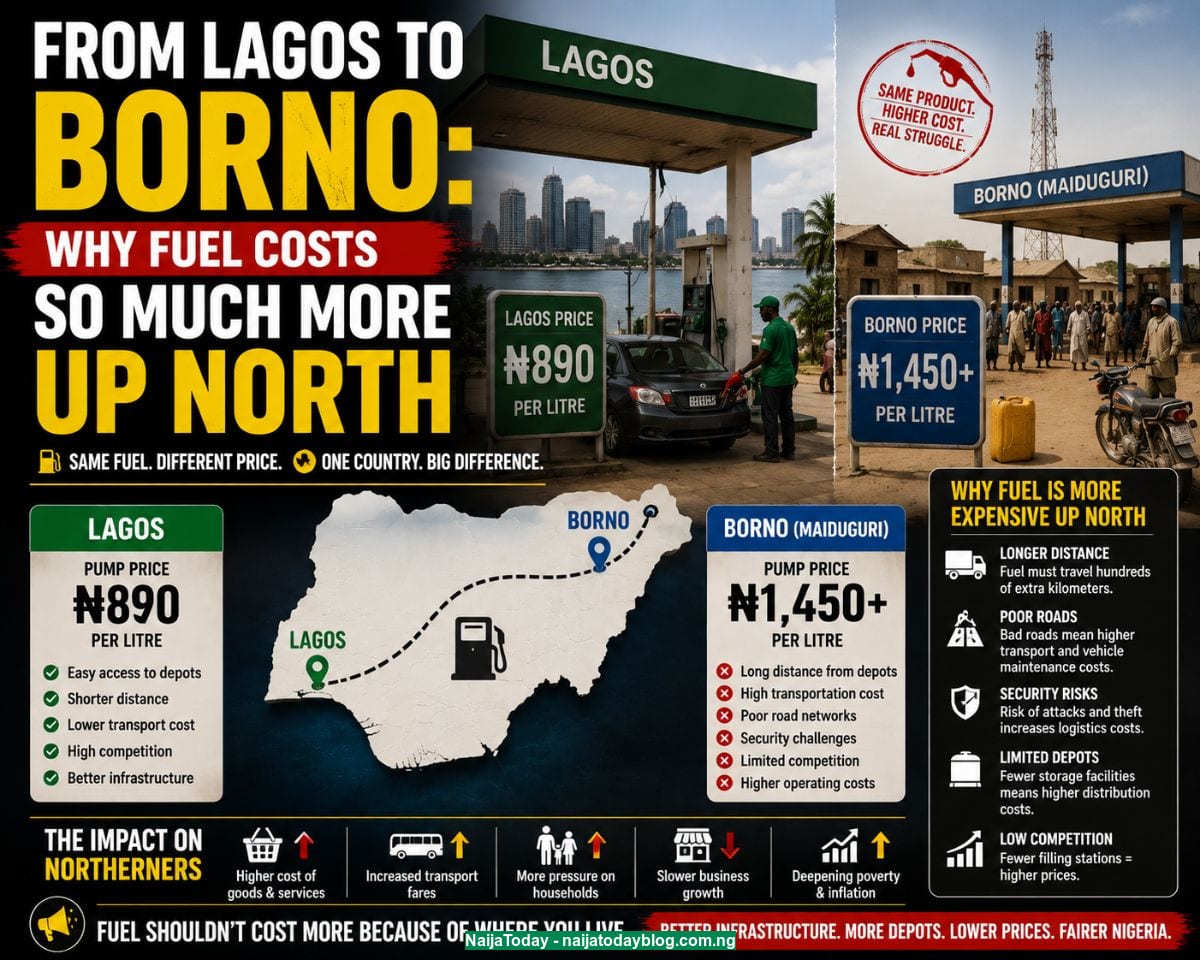
rate wherever you buy it. In practice, a litre of petrol in Lagos and a litre
of petrol in Maiduguri are two very different purchases, separated by a gap
that can run past ₦200 per litre depending on the week.
Why Location Determines Price
The mechanics are straightforward, if easy to forget when you're the one paying
at the pump. Nigeria's major fuel supply points — the Dangote Refinery in
Lekki, the NNPCL depots, and the tank farms clustered around Lagos and the
Niger Delta — sit overwhelmingly in the south. States closer to refineries or
major fuel depots like Lagos, Port Harcourt and Warri tend to have lower
prices, while northern and remote states pay more due to logistics costs, since
every litre sold in Kano or Maiduguri has already traveled hundreds of
kilometers by tanker truck before it reaches a filling station, and every
kilometer adds cost: fuel for the truck itself, driver allowances, tolls, and
the informal costs of navigating a road network where potholes and, in parts of
the Northeast, security concerns can add hours or days to a delivery.
Among the ten states people most often ask about — Lagos, Rivers, Delta, Oyo,
Anambra, Enugu, the FCT, Kano, Kaduna, and Borno — this logistics gradient
plays out almost exactly as the map would predict.
Lagos and Rivers, sitting closest to refining and import infrastructure,
have consistently shown the lowest prices nationally, with Dangote-supplied
stations in particular dipping toward ₦1,075 per litre in early July before the
mid-month hike, and independent marketers in the ₦1,100 to ₦1,200 range.
Delta, home to Warri's refining and depot infrastructure, sits close behind
— cheap enough to benefit from proximity, but with slightly higher prices than
Lagos in areas further from the depot clusters.
Oyo, Anambra, and Enugu occupy the middle of the range. They're far enough
from the major coastal depots that transport costs add a noticeable premium,
but still connected by reasonably functional road networks that keep the gap
from widening too far — typically landing somewhere in the ₦1,150 to ₦1,250
range depending on the specific filling station and week.
Abuja (FCT), despite its status as the capital and its relatively good
infrastructure, still sits a rung above the southern cities, reflecting its
distance from the coastal supply chain even as its road network is better
maintained than most.
Kano and Kaduna, the two biggest hubs in the North-West, absorb the fuller
weight of that transport cost. Prices in these states have often run ₦150 to
₦250 higher than Lagos, driven by both the distance from depots and the sheer
volume of onward distribution — tankers arriving in Kano frequently
redistribute fuel to smaller towns across the wider North-West, adding another
layer of markup before it reaches the final buyer.
Borno, at the far end of the spectrum, illustrates just how much security
and infrastructure challenges compound the basic distance problem. Years of
instability in the Northeast have disrupted road networks and made fuel
transport riskier and more expensive, a dynamic that shows up in consistently
higher pump prices — often the highest of any state in the country, sometimes
₦300 or more above what a Lagos motorist pays for the same product.
A Trader's View From Kano
Ordinary Nigerians living with this gap describe it less in percentages and
more in what it forces them to give up. A generator-repair technician in Kano,
who asked to be identified only by his trade rather than his name, put it
plainly during a conversation about his monthly costs: he spends nearly a third
of his income on fuel for the small van he uses to move between customers'
homes, a burden that has pushed him to raise his callout charges twice in the
past year just to keep pace. "Customer go complain," he said,
"but if I no raise am, na me go dey suffer, because fuel no dey wait for
anybody."
Traders moving goods between regions feel the gap even more acutely, because
they absorb it twice — once on the outbound fuel cost, and again in the higher
price northern buyers are willing to pay once transport costs are baked into
everything from foodstuff to building materials. A trader who regularly moves
tomatoes and onions from the North to Lagos markets described watching her
transport costs rise faster than the prices she could realistically charge
buyers accustomed to a certain range, squeezing her margin from both
directions.
The Bigger Picture
None of this is unique to petrol, and none of it is new. Nigeria's regional
price gaps have existed for as long as its road-dependent, depot-centered
distribution network has existed. What has changed since the 2023 subsidy
removal is the scale of the gap in absolute naira terms. When petrol cost ₦185
per litre, a ₦50 regional difference was noticeable but survivable. When the
baseline is ₦1,100 to ₦1,400, that same proportional gap now represents ₦200,
₦300, sometimes more — money that matters enormously to a household or a small
trader operating on thin margins.
The Dangote Refinery's growing output offers a partial counterweight, gradually
pulling southern prices down as local supply reduces dependence on imported
cargoes. But its geographic advantage, rooted in its Lagos location, means the
refinery's price relief naturally reaches southern and south-western states
first and most strongly, leaving the North-South gap intact for now, even as
the national average shifts.
For the man in Kano fixing generators, the trader moving tomatoes south, or the
family in Maiduguri budgeting for a week's transport, the map isn't an
abstraction — it's the difference between a manageable month and one where
something else has to give. And until Nigeria's refining and distribution
infrastructure spreads more evenly across the country, that gap between Lagos
and Borno, between the coast and the interior, looks set to remain one of the
most consistent features of the nation's fuel market, price hike or no price
hike.
🎭 Entertainment🔥 HOT
From Lagos to Borno: Why Fuel Costs So Much More Up North
By NaijaToday Desk · 18 July 2026 · 6 min · 👁 2
Breaking down why petrol prices differ by hundreds of naira between southern and northern Nigerian states, and what it costs traders and commuters in each region.
#fuel price by state#north-south divide#lagos#borno#kano#kaduna#logistics cost#dangote refinery#regional economy
How does this story make you feel?
No account or sign-in needed. You can react instantly.
Share:
NaijaToday Desk
The NaijaToday newsroom
More Stories to Explore
More reporting selected from NaijaToday, based on topics and categories.