Naira,
Inflation and Survival: How Nigerians Are Actually Coping With the Cost of
Living in 2026
If you want to know how bad things really are in Nigeria, don't ask an
economist. Ask any woman selling pepper and tomatoes at Mile 12 how much a
basket costs her this week compared to last month, or ask a Lagos danfo
conductor why he suddenly increased fare from Ojota to CMS by another hundred
naira "because of fuel." The numbers from the National Bureau of
Statistics will tell you inflation eased slightly and then crept back up again,
month after month, hovering around 15 to 16 percent for most of this year. But
numbers on a government website don't tell you what it actually feels like to
walk into Shoprite with twenty thousand naira and leave with items that fit
into one small nylon bag.
I've spent the last few months talking to friends, family, market women, okada
riders and even a few small business owners here in Lagos, trying to understand
how the ordinary Nigerian is actually surviving this economy. Not the theory of
it, not what the CBN governor says on television, but the actual, lived,
day-to-day hustle of staying afloat when everything costs more than it did last
year, and last year it already cost more than the year before that.
The Numbers Behind the Struggle
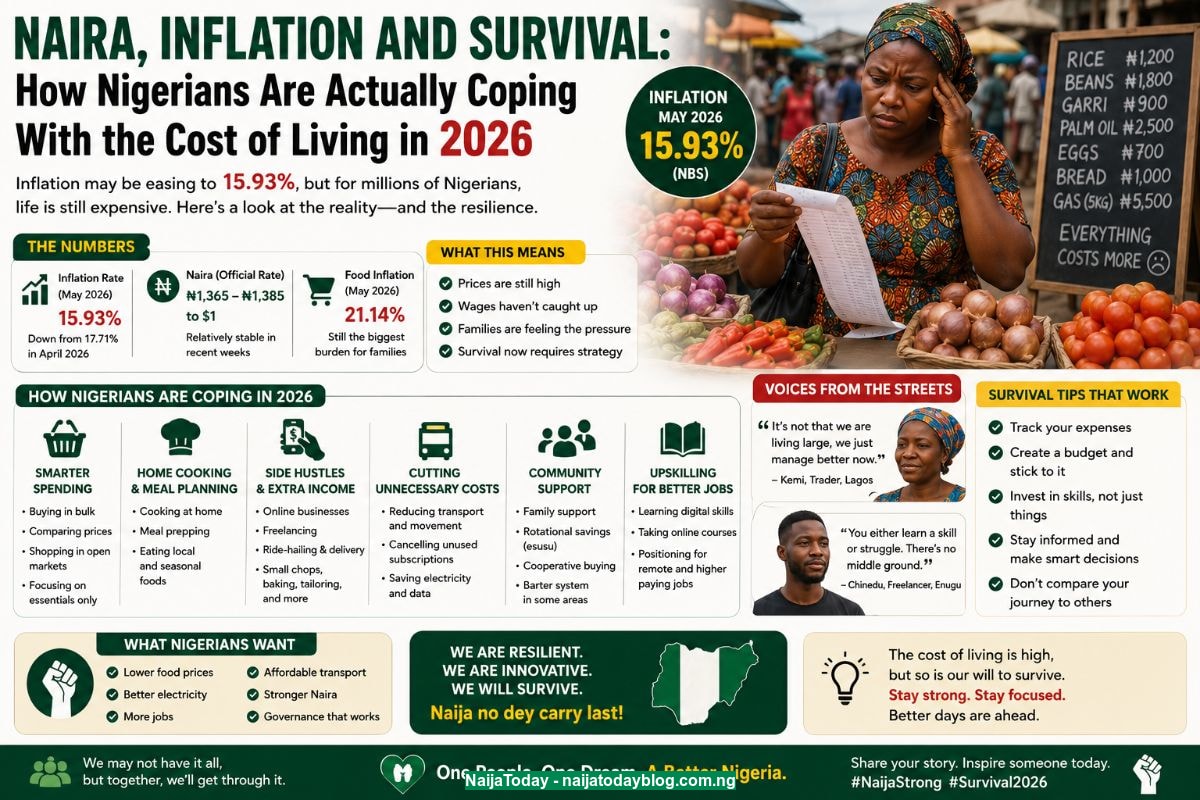
Let's start with what the data says, because context matters. Nigeria's
headline inflation rose to 15.93 percent year-on-year as of May 2026, marking
the third consecutive month of increase, after a period where things had
actually started to ease from the brutal 30-plus percent rates we saw back in
2024. Food inflation alone sat close to 17 percent, which explains why every
trip to the market feels like a small negotiation with your own budget. Core
inflation, the figure that strips out food and energy to show underlying price
pressure, nearly doubled month-on-month in May, which analysts say signals that
price pressure is now spreading well beyond just food and fuel into almost
everything else people buy.
Meanwhile the naira has been doing its usual dance. Official market rates have
hovered around ₦1,370 to the dollar in recent weeks, while the parallel market,
the one most Nigerians actually deal with when sending money abroad or paying
for imported goods, sits a bit higher. It's not the free fall we saw a couple
of years back, and honestly there's been more stability lately than many of us
expected, helped along by rising foreign reserves and steadier oil revenue. But
stability at a high number is still a high number. A dollar that costs over a
thousand naira means anything imported, from spare parts to skincare products
to that phone you've been eyeing, remains expensive by any standard Nigerians
were used to a decade ago.
What People Are Actually Doing About It
Here's where it gets interesting, and honestly, where Nigerian resilience shows
itself in ways that no economic report can fully capture.
Buying in bulk, together. I've noticed more people in my estate forming
informal buying groups, sometimes just three or four neighbours, to purchase
rice, beans, and cooking oil in bulk from wholesalers rather than buying retail
bit by bit. It's not a new idea, cooperative buying has always existed in
Nigerian culture, but it's become far more deliberate now. You split a bag of
rice three ways and each person saves a few thousand naira they wouldn't have
saved buying a paint rubber at a time from the corner shop.
The rise of the "small chops" side hustle economy. Everyone, and
I mean everyone, seems to have something on the side now. The bank teller who
also sells perfume oil on Instagram. The civil servant whose wife bakes
puff-puff and moin-moin for events on weekends. The security guard who does
barbing on his off days. This isn't new to Nigeria, we've always been a nation
of hustlers, but the intensity has changed. What used to be "extra income
for small comfort" has become "the thing keeping the lights
on."
Skipping meals, quietly. This one is harder to talk about, but it's real.
Several people I spoke to admitted, almost sheepishly, that they've cut down
from three meals to two, not as a health choice but as a budget one. Breakfast
has become the casualty in many households, replaced with just tea or nothing
at all, with the first real meal pushed to early afternoon.
Leaning harder on fintech to manage the little they have. This is one of
the more encouraging shifts. Apps like Cowrywise, PiggyVest, and even the
savings features baked into Opay and PalmPay have become genuinely useful tools
for people trying to build small buffers against emergencies. Automated savings
that lock money away before you can spend it on "urgent 2k" transfers
to friends has helped a lot of young Nigerians build a discipline that pure
willpower alone never could.
Second-hand everything. Okrika, or "bend down select" as it's
affectionately called, has expanded well beyond clothes. People are now buying
second-hand phones, second-hand kitchen appliances, even second-hand furniture,
through Facebook Marketplace groups and WhatsApp trading communities specific
to their local government areas. There's no shame in it anymore, if it ever
existed. In fact, spotting a good deal on a fairly-used generator or air fryer
has become something people brag about rather than hide.
Relocating further from the city centre. Rent in Lagos mainland, let alone
the island, has become almost comedic in its unaffordability for the average
earner. I know families who've moved from places like Yaba or Surulere to areas
like Mowe, Arepo, or even further into Ogun State, trading a longer commute for
rent they can actually manage. The trade-off is brutal, sometimes two or three
extra hours a day spent in traffic, but the math works out cheaper.
The Emotional Weight Nobody Talks About Enough
What strikes me most in these conversations isn't the strategies themselves,
it's the exhaustion behind them. There's a particular kind of tiredness that
comes from constantly calculating, constantly adjusting, constantly finding a
new way to stretch what little you have. A friend of mine, a graphic designer
who freelances from home, told me something that stuck with me: "I'm not
broke, I'm just tired of doing math every single day just to survive."
That's the part the inflation figures never capture. The mental load of
budgeting for a family when prices shift under your feet from one week to the
next. The quiet anxiety of watching your salary stay the same while everything
around it moves. It's not just an economic story, it's a psychological one too,
and I think we as Nigerians don't talk about that enough. We're so used to
"managing" that we forget to acknowledge how heavy it actually is.
Small Signs of Light
I don't want to paint this as entirely bleak, because it isn't. There are real,
tangible signs of improvement that shouldn't be dismissed. Food inflation has
actually eased somewhat compared to the extreme levels of 2024, when an item
that cost a hundred naira decades ago would now cost over a million. External
reserves have climbed to their highest level in over a decade, driven by oil
revenue, diaspora remittances and foreign portfolio inflows, which at least
gives the CBN more room to defend the naira and keep things from spiralling the
way they did before. Analysts are cautiously projecting inflation could ease
further toward the second half of the year if exchange rate stability and food
supply conditions hold.
None of that erases the daily struggle, but it does mean the ground isn't
shifting quite as violently as it was two years ago. There's a difference
between a country in freefall and a country that's still hard but at least
somewhat predictable. Right now, we seem to be somewhere in the second
category, which, given where we've been, almost feels like relief.
What This Means Going Forward
If there's one thing I've learned writing about Nigeria's economy for this
platform, it's that Nigerians don't wait for the government to fix things
before they start fixing their own lives. The coping mechanisms I've described
here aren't temporary panic responses, they're becoming permanent features of
how the average household operates. Bulk buying groups, side hustles, automated
fintech savings, second-hand markets, these aren't going anywhere even if
inflation eventually cools to a comfortable single digit, because Nigerians
have learned, painfully, that the ground can shift again at any moment.
My honest advice to anyone reading this and trying to figure out their own next
move: build multiple small income streams rather than relying on one. Use the
fintech tools available to automate savings before the money reaches your hand
to spend. Join or start a bulk-buying arrangement with people you trust. And be
honest with yourself and your family about where you can cut back without
cutting into your dignity or your health. The economy will do what it does,
we've never had full control over that. But how we respond to it, collectively
and individually, that part is still very much in our hands.
We'll keep tracking this story as the numbers shift through the rest of the
year, because if there's one thing that affects every single Nigerian
regardless of tribe, religion, or class, it's the price of garri.
Naira, Inflation and Survival: How Nigerians Are Actually Coping With the Cost of Living in 2026
By NaijaToday Desk · 10 July 2026 · 8 min · 👁 2
If you want to know how bad things really are in Nigeria, don't ask an economist. Ask any woman selling pepper and tomatoes at Mile 12 how much a basket costs her this week compared to last month, or ask a Lagos danfo conductor why he suddenly increased fare from Ojota to CMS by another hundred naira "because of fuel." The numbers from the National Bureau of Statistics will tell you inflation eased slightly and then crept back up again, month after month, hovering around 15 to 16 percent for most of this year. But numbers on a government website don't tell you what it actually feels like to walk into Shoprite with twenty thousand naira and leave with items that fit into one small nylon bag.
How does this story make you feel?
No account or sign-in needed. You can react instantly.
Share:
NaijaToday Desk
The NaijaToday newsroom
More Stories to Explore
More reporting selected from NaijaToday, based on topics and categories.