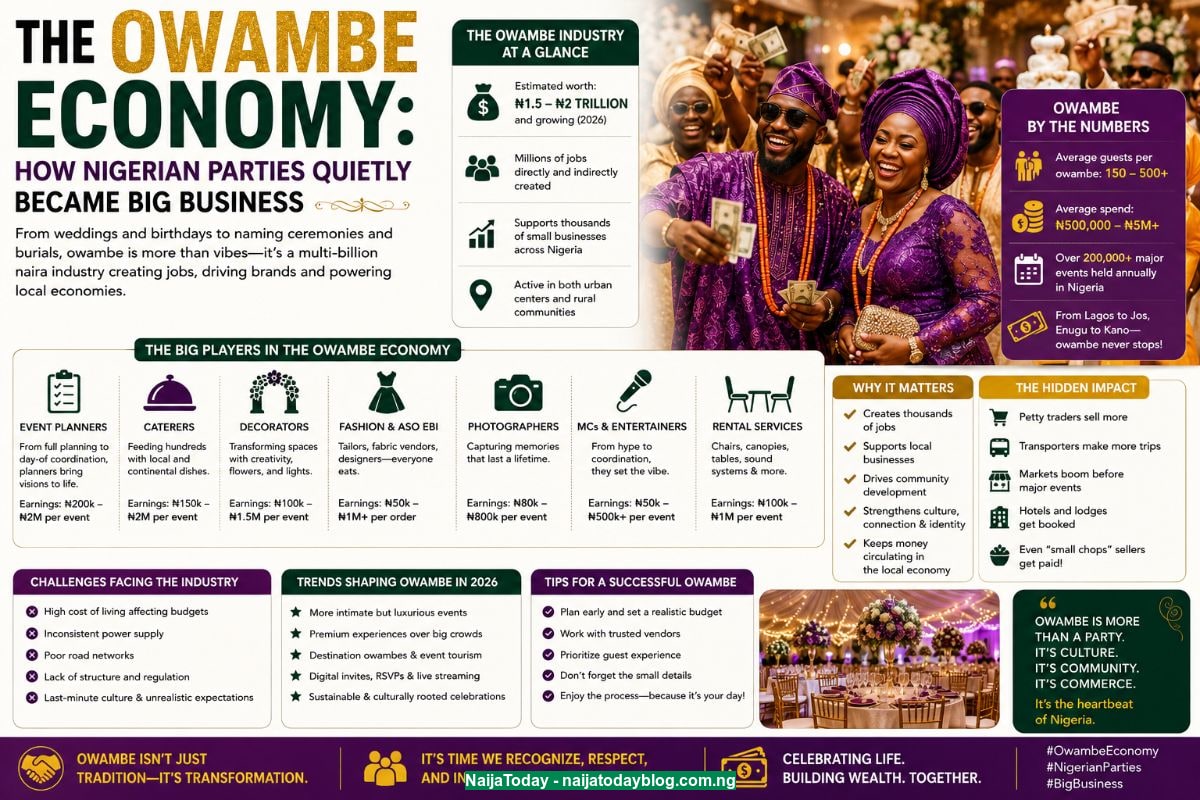
The Owambe
Economy: How Nigerian Parties Quietly Became Big Business
I attended a wedding in Ikeja a few months ago where the aso-ebi alone, the
matching fabric guests are expected to buy and wear, cost more than what some
entry-level graduates earn in a month. There was a live band, a DJ, a separate
MC for the traditional engagement segment and another for the white wedding
reception, a professional photography team with a drone, small chops stationed
at three different corners of the hall, and a "surprise" celebrity
performance that the couple had clearly budgeted for months in advance. By the
time the day ended, I found myself doing quiet mental math and thinking, this
isn't just a party anymore. This is an entire industry.
If you're Nigerian, none of this will surprise you. Owambe culture, the
elaborate, no-expense-spared approach to celebrating weddings, birthdays,
burials, and pretty much any milestone worth marking, has always been part of
who we are. What's changed, and what I think deserves more attention than it
gets, is just how much of a legitimate economic engine this culture has quietly
become, even as everyday Nigerians complain, rightly, about the cost of
living.
Why We Party Like This
To understand the owambe economy, you first have to understand that for many
Nigerians, these events were never just about celebration. They're about
visibility, community, and status, wrapped into one loud, colourful,
unforgettable day. Aso-ebi, the tradition of guests wearing matching fabric to
show solidarity with the celebrant, isn't just fashion, it's a public
declaration of relationship and support. Showing up "correctly
dressed" at a friend's daughter's wedding says something about your
standing in that friendship that words alone don't quite capture.
There's also a deeply communal, almost redistributive logic to it that
outsiders often miss. Money spent on a big wedding doesn't just disappear, it
flows outward, to tailors, caterers, decorators, musicians, photographers,
drivers, and dozens of other small vendors who depend on event season for a
meaningful chunk of their annual income. In a country where formal employment
is scarce and inconsistent, the owambe circuit has become a genuine, if
informal, source of livelihood for an enormous number of skilled and
semi-skilled workers.
The Numbers Behind the Glitter
Nobody tracks "owambe GDP" officially, there's no line item for it in
any national budget, but if you talk to the people working inside this
ecosystem, the scale becomes obvious fast.
Aso-ebi fabric alone has become a multi-million naira micro-economy on its own.
Popular Ankara and lace designs can sell for anywhere from ten thousand to well
over a hundred thousand naira per yard depending on the quality and
exclusivity, and a single wedding can move hundreds of yards when you factor in
the bride's family, groom's family, and close friends all coordinating separate
colours for different segments of the celebration. Multiply that across the
thousands of weddings happening across Nigeria every single weekend during peak
season, typically November through January and again around Easter, and you
start to see numbers that rival small formal industries.
Event planners in Lagos, Abuja and Port Harcourt regularly quote budgets
running into tens of millions of naira for mid-to-large weddings, and that's
before you factor in the increasingly common practice of flying in
international musicians or securing appearances from Nollywood actors and
Afrobeats artists for a segment of the reception. Caterers who specialise in
event food, jollof rice cooked in those massive party-sized pots that have
become an internet meme in their own right, small chops, asun, peppered snail,
can service multiple events in a single weekend during peak season, each one
bringing in fees that, when added up across a busy season, genuinely rival what
many salaried professionals earn in a year.
Photography and videography have gone through a particularly dramatic
transformation. What used to be one photographer with a single camera has
become full production teams with drone operators, cinematic videographers who
deliver same-day highlight reels for Instagram, and editors who turn a single
day's footage into a mini-documentary complete with music licensing and
voiceovers. Some of the more established wedding photography studios in Lagos
now book out entire seasons in advance, and their pricing reflects genuine,
high-end production value.
The People Who Quietly Depend On This Industry
What I find most compelling about the owambe economy isn't the glitzy end of
it, the celebrity appearances or the drone shots. It's the invisible layer of
workers whose entire livelihood is built around event season.
Tailors, particularly the ones known for turning around aso-ebi outfits on
impossibly tight timelines, often work through the night during peak wedding
months. I know a tailor in Surulere who told me she stops taking new orders by
October each year because her books are already full through January.
Decorators who transform bare event halls into elaborate, Pinterest-worthy
setups with flowers, drapery, and lighting have built entire businesses, some
with staff of ten or more, purely off referral within this circuit.
Then there are the "aso-ebi sellers," a particularly interesting
micro-profession that's exploded with the rise of Instagram and WhatsApp
Business. These are individuals, often women, who source fabric in bulk
directly from Asaba, Kano, or increasingly from Dubai and China, and resell
smaller quantities to individual celebrants planning events. It's a business
built almost entirely on trust and referral networks, and for many of the women
running it, it's become a full-time, genuinely profitable enterprise, not a
side hustle.
Even the "gate crashers" and professional attendees, people jokingly
known online as always being present at every owambe regardless of invitation,
point to something real: these events have become genuine social
infrastructure, spaces where business connections form, where new clients meet
vendors, where marriages between families translate into economic partnerships
that outlast the event itself.
The Tension Nobody Fully Resolves
I'd be doing this topic a disservice if I didn't acknowledge the very real
criticism that runs alongside all this celebration. In an economy where
inflation sits close to 16 percent and food prices remain painfully high for
the average household, spending millions of naira on a single day's party
understandably draws criticism, sometimes fierce, particularly online where clips
of extravagant weddings regularly go viral and spark debate about
priorities.
I've heard the arguments on both sides more times than I can count. Some argue
it's irresponsible, even embarrassing, to spend so lavishly while so many
Nigerians struggle to afford three meals a day. Others push back just as
firmly, pointing out that it's not the government's or the internet's business
how a family chooses to spend money they earned, and that the same critics
complaining about extravagance rarely acknowledge how many ordinary workers,
tailors, caterers, drummers, decorators, are being paid directly because that
wedding happened.
Honestly, I don't think this tension resolves neatly, and I'm not sure it needs
to. Both things can be true at once. The owambe economy genuinely sustains
thousands of livelihoods and represents something culturally meaningful about
how Nigerians celebrate community and relationships. And the scale of spending
at the very top end of it can feel, and sometimes is, wildly out of step with
the economic reality most Nigerians are living through.
Where This Is Heading
What's clear to me, watching this space closely, is that owambe culture isn't
shrinking, even in a tough economy. If anything, it's professionalising. Event
planning has become a legitimate, respected career path rather than something
people fall into informally. Vendors increasingly market themselves properly
online, with portfolios, pricing sheets, and client testimonials, treating it
as the serious business it's become rather than a casual side gig.
I've also noticed a quiet shift toward more "intentional" scaling,
some couples choosing smaller, more curated celebrations rather than the
maximum-spectacle approach that dominated the last decade, partly driven by
cost, partly by a generational shift toward wanting experiences that feel
personal rather than performative. But even these "smaller" events,
by international standards, often remain fairly elaborate. The core cultural
instinct to celebrate loudly, generously, and visibly isn't going anywhere.
If you ever find yourself wondering why Nigerians, in the middle of genuine
economic hardship, still find a way to throw parties that would make
international wedding planners blink twice, I'd encourage you to look past the
surface. Underneath the aso-ebi and the jollof and the drone footage is an
entire, self-sustaining economy that quietly employs, feeds, and enriches far
more people than the flashy Instagram posts ever let on. It's chaotic,
occasionally excessive, sometimes genuinely questionable in its priorities, but
undeniably, unmistakably, one of the most resilient informal industries we
have.
The Digital Layer Reshaping It All
One thing I haven't touched on yet, and honestly think deserves its own
conversation entirely, is how social media has fundamentally rewired how this
whole ecosystem operates. A decade ago, an event planner's reputation travelled
through word of mouth alone, through aunties comparing notes at church or
mosque, through the slow, trust-based referral chains that Nigerian social life
has always run on. Today, a single viral TikTok clip of a beautifully executed
traditional wedding can bring a decorator or planner more bookings in a week
than an entire year of word-of-mouth referrals used to.
This has created a new class of "content-first" vendors,
photographers and videographers in particular, who now build their entire
client pipeline through Instagram Reels and TikTok highlight edits rather than
direct referrals. It's changed the aesthetic of these events too. Couples
increasingly plan segments of their wedding specifically with the camera in
mind, the "grand entrance" dance choreography, the synchronized
aso-ebi reveal, the slow-motion first dance shot, because they know these moments
are the ones that will circulate online long after the actual guests have gone
home. Some cynics call this performative. I'd argue it's just the latest
evolution of a culture that has always understood the power of spectacle and
shared celebration, now simply extended to a digital audience beyond the hall
itself.
There's also a quieter, more practical digital shift happening underneath the
glamorous surface: payment. Vendors who once insisted on cash deposits, partly
out of habit and partly out of necessity, now routinely accept transfers and
even offer instalment arrangements through fintech apps, making it easier for
couples to spread costs across months rather than needing one enormous lump sum
upfront. Aso-ebi sellers run entire operations through WhatsApp Business
catalogues and Instagram Shops, taking pre-orders for fabric months before an
event date, which has made the whole supply chain considerably more efficient
than the informal, in-person haggling that used to dominate this space.
Taken together, these shifts suggest the owambe economy isn't just surviving
Nigeria's tough economic climate, it's actively adapting to it, becoming
leaner, more digitally efficient, and more accessible to vendors who might
never have had the capital or connections to break into this space through the
old, purely relationship-based system. That, to me, is the most encouraging
part of the whole story, not the extravagance at the very top, but the quiet
resilience and innovation happening at every level beneath it.
🎭 Entertainment🔥 HOT
The Owambe Economy: How Nigerian Parties Quietly Became Big Business
By NaijaToday Desk · 10 July 2026 · 10 min · 👁 7
I attended a wedding in Ikeja a few months ago where the aso-ebi alone, the matching fabric guests are expected to buy and wear, cost more than what some entry-level graduates earn in a month. There was a live band, a DJ, a separate MC for the traditional engagement segment and another for the white wedding reception, a professional photography team with a drone, small chops stationed at three different corners of the hall, and a "surprise" celebrity performance that the couple had clearly budgeted for months in advance. By the time the day ended, I found myself doing quiet mental math and thinking, this isn't just a party anymore.
How does this story make you feel?
No account or sign-in needed. You can react instantly.
Share:
NaijaToday Desk
The NaijaToday newsroom
More Stories to Explore
More reporting selected from NaijaToday, based on topics and categories.