Highest Paying Jobs in Nigeria 2026: Real Salary Ranges by Sector
Category: Jobs | Author: NaijaToday Desk | Published: Wed Jul 15 2026
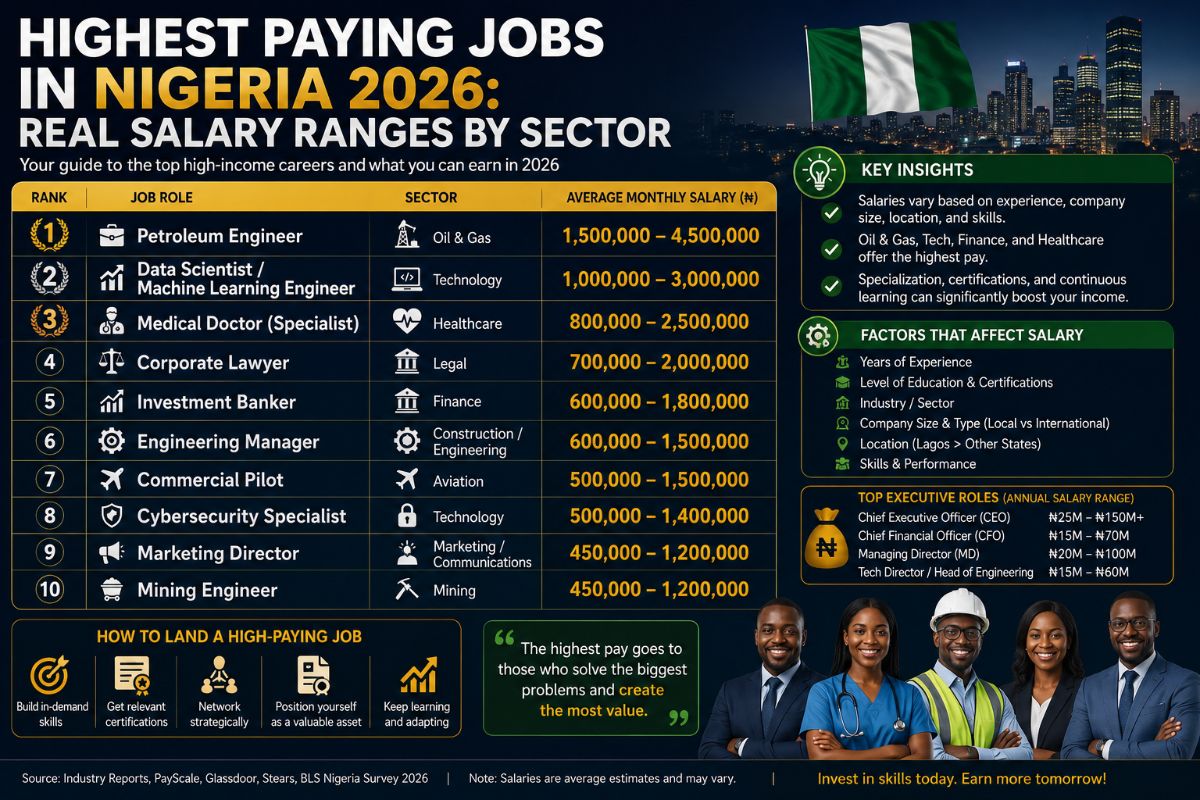
Choosing a career path in Nigeria based on genuine earning potential — rather than assumption or outdated advice — can be the difference between financial stability and years of underpayment relative to your skill. This guide breaks down what the highest-paying fields in Nigeria actually pay in 2026, based on current market data across oil and gas, technology, healthcare, finance, and federal government employment.
Choosing a career path in Nigeria based on genuine earning potential — rather than assumption or outdated advice — can be the difference between financial stability and years of underpayment relative to your skill. This guide breaks down what the highest-paying fields in Nigeria actually pay in 2026, based on current market data across oil and gas, technology, healthcare, finance, and federal government employment. Why Salary Research Matters More Than Ever With inflation continuing to pressure household budgets and the naira remaining volatile against major currencies, choosing or transitioning into a genuinely high-paying career isn't about luxury anymore — for many Nigerians, it's increasingly about financial survival and staying ahead of rising costs. Understanding realistic salary benchmarks, rather than relying on outdated assumptions about which fields pay well, puts you in a much stronger position when negotiating your next role. Oil & Gas: Still Nigeria's Highest-Paying Sector Overall Given Nigeria's standing as a major oil-producing nation, it's no surprise that oil and gas roles continue to dominate the top of the salary charts. Petroleum Engineers remain among the very highest earners, with reported figures ranging widely depending on employer and experience — from roughly ₦500,000 to ₦3,000,000 monthly at multinational companies like Chevron or Shell, and annual averages cited around ₦5.8 million for the broader field. Multinational players typically bundle this with housing, travel, and hazard allowances on top of base pay. At the specific multinational level, reservoir engineers at companies like ExxonMobil have been reported earning in the ₦6-10 million annual range, with Chevron and TotalEnergies offering broadly comparable packages for experienced engineers and geoscientists. Indigenous players like Seplat Energy also offer strongly competitive packages, often in the ₦4.5-9 million annual range. Getting in: A five-year engineering degree (Petroleum, Chemical, or Mechanical) from an approved institution, plus relevant certifications, is the standard entry path. The field is highly competitive precisely because of the compensation on offer. Healthcare: Consistently Among the Best-Compensated Professions Healthcare remains one of Nigeria's most respected and well-paid sectors, reflecting both the intensity of training required and the critical nature of the work. Surgeons report average annual earnings around ₦11.7 million (roughly ₦975,000 monthly), among the highest in the medical field. Anesthesiologists report median monthly figures around ₦1,058,000. Specialist consultants generally command significantly more than general practitioners across the board. Getting in: An MBBS degree (roughly six years), followed by specialisation training, is the standard route — a long path, but one that consistently ranks among Nigeria's best-compensated career tracks. Technology: The Fastest-Closing Gap on Traditional High Earners Tech has