The Nigerian Job
Market in 2026: The Skills That Actually Get You Hired
If you've sent out fifty applications this year and heard back from none of
them, you're not imagining things. The Nigerian job market in 2026 is not short
of graduates — it's short of the right skills. And that gap is exactly where
opportunity is hiding for anyone paying attention.
A market with too many degrees and too few skills
Nigeria's labour numbers tell a strange story. Unemployment, on paper, sits at
a relatively low 5.3%, according to the National Bureau of Statistics. But that
number hides more than it reveals — over 92% of working Nigerians are in the
informal sector, meaning most people aren't unemployed, they're underemployed,
hustling in roles that don't match their training or their potential
earnings.
Meanwhile, employers are struggling to fill the roles they do have. Industry
surveys this year put the figure at roughly seven in ten Nigerian employers
saying they cannot find candidates with the skills they actually need. That's
not a shortage of ambition or education — Nigerian universities graduate
hundreds of thousands of students annually — it's a mismatch between what
schools teach and what the market pays for.
Take cybersecurity as an extreme example. Nigeria has an estimated 25,000-odd
certified cybersecurity professionals for a population well above 220 million.
The National Information Technology Development Agency has flagged this as one
of the widest workforce gaps in any tech-adjacent field in the country. Banks,
telecoms, and now government agencies are all competing for the same small pool
of people — which means salaries for anyone with real, demonstrable
cybersecurity or networking skills (CCNA-level and above) are climbing fast.
The skills actually worth your time in 2026
Forget generic "top 10 skills" listicles for a second. What's changed
this year is that Nigerian employers increasingly want combinations, not
single skills. A person who can do one thing well is replaceable. A person who
pairs two or three adjacent skills becomes the one recruiters fight over. A few
combinations showing up repeatedly in job postings across Lagos, Abuja, and
Port Harcourt:
- Compliance + data analytics. Compliance is currently one of the single
most requested skills in the country, but plain compliance officers — the ones
who just fill forms and quote regulations — top out at modest pay. Add the
ability to build a dashboard in Power BI that tracks regulatory risk in real
time, and you've turned a paperwork job into a strategic one.
- Power BI + Excel + SQL. This is the backbone of business analyst roles
across Nigerian banking, consulting, and the NGO sector — arguably the most
"learnable in six months" combination on this list, and one of the
highest-leverage for anyone starting from a non-tech background.
- Python + SQL + machine learning, ideally with a cloud platform like AWS
or Google Cloud layered on top, for anyone serious about data science.
- JavaScript + React + Node.js, the standard full-stack web developer
stack, which continues to see strong freelance and startup demand — useful if
you want to earn in dollars from Nigeria without relocating.
- Cybersecurity + networking, for the reasons above.
Software development itself remains the single most advertised tech role in the
country this year, which tells you something simple: companies would rather
build software in-house than keep paying for foreign SaaS subscriptions in
dollars while the naira stays under pressure.
It's not all tech — trade skills are quietly booming
Not everyone wants to sit behind a laptop, and 2026 is a genuinely good year
not to. With youth unemployment still hovering near 40% by some estimates,
hands-on trade skills are being taken more seriously than they have in a decade
— partly because Nigeria's new secondary school curriculum now formally
includes trade subjects, and partly because the money has become hard to
ignore.
Solar installation is the standout example. Nigeria added more than 2 gigawatts
of solar capacity in 2025 alone, driven by the same grid unreliability that's
frustrated households and businesses for years. A certified solar technician
today can realistically earn between ₦150,000 and ₦400,000 monthly installing
and maintaining panels — often more than an entry-level graduate salary, and
without four years of tuition fees behind it.
What this actually means if you're job hunting right now
A few practical takeaways, rather than vague encouragement:
1. Stack, don't specialise narrowly. If you already have one skill — say,
accounting, marketing, or a trade — spend three to six months adding one
adjacent, in-demand skill on top of it rather than starting from zero in
something unrelated.
2. Your online presence is now part of your CV. Employers routinely search
candidates before interviews. A LinkedIn profile with no activity, or none at
all, quietly costs you opportunities you'll never know you lost.
3. Digital marketing is a safe bet regardless of your field. Every
business, from a roadside food vendor with an Instagram page to a
multinational, now needs someone who understands social media, basic SEO, and
content creation. It's one of the few skills that stays relevant no matter
which sector you're in.
4. Don't dismiss trades as a fallback. A solar technician certificate can
be completed in weeks to a few months through private academies or
government-backed programmes, and the earning ceiling is higher than many
assume.
A real-world example worth thinking about: picture a young graduate in
Lagos with a general business administration degree — the kind that, on its
own, competes with thousands of identical CVs. Add a three-month Power BI and
Excel certification, and suddenly that same person can apply for business
analyst roles in banking or consulting, a category where demand consistently
outpaces supply. The degree didn't change. The stack did.
The bigger picture
Nigeria's job market isn't shrinking — it's reshaping. Nearly 84% of working
Nigerians are already self-employed in some form, and that number is likely to
grow, not because formal jobs have disappeared, but because starting something
yourself — a service, a digital product, a trade — has become a more realistic
path to income than waiting for a single "dream job" to open up.
Whether you're chasing a corporate role or building your own thing, the
underlying lesson for 2026 is the same: skills that solve a specific, visible
business problem will always out-earn a certificate that just proves you showed
up to class.
If there's one thing to take from this: audit your own skill set honestly this
month. Not what you studied — what you can actually do that a business
would pay for today. That gap between the two is usually where the next six
months of your career should go.
💰 Jobs🔥 HOT
The Nigerian Job Market in 2026: The Skills That Actually Get You Hired
By NaijaToday Desk · 31 July 2026 · 6 min · 👁 2
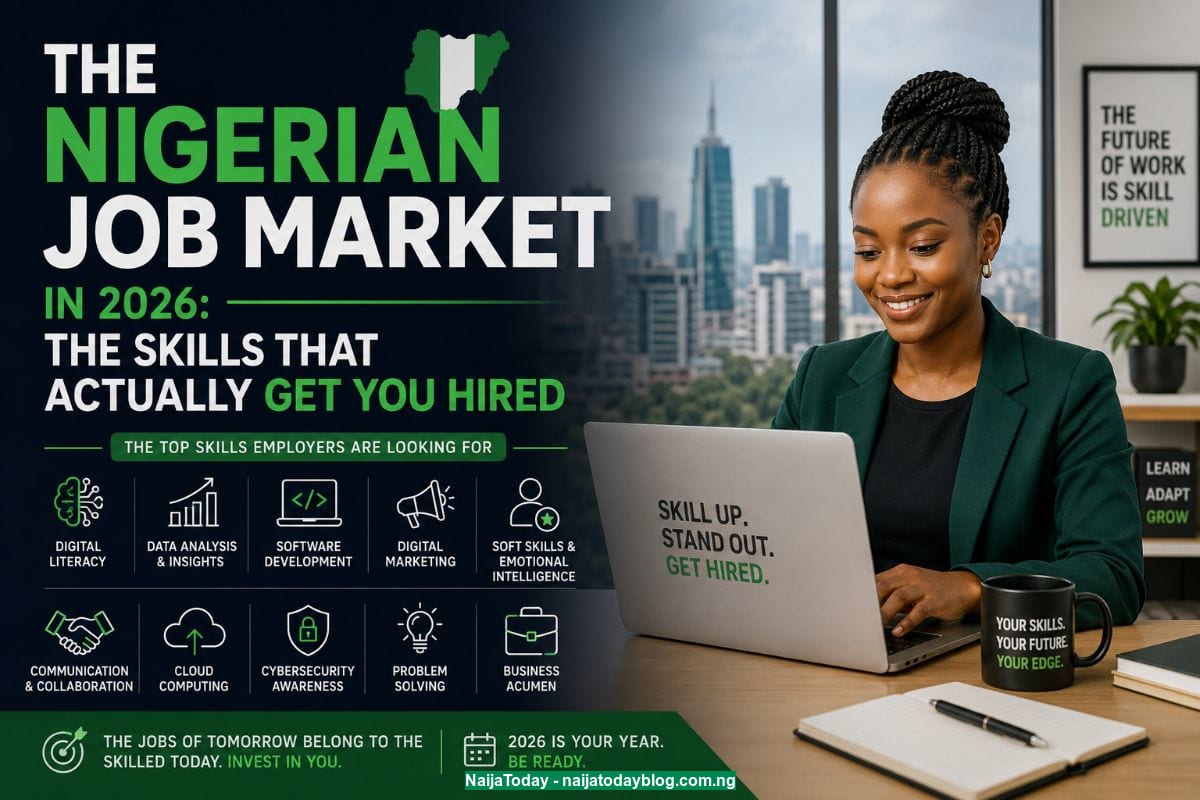
Nigeria's job market in 2026 isn't short of graduates, it's short of the right skills. See the exact skill combinations, salary ranges, and trade opportunities employers are actually hiring for.
How does this story make you feel?
No account or sign-in needed. You can react instantly.
Share:
NaijaToday Desk
The NaijaToday newsroom
More Stories to Explore
More reporting selected from NaijaToday, based on topics and categories.