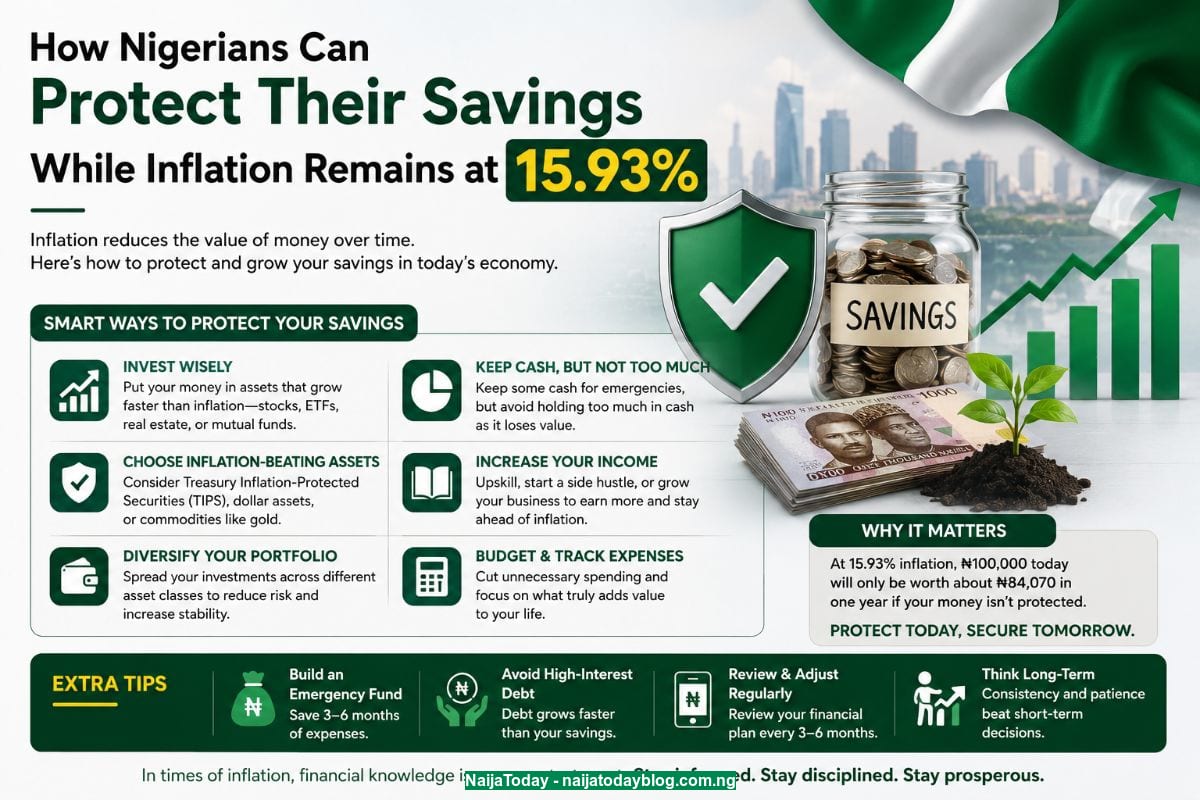
How Nigerians Can Protect Their Savings While Inflation Remains at 15.93%
For many Nigerians, the feeling is familiar. You receive your salary, transfer some money into a savings account, and hope you're doing the responsible thing. Yet a few months later, that same money doesn't seem to go as far as it used to. A bag of rice costs more, transportation fares have increased, and everyday groceries keep taking a bigger bite out of your income.
The reason is simple: inflation.
According to the National Bureau of Statistics (NBS), Nigeria's headline inflation rate stood at 15.93% in May 2026. While this is a significant improvement from 26.06% recorded in May 2025, prices are still rising much faster than the interest most banks pay on ordinary savings accounts.
In practical terms, this means that even though your bank balance may be increasing slightly, your purchasing power is shrinking. The money you're saving today may buy less tomorrow if it isn't growing faster than inflation.
The good news is that protecting your finances doesn't always require earning millions or becoming a professional investor. Small financial decisions, made consistently, can help preserve the value of your money even during periods of high inflation.
Here's what every Nigerian should know.
Why Inflation Matters More Than Your Bank Balance
Many people assume that as long as they're saving money, they're making financial progress.
Unfortunately, that's not always true.
Imagine you have ₦1,000,000 in a savings account earning 5% annual interest.
After one year, your balance grows to ₦1,050,000.
At first glance, it looks like you've made ₦50,000.
However, if prices across the economy increased by 15.93% during the same period, the goods and services that cost ₦1,000,000 a year earlier would now cost roughly ₦1,159,300.
Although your account balance increased, your money now buys less than it did before.
Economists refer to this as a negative real return—when your investment grows more slowly than inflation.
This is why leaving large sums of money in low-interest savings accounts can quietly reduce your wealth over time.
Inflation Is Slowing—But It's Still High
There is encouraging news.
Nigeria's inflation rate has fallen significantly compared to last year, dropping from over 26% to below 16%.
That suggests that government policies, exchange rate stability, and improvements in food supply may be helping to reduce the pace of price increases.
However, it's important to understand what this decline actually means.
It doesn't mean prices are falling.
It simply means prices are increasing more slowly than they were a year ago.
For households, the reality remains the same: everyday expenses continue to rise.
That's why financial planning remains essential even as inflation gradually eases.
Food Prices Continue to Put Pressure on Families
According to the National Bureau of Statistics, food inflation remained one of the biggest contributors to rising living costs.
Products including:
Onions
Tomatoes
Pepper
Yam
Cassava flour
Plantain
all recorded notable price increases during the period.
Since food accounts for one of the largest portions of household spending in Nigeria, even small increases in grocery prices can significantly affect monthly budgets.
For many families, controlling food expenses is one of the fastest ways to reduce the impact of inflation.
Smart Ways to Reduce Your Food Budget
You cannot control inflation, but you can control how you respond to it.
One practical strategy is buying staple foods in bulk whenever prices temporarily decline.
Products like rice, beans, garri, vegetable oil, and flour often become cheaper during harvest seasons or promotional sales.
Purchasing larger quantities during these periods can help you avoid paying higher prices later.
Another useful habit is comparing prices across different markets.
Many Nigerians shop at the nearest market out of convenience, but prices often vary significantly between locations.
For example, shoppers in Lagos frequently notice price differences between Mile 12 Market, Mushin Market, Oyingbo, and neighborhood stores.
Taking time to identify cheaper markets can result in meaningful savings over the course of a year.
Families, neighbours, religious groups, and workplace colleagues can also form cooperative buying groups.
Pooling funds allows members to purchase larger quantities directly from wholesalers, reducing the cost per item.
Avoid Letting Large Amounts of Cash Sit Idle
Having an emergency fund is important.
Keeping all your savings in a regular current or savings account is not.
Once you've set aside enough cash for emergencies and everyday expenses, consider placing excess funds in investments that offer better returns.
The objective isn't necessarily to make huge profits.
It's simply to reduce how much inflation erodes your money over time.
Treasury Bills Remain One of the Safest Options
One of the most popular low-risk investment options available to Nigerians is Treasury Bills.
Treasury Bills are short-term government securities issued by the Central Bank of Nigeria on behalf of the Federal Government.
Because they're backed by the government, they are generally considered among the safest investments in the country.
Depending on market conditions and auction results, Treasury Bills often offer higher returns than ordinary savings accounts.
They are available in different durations, including:
91 days
182 days
364 days
This flexibility allows investors to choose an investment period that matches their financial needs.
For individuals who won't need certain savings immediately, Treasury Bills can help preserve purchasing power more effectively than leaving money idle.
Money Market Funds Are Becoming More Popular
Another option gaining popularity is the money market fund.
These funds are managed by licensed investment firms that pool money from many investors and invest in relatively low-risk financial instruments such as:
Treasury Bills
Commercial paper
Bank deposits
Short-term government securities
Money market funds generally offer returns that exceed ordinary savings accounts while still allowing relatively easy access to your money.
Although returns are not guaranteed, they have become an attractive choice for many Nigerians seeking better yields without taking excessive risks.
Before investing, however, ensure the fund manager is properly licensed and regulated.
Should You Save in Dollars?
Many Nigerians consider holding part of their savings in dollars as a hedge against naira depreciation.
With the exchange rate trading around ₦1,370–₦1,400 per US dollar in early July 2026 and showing signs of greater stability than previous years, some investors continue to diversify by owning dollar-denominated assets.
These may include:
Domiciliary accounts
Dollar mutual funds
Eurobonds
Foreign investment accounts
The idea is simple.
If the naira loses value, dollar-denominated assets may help offset part of that loss.
However, this strategy isn't suitable for everyone.
People who rely entirely on their savings for daily expenses should first build an emergency fund in naira before considering foreign currency investments.
Diversification works best when it complements—not replaces—good financial planning.
Don't Ignore Debt
Inflation also affects borrowing.
Some people assume that because inflation reduces the value of money over time, borrowing automatically becomes beneficial.
That's only partly true.
If you have a long-term loan with a relatively low fixed interest rate, inflation can reduce the real value of your repayments over time.
However, most consumer loans in Nigeria carry relatively high interest rates.
Personal loans, salary advances, digital lending apps, and credit facilities often charge rates that exceed inflation.
As a result, taking unnecessary debt simply because inflation is high is rarely a wise financial decision.
Instead, prioritize paying off expensive debt before making new investments.
The guaranteed return from eliminating high-interest debt is often greater than many investment opportunities.
Build an Emergency Fund First
Before chasing investment returns, every household should have an emergency fund.
Unexpected medical bills, job loss, car repairs, school fees, or family emergencies can quickly derail financial plans.
Financial experts generally recommend keeping between three and six months' worth of essential expenses in easily accessible savings.
This ensures you won't be forced to sell investments at the wrong time or borrow money at high interest rates when emergencies arise.
Once this safety net is established, additional savings can be invested more confidently.
Increase Your Income Where Possible
Inflation affects spending, but income matters too.
Many Nigerians are exploring additional income streams to keep pace with rising living costs.
Some common options include:
Freelancing
Online tutoring
Digital marketing
Graphic design
Content creation
Small-scale farming
E-commerce
Selling handmade products
Consulting
Ride-hailing services
Even modest additional monthly income can significantly reduce financial pressure and increase the amount available for long-term savings and investment.
Develop a Monthly Financial Routine
Good financial habits matter more than one-time decisions.
Instead of making drastic changes, develop a simple monthly routine.
Consider the following checklist:
Track your spending every month.
Review your food and transportation costs.
Compare your savings interest with inflation.
Move idle cash into better-performing investments where appropriate.
Review new inflation reports released by the National Bureau of Statistics.
Adjust your budget whenever prices change significantly.
Small adjustments made consistently often produce better results than occasional major financial overhauls.
Common Mistakes to Avoid
Many people unknowingly make financial decisions that worsen the effects of inflation.
Some of the most common mistakes include:
Leaving all savings in low-interest accounts.
Spending salary before creating a budget.
Taking expensive loans for non-essential purchases.
Investing without understanding the risks.
Ignoring emergency savings.
Waiting too long before adjusting spending habits.
Avoiding these mistakes can help improve your financial resilience during uncertain economic periods.
What Inflation Means for the Average Nigerian
Inflation doesn't affect everyone equally.
For households with fixed incomes, rising prices reduce purchasing power unless salaries increase at a similar pace.
Business owners may experience higher operating costs as raw materials, transportation, and utilities become more expensive.
Retirees relying on fixed pensions often feel inflation even more sharply because their income may not keep pace with rising living expenses.
Understanding how inflation affects your personal finances is the first step toward making better financial decisions.
The Bottom Line
Nigeria's inflation rate may be heading in the right direction, but 15.93% is still high enough to reduce the value of idle savings over time. Simply leaving money in a traditional savings account is no longer enough for many households looking to preserve their purchasing power.
The most financially resilient Nigerians are increasingly combining disciplined budgeting with smarter saving and investing. Whether it's reducing unnecessary expenses, buying staple foods in bulk, investing in Treasury Bills or money market funds, or building multiple income streams, these practical steps can help cushion the impact of rising prices.
Inflation is unlikely to disappear overnight, but with the right financial habits, you can limit its effect on your savings and put yourself in a stronger position for the future.