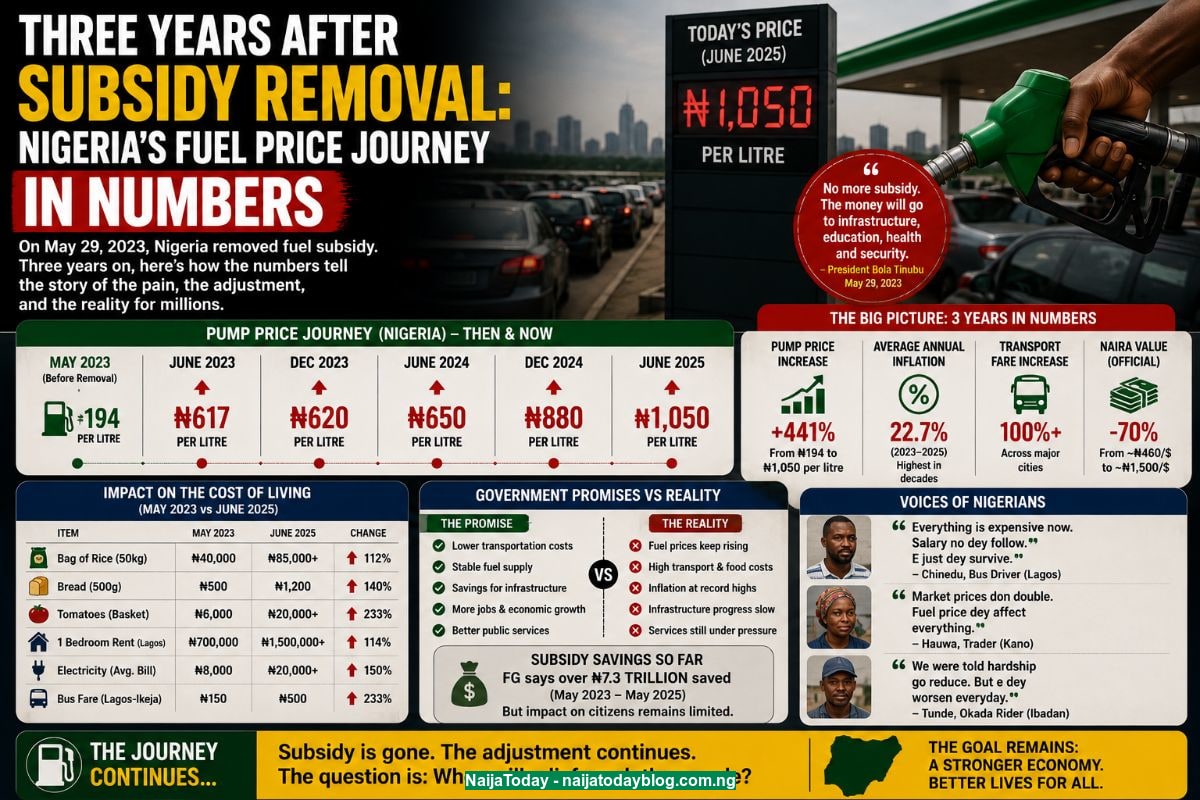
On May 29, 2023, in the same breath as his inauguration speech, President Bola
Ahmed Tinubu delivered a sentence that would reshape the daily arithmetic of
nearly every Nigerian household: fuel subsidy is gone. Within days, petrol
prices that had held for years at roughly ₦185 to ₦200 per litre more than
doubled to around ₦537. It was, by any measure, one of the most consequential
policy pivots in Nigeria's recent economic history — and three years on, with a
fresh price hike sweeping the country in mid-July 2026, it is worth tracing the
full arc of what that decision has meant in naira and kobo, rather than in
abstractions.
The Numbers, Year by Year
The trajectory is stark when laid out in sequence. Before the subsidy removal,
Nigerians had grown accustomed to petrol prices that, while occasionally
adjusted, remained artificially suppressed by a subsidy regime that, at various
points, consumed trillions of naira annually from the federal budget — money
that critics argued disproportionately benefited smugglers and well-connected
marketers rather than ordinary consumers, while defenders of the subsidy
pointed to the real, immediate pain its removal would cause.
That pain arrived quickly. By September 2023, further deregulation of the
downstream sector pushed prices to approximately ₦617 per litre, as the market
adjusted to operating without government price support for the first time in
over a decade. Through 2024, as the naira came under sustained pressure against
the dollar following the Central Bank's own currency reforms, petrol prices
climbed further, settling into a ₦750 to ₦900 range — a period that also saw
the gradual ramp-up of the Dangote Refinery's domestic production, introducing
the first real counterweight to Nigeria's near-total historical dependence on
imported refined fuel.
By 2025 and into 2026, prices had settled into a new normal above ₦900,
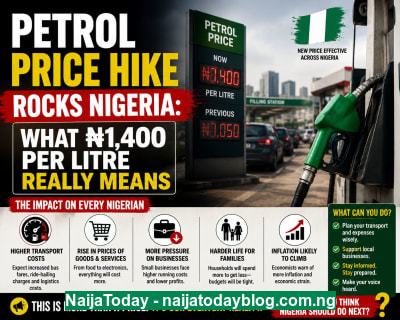
frequently exceeding ₦1,000 per litre, before the events of this past week
pushed the market higher still: depot prices rising from ₦1,230 to ₦1,350 per
litre starting July 17, 2026, with pump prices expected to follow toward ₦1,380
to ₦1,400 in many parts of the country. Measured from the pre-subsidy-removal
baseline of roughly ₦185, that represents better than a seven-fold increase in
three years — a pace far outstripping wage growth for the vast majority of
Nigerian workers over the same period.
What Deregulation Was Supposed to Deliver
The policy logic behind the subsidy removal rested on a few core arguments that
are worth revisiting now that enough time has passed to judge them against
results. Proponents argued that ending the subsidy would free up federal
revenue for infrastructure and social investment, eliminate the incentives for
cross-border fuel smuggling that had plagued the subsidized regime, and —
crucially — attract the private investment needed to build domestic refining
capacity, since no investor could justify building a refinery to compete against
artificially cheap subsidized imports.
On that last point, the emergence of the Dangote Refinery as a serious domestic
supplier represents a genuine, if partial, vindication of the deregulation
thesis. The refinery's ex-depot pricing, sitting at roughly ₦1,075 per litre in
early July 2026 compared to the ₦1,100 to ₦1,400 charged by many
import-dependent marketers, has demonstrably introduced competitive pressure
into a market that previously had none. Whether that pressure will eventually
pull the entire national market toward its lower end, or remain confined
largely to Lagos and the South-West where the refinery's logistics advantage is
strongest, remains one of the central open questions of the post-subsidy
era.
The Cost Side of the Ledger
Set against that partial success is a set of costs that have fallen hardest on
Nigerians with the least capacity to absorb them. Nigeria's inflation rate,
sitting at 15.91 percent as of mid-2026 and expected to rise further with this
month's fuel price adjustment, reflects in significant part the compounding
effect of fuel costs working their way through transport, food distribution,
and manufacturing input costs across the economy. A tomato that has to travel
from a northern farm to a Lagos market carries the transport sector's fuel
costs embedded in its final price; a loaf of bread reflects the fuel cost of
running a bakery's ovens and delivering flour. Three years of steadily rising
fuel prices have pushed that embedded cost higher across nearly every category
of goods Nigerians buy daily.
The transport sector has borne this most visibly and most immediately.
Commercial drivers who were charging ₦50 to ₦100 for short trips before 2023
now routinely charge several times that amount, adjustments that track the
roughly seven-fold rise in their primary input cost. Household budgets that
once allocated a modest share to daily transport now often dedicate a much
larger portion, squeezing out spending on food quality, education costs, or
savings that might otherwise have built some resilience against future
shocks.
A Regional Story Layered on Top
The national numbers also obscure a persistent regional pattern that has held
throughout the post-subsidy period: states closer to refineries or major fuel
depots like Lagos, Port Harcourt and Warri have consistently paid less than
northern and remote states, where transport logistics add substantial cost on
top of whatever the national price trend is doing. This means the seven-fold
national increase since 2023 has not been evenly felt — a Lagos resident and a
Borno resident, both watching their local pump price climb over the past three
years, have been climbing from different starting points and at somewhat
different paces, with the gap between them, in absolute naira terms, growing
larger as the overall price level rises.
Looking at the Next Three Years
Three years is enough time to draw some tentative conclusions, but not enough
to call the transition complete. The Dangote Refinery's expansion remains
ongoing, with further capacity increases plausible over the coming years that
could extend its price-suppressing effect beyond its current stronghold in the
South-West. The regulatory posture, reflected in NMDPRA's continued issuance of
fresh import licenses even as domestic refining grows, suggests officials are
betting on a hybrid market — part domestic, part imported — for the foreseeable
future, rather than a rapid consolidation around local production alone.
What is clear, looking back from mid-July 2026, is that the subsidy removal
delivered on some of its proponents' promises while imposing costs that have
proven more severe and more prolonged than many Nigerians were initially led to
expect. The seven-fold price increase since May 2023 is not a number that
exists only in economic reports — it is lived, daily, by the commercial driver
recalculating his fare, the trader absorbing higher transport costs before she
even reaches the market, and the household quietly cutting back on something
else each time the price at the pump climbs again. Whichever way the next three
years break, that lived experience, more than any single policy announcement,
will be how most Nigerians measure whether the promise of deregulation was
ultimately kept.
🏛️ Politics🔥 HOT
How Nigeria's Fuel Prices Multiplied Sevenfold in Three Years
By NaijaToday Desk · 18 July 2026 · 6 min · 👁 5
Tracing Nigeria's petrol prices from ₦185 before the 2023 subsidy removal to over ₦1,350 today, and what three years of deregulation has actually delivered.
#subsidy removal#tinubu policy#fuel price history#deregulation#inflation#naira devaluation#economic reform
How does this story make you feel?
No account or sign-in needed. You can react instantly.
Share:
NaijaToday Desk
The NaijaToday newsroom
More Stories to Explore
More reporting selected from NaijaToday, based on topics and categories.