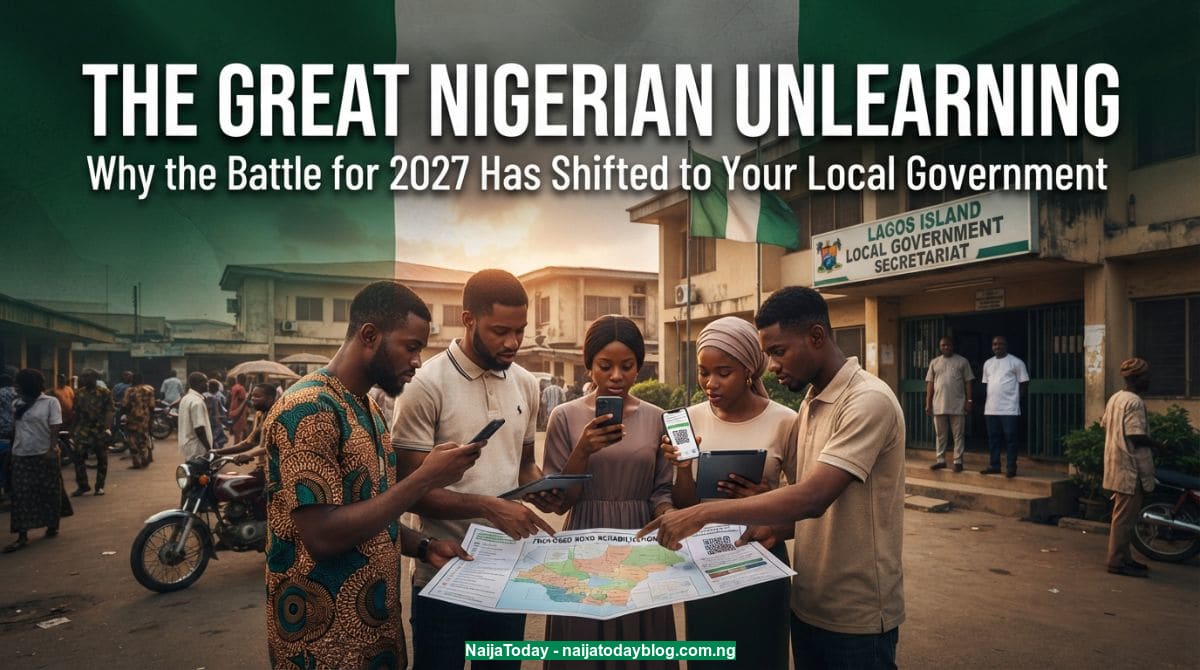
The Great Nigerian Unlearning: Why the 2027
Election Won't Be Fought in Abuja, and How the Grassroots Revolution Is Already
Here
If you stand at the
crowded bus stop in Ojota, Lagos, on a humid Monday morning, or walk through
the bustling aisles of Bodija Market in Ibadan or listen to the sharp debates
inside a suya spot in Kano, you will hear a distinct shift in how Nigerians
talk about power.
For nearly three decades,
Nigerian political discourse operated on a single, top-heavy assumption: Everything
begins and ends in Abuja.
If a transformer blew up
and threw an entire neighbourhood into three weeks of darkness, the blame was
hurled straight at Aso Rock. If the road leading into a community primary
school became a muddy river every rainy season, citizens cursed the President.
If local market women marked up the price of a basket of tomatoes, the
consensus on the street was simple: "The government in Abuja has failed
us."
We treated the Federal
Government as an all-powerful, omnipresent father figure responsible for
everything from national defence down to the sweeping of inner-city street
gutters. Meanwhile, the political actors who lived closest to us—our State
Governors, our State Assembly members, and most importantly, our Local
Government Chairmen—operated in comfortable, unaccountable shadows.
That era is over. A quiet,
profound unlearning is taking place across Nigeria today.
As we navigate complex
economic reforms, shifting political coalitions, and the countdown toward the
2027 general elections, Nigerians are realizing a fundamental truth: A country
cannot be fixed from the top down if the foundation at the bottom is completely
rotten.
1. The Macro Illusion vs. The Kitchen Table
Reality
To understand why the
political mood in Nigeria is shifting, one must look at the widening gap
between high-level macroeconomic news and the daily reality on the kitchen
table of the average citizen.
Over the past two years,
national headlines have been dominated by big-ticket policy shifts. We read
daily reports about domestic petroleum refineries ramping up production,
foreign exchange reserves recovering to multi-year highs, non-oil exports
expanding, and sweeping Tax Reform Bills passing through the National Assembly.
On paper, these macro indicators are vital. No modern economy can survive
without local industrial refining, fiscal harmonization, and foreign direct
investment.
Yet, walk into any local
provision store or talk to a taxi driver buying fuel, and you will encounter an
undeniable disconnect.
Why does a positive
macroeconomic statistic fail to bring immediate relief to a mother buying food
for her children? Because macro policy creates wealth at the national level,
but local governance converts that wealth into daily liveability.
|
THE GOVERNANCE
GAP |
|
MACRO POLICY (Federal) ---> Creates
foreign reserves & energy |
|
security on
paper. | |
|
LOCAL GOVERNANCE (LGA) ---> Determines
market access, street |
|
roads,
drainage, and local clinic |
|
functionality
in real life. |
If the Federal Government
stabilizes wholesale fuel supplies or reforms national corporate taxes, but
your Local Government Chairman allows the primary market road to remain a
cratered swamp, the cost of moving food from the farm to the market will remain
outrageously high. The truck driver will still break his suspension; the trader
will still double her transport markup; and the final consumer will still
suffer high food inflation.
Good national economic
policy cannot survive bad local administration. You cannot build a 21st-century
economic power on top of collapsed, abandoned municipal infrastructure.
2. The Death of the "Governor Ate Our
Allocation" Excuse
For twenty-five years,
local government administration in Nigeria was an elaborate ghost show.
On paper, the 1999
Constitution established 774 Local Government Areas (LGAs) to bring development
close to the people. In practice, 36 State Governors turned those 774 local
secretariats into private political fiefdoms.
Through the controversial
State Joint Local Government Accounts (SJLGA), governors routinely hijacked
monthly federal allocations meant for local councils. They handed out petty
stipends to local chairmen—just enough to pay basic local civil service salaries
and buy fuel for official SUVs—while swallowing the billions intended for
primary health centres, rural feeder roads, basic education, and public
sanitation.
Local Government Chairmen
quickly adapted to this parasitic arrangement. They learned that their survival
did not depend on pleasing the voters in their communities; it depended
entirely on bowing before the Governor in the state capital. Whenever angry residents
asked why the local clinic had no drugs or why the streets were overflowing
with garbage, the Chairmen had a ready-made, bulletproof excuse: "The
Governor has not released our allocation."
That excuse is now
officially dead.
Following landmark legal
battles and the full enforcement of financial autonomy for all 774 LGAs,
Federal Account Allocation Committee (FAAC) funds now land directly into the
dedicated bank accounts of local government councils. State Governors no longer
have the legal authority to freeze, seize, or divert those funds.
Every single month,
hundreds of millions—and in major urban councils like Alimosho in Lagos, Port
Harcourt City in Rivers, or Abuja Municipal—over a billion Naira drops directly
into local government coffers.
The money is there. It is
arriving every 30 days. And for the first time in our democratic history, the
spotlight of public accountability has shifted directly onto the Local
Government Chairman.
"If an inner road in your neighbourhood
has been broken for four years, or if the primary healthcare centre down your
street has no running water, do not look to Abuja. Look at your Local
Government Secretariat. The money landed in their bank account three weeks
ago."
3. What Should Your Local Government Chairman
Be Doing with Your Money?
Because local government
administration was crippled for so long, many educated Nigerians have forgotten
what a functional local council is supposed to do.
We have become so
accustomed to self-help—digging our own boreholes, buying our own neighbourhood
transformers, hiring private security guards, and contributing money to grade
our own streets—that we no longer realize these are basic municipal services
funded by our taxes.
Let us clearly lay out
what your Local Government Council is constitutionally mandated and financially
funded to deliver:
A. Primary Healthcare Services
Your local Primary
Healthcare Centre (PHC) is not the responsibility of the President or the
Governor. It belongs entirely to your LGA. When a local clinic lacks basic
antimalarial medication, clean maternity beds, functional blood pressure
monitors, or basic night-duty staff, that failure belongs 100% to your Local
Government Chairman.
B. Inner-Street Roads and Drainage Maintenance
While state governments
build major inter-city highways, all inner-residential roads, street culverts,
and neighbourhood drainage channels belong to the local government. Every time
a short twenty-minute rainfall floods your street because the gutters haven't
been cleared in three years, that is a direct failure of local council
administration.
C. Primary School Infrastructure
While secondary schools
and state universities fall under state oversight, the foundation of national
literacy—primary education—is managed by local governments. The leaky roofs,
missing desks, and unequipped classrooms in local public primary schools represent
a failure at the local level.
D. Markets, Motor Parks, and Public Sanitation
Who collects fees from the
local markets where your family buys food? Who manages the motor parks? Who is
supposed to collect municipal solid waste so that refuse heaps don't turn
residential streets into health hazards? Your Local Government Council.
|
LOCAL GOVERNMENT
RESPONSIBILITIES |
|
[🏥] Primary Healthcare Clinics & Basic Drugs |
|
[🛣️] Inner-Community Roads, Culverts & Drainage
Channels |
|
[🏫] Public Primary School Buildings & Desks |
|
[🛒] Local Market Infrastructure & Sanitation |
|
[💡] Neighbourhood Street Lighting & Community
Security Support |
When you look at this
list, an undeniable truth emerges: Over 70% of the daily issues that make
living in Nigeria stressful, expensive, and frustrating fall squarely under the
authority of your Local Government Chairman.
4. The 2027 Pre-Game: Why the Old Political
Playbook Is Breaking Down
As political parties begin
preliminary alignment talks, coalition meetings, and zoning debates ahead of
the 2027 general elections, national political strategists are confronting a
vastly different electorate than the one they managed a decade ago.
The old political playbook
in Nigeria relied on three basic tools:
1. Ethno-religious
sentiment to divide the electorate.
2. Monopolized state
financial machinery to starve opposition movements.
3. Electoral day logistics
(stomach infrastructure, cash distribution at polling units, and manual result
manipulation during collation).
That old playbook is
breaking down under the weight of three emerging forces:
Force 1: The Technological Lock-In
Despite public debates
over election administration, the progressive digitization of Nigeria’s
electoral framework—from mandatory voter registration portal updates to
real-time digital result transmission (IReV) and biometric verification—has
permanently raised the cost of electoral fraud. It is no longer as easy to sit
in a local government collation centre and write fictional figures while the
real voters are at home.
Force 2: The Demographics of Exhaustion
Nigeria is one of the
youngest nations on Earth, with over 60% of its population under the age of 25.
This demographic did not grow up during the oil boom years; they grew up during
economic structural adjustments, security challenges, and digital global
connectivity. They are hyper-aware of how citizens live in other developing
nations. You cannot easily satisfy a 22-year-old software developer, digital
marketer, or trade apprentice with a ₦2,000 note and a bag of salt on election
day when they know that bad governance is costing them their global
competitiveness.
Force 3: The Rise of Issue-Based Opposition
Coalitions
Across the country,
preliminary merger discussions between major opposition platforms reflect a
growing realization: Splitting votes along regional or individual personality
lines simply guarantees the retention of the status quo. Whether these
coalition talks result in a single mega-party or targeted electoral alliances,
the era of fragmented opposition is drawing to a close.
---
5. The Informal Economy: How Ordinary
Nigerians Keep the Country Running
While politicians manoeuvre
for 2027 and state institutions debate policy frameworks, there is an unsung
hero keeping Nigeria alive every single day: The Informal Sector.
Nigeria’s informal
economy—the market women in Mile 12, the phone repair technicians in Computer
Village, the tech founders in Yaba and Enugu, the fabric merchants in Aba, the
grain traders in Kano, the fashion designers in Ibadan, and the millions of digital
hustlers earning remote income—is the true engine of national survival.
|
NIGERIA'S REAL ECONOMIC
ENGINE |
|
Informal Sector Contribution: Over 55% of National GDP |
|
Employment Generation: Over 80% of the total workforce |
|
Primary Driver: Relentless citizen hustle
& digital |
|
adoption
despite infrastructure gaps. |
In Q3 alone, digital
payment data from NIBSS showed that electronic transfers crossed tens of
trillions of Naira. Small business owners who five years ago only accepted
crisp cash notes now display QR codes and instant transfer account numbers on
their wooden market stalls.
When a country’s citizens
demonstrate this level of resilience, ingenuity, and technological adoption,
they deserve a public administration system that matches their work ethic. It
is an insult to an entrepreneur who generates her own solar power, manages her
own logistics, and finds her own foreign customers to be governed by a local
chairman who cannot keep the street drainages clean.
---
6. The Civic Blueprint: How Citizens Take
Control Before 2027
So, what must we do? How
do we translate this understanding into real, measurable progress in our daily
lives?
At NaijaTodayBlog, we
believe that real civic power does not lie in complaining on social media and
then disappearing on election day. Real civic power is active, local, and
continuous.
Here is the four-step
blueprint for every Nigerian who wants to see real change in their community
starting today:

Step 1: Identify Your Local Representatives
Do not rest until you know
the full name, political party, and contact details of two specific
individuals:
1. Your Local Government
Area (LGA) Chairman.
2. Your Ward Councillor
(the politician representing the exact neighbourhood where you sleep).
Write their names down.
Search for their official social media handles. Learn where their offices are
located. The moment a politician realizes their constituents know their exact
name and face, the era of silent stealing ends.
Step 2: Track the FAAC Disbursements
Every single month, the
Federal Ministry of Finance publishes the exact breakdown of revenues shared to
all 774 Local Government Areas. This is public information.
When you see that your
local council received ₦700 Million or ₦1.2 Billion for the month, take a
screenshot. Share it on your community WhatsApp groups. Ask polite,
uncompromising questions: "Our LGA received ₦800 Million this month. Where
is the budget allocation for fixing our primary health clinic?"
Step 3: Participate in Ward Development
Meetings
Every political ward has a
community development structure—whether it is a Landlords' Association, a
Community Development Area (CDA), a Youth Council, or a Ward Development
Committee. Show up to these meetings. When educated, professional, and
digital-savvy citizens show up at local ward meetings, local politicians can no
longer bribe their way through community leadership.
Step 4: Use Your Smartphone as a Weapon of
Transparency
You carry a powerful
broadcasting tool in your pocket. When a local government council claims on
paper to have spent ₦40 Million renovating a public primary school, but the
school remains a roofless building with children sitting on bare floors, take
clear photos and videos.
Tag tracking platforms
like BudgIT, tag media outlets like NaijaTodayBlog, tag relevant anti-graft
oversight handles, and make the truth visible. Public exposure remains the
single most effective deterrent to local government impunity.
Conclusion: The Nation We Build Depends on the
Local Ground We Stand On
Nigeria will not be saved
by a miracle in Abuja. It will not be transformed overnight by a single speech
from a President or a grand manifesto from an opposition coalition.
Nigeria will be saved when
774 Local Government Areas begin to function as safe, clean, productive, and
accountable hubs of human development.
Nigeria will be
transformed when an ordinary citizen in an urban suburb or a rural town can
step out of their front door onto a well-paved street, send their child to a
clean local primary school, access functional medical care at a neighbourhood
clinic, and run their business without local government harassment.
The legal excuses have
expired. The direct funds are landing every thirty days. The power has returned
to the grassroots.
It is time for every
Nigerian to look away from Aso Rock for a moment, turn around, and look
directly at their Local Government Secretariat.
It is time to ask your chairman:
"Our money has arrived. What have you built for our community today?"
Join the Conversation
Do you know the name of
your Local Government Area and your current LGA Chairman? What is the 1 project
your local council urgently needs to fix in your neighbourhood this month?
Drop your LGA Name, State,
and thoughts in the comments section below!
Don't forget to SHARE this
article with your community WhatsApp groups, Facebook friends, and political
forums. Follow naijatodayblog.com.ng for daily verified news, deep political
analysis, and citizen-led reporting across Nigeria.


