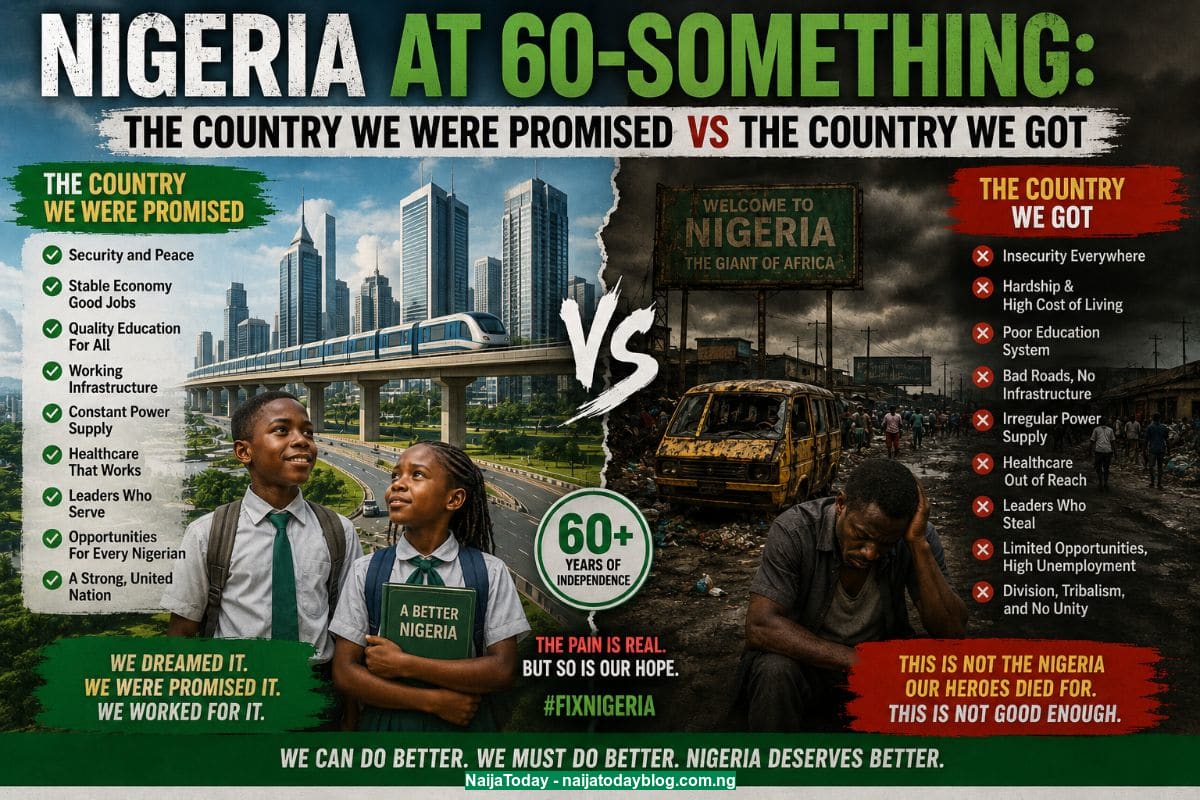
Nigeria at 60-Something: The Country We Were Promised vs The Country We Got
A reckoning with independence, disappointment, and the stubborn refusal to give up
There is a photograph that surfaces every so often on Nigerian social media — black and white, slightly grainy, from somewhere around 1960 or 1961. In it, Lagos looks like a city on the edge of becoming something extraordinary. The streets are clean in a way that feels almost fictional to anyone who has navigated them recently. The buildings have a mid-century optimism to their architecture. The people in the frame are dressed with a formality and a pride that speaks of a moment that felt, to those living in it, like the beginning of everything.
The caption, when someone adds one, is usually some version of the same sentence: We had everything. What happened?
It is a question that contains within it a universe of pain. The kind of pain that comes not just from suffering but from the particular anguish of knowing that things were not always this way. That there was a before. That the before was better. And that somewhere between that photograph and right now, something went profoundly, catastrophically wrong.
The Dream That Independence Carried
To understand contemporary Nigeria, you have to understand what independence felt like — not as a historical fact but as an emotional experience.
October 1st, 1960 was not just a date. It was a declaration. It was the moment a people said to the British Empire — to the entire machinery of colonial extraction and cultural humiliation and deliberate underdevelopment — enough. We are ending this now. We are taking our country back. We are going to show you, and ourselves, what we are actually capable of when nobody is holding us down.
The optimism of that moment was not naive. It was earned. Nigeria had produced scholars and lawyers and doctors and writers who could compete with anyone in the world. It had oil that was beginning to be discovered in quantities that promised enormous wealth. It had a young population full of energy and intelligence and ambition. It had cultural traditions of governance — in the Yoruba kingdoms, in the Caliphate, in the Igbo systems of republican organisation — that proved Africans had been building sophisticated societies long before any European arrived to tell them they needed to be civilised.
The dream was real. The foundation was real. The potential was absolutely, undeniably real.
Where It Started to Break
The cracks appeared almost immediately. And understanding where they came from matters, because Nigeria has a habit of explaining its failures in ways that let the most culpable people off the hook.
The colonial structure that Britain left behind was not designed for Nigerian success. The borders that were drawn — cutting through ethnic groups, forcing communities with centuries of conflict into the same national household, separating communities that belonged together — were drawn for British administrative convenience, not for African flourishing. The economic structures that were left in place continued to extract resources outward rather than circulate wealth internally. The institutions that were handed over had been designed to manage a colony, not to serve a self-governing people.
This is not an excuse. It is a context. And context matters.
But context is also not the whole story. Because other countries inherited colonial structures just as brutal and have built more functional states. Because the oil wealth that arrived in the 1970s was an opportunity of staggering proportions that was stolen and wasted by Nigerians — not by foreigners, by Nigerians — on a scale that should be taught in schools as a case study in how not to manage a nation's resources.
The military governments that came and went and came again — each one promising discipline and correction and a return to the right path — did not fix the corruption. They institutionalised it. They made it structural. They embedded it so deeply into the operating systems of government that when civilian rule finally returned, the civilians simply inherited a machine that had been specifically designed for extraction rather than service.
The Oil Curse Nobody Wanted to Believe Was Real
Nigeria struck oil and the oil struck Nigeria back.
This is the uncomfortable truth that the petro-nationalism of the 1970s tried to obscure. The discovery of oil in commercial quantities in the Niger Delta should have been the beginning of a transformation. The revenues that flowed into government coffers in the 1970s, when oil prices were high and production was booming, were large enough to have built a genuinely different country.
Instead, they built an economy entirely dependent on one resource — which meant that when oil prices fell, everything fell with them. They built a political culture where controlling the federal government meant controlling the oil money, which meant that power at the centre became worth fighting for by any means necessary. They built a rentier state where the relationship between citizens and government was not one of taxpayer and public servant but of supplicant and patron — where what mattered was not building productive capacity but being close enough to the source of oil money to get a share.
They built, in short, the Nigeria we have now.
The Niger Delta — the communities that sit on top of the oil that has generated trillions in revenue — has some of the worst human development indicators in the country. The water is polluted. The air is polluted. The young men have watched their fishing grounds destroyed and their farmland contaminated and have received in return a level of government presence that consists almost entirely of security forces deployed to protect the oil infrastructure from the people whose land it sits on.
This is not an accident. This is policy.
The Youth and the Weight of Inheritance
The generation of Nigerians currently between the ages of eighteen and thirty-five has inherited a country they did not break and are being asked to fix it with tools they were not given.
They are the most educated generation in Nigerian history — and they are also the most unemployed. They are the most globally connected — and they are watching their peers in other countries access opportunities that remain closed to them through no fault of their own. They are the generation that turned out in enormous numbers for the EndSARS protests of 2020 — that stood in the streets and demanded, with remarkable organisation and clarity, that the state stop brutalising them — and then watched as the state responded with the Lekki Toll Gate massacre and then proceeded to act as though the protests had never happened.
They are a generation that has reason to be furious and reason to be despairing — and many of them are both — but who are also, quietly and persistently and often without recognition, building things. Starting businesses in the most difficult economic conditions. Creating art that is reaching the world. Building technology companies that are solving African problems with African solutions. Leaving in their millions through the Japa wave, yes — but many of those who leave are sending back remittances that are keeping families afloat, and some of them are building skills and networks they intend to bring home.
The story of Nigerian youth is not simply a story of flight. It is a story of people trying to survive a situation they did not create, with more creativity and resilience than they are usually given credit for.
The Conversation We Keep Avoiding
Nigeria has a conversation it needs to have and keeps finding ways not to have.
About whether the current structure of the federation is working for the majority of its people — or whether the centralisation of power and resources in Abuja serves a small political class at the expense of everyone else.
About what true restructuring would look like and who is afraid of it and why.
About the ethnic and religious divisions that politicians exploit every election cycle to mobilise people against each other rather than against the systems that are failing all of them simultaneously.
About what accountability actually means in a country where former heads of state die peacefully in their beds having never been asked to account for what happened to the billions that passed through their hands.
About the Naira and the economy and the cost of living that has turned ordinary survival into an act of heroism for millions of people who are doing everything right and still cannot afford to eat properly.
These are not abstract questions. They are the questions that determine whether the children being born in Nigeria today will have better lives than their parents — or whether they will be asking, forty years from now, the same questions their grandparents asked while looking at that black and white photograph of a city that looked like the beginning of something.
The Stubbornness That Might Save Us
And yet. And yet.
Nigeria has a quality that defies easy description. A refusal to be finished. A stubbornness in the face of circumstance that is either the most admirable thing about Nigerians or a trauma response so deeply internalised that it has become a personality — and perhaps it is both of those things at the same time.
A country that was this broken should not produce this much art. This much music. This much humor. This much entrepreneurial energy. This many people waking up every morning and deciding, against all available evidence, that today might be the day something gets better. That the next government might be different. That the next generation might be the one that finally, finally gets it right.
That stubbornness is not stupidity. It is not ignorance of how bad things are. It is something else — something harder to name but possible to feel if you have spent time among Nigerians who have every reason to have given up and have chosen, defiantly, not to.
That choice — to stay in it, to fight for it, to love a country that has not yet loved you back the way it should — is the most Nigerian thing that exists.
And it might, against all odds, be enough.
Published on NaijaToday — naijatodayblog.com.ng