The Great Nigerian Reset: Why Local Government Autonomy Changes Everything | NaijaTodayBlog
By NaijaToday Desk · 30 September 2026 · 10 min · 👁 13
Discover why Nigeria's real battle for development has shifted from Aso Rock to your local government secretariat. Read our in-depth analysis on LGA autonomy.
The Great Nigerian Reset: Why The Real Battle for Nigeria’s Future Has Moved From Aso Rock to Your Local Government Headquarters
By NaijaTodayBlog Editorial Team
Published for naijatodayblog.com.ng
If you take a walk down almost any street in Nigeria today—whether in the bustling neighborhoods of Ikeja, the sprawling residential layouts of Enugu, the ancient quarters of Kano, or the creekside communities of Port Harcourt—you will notice a familiar pattern.
When a transformer blows up and throws a community into darkness for three weeks, the residents gather at the street corner and curse "the government." When the first heavy rains of the season turn an inner-city road into a muddy river, washing dirt straight into people’s living rooms, the blames fly straight to Aso Rock in Abuja or the Governor's Lodge in the state capital. When a pregnant woman arrives at a neighborhood health center only to discover there is no running water, no basic antiseptics, and only one overworked nurse on duty, the consensus is always the same: “Nigeria has failed us.”
For decades, this reflex has defined our national psyche. We have been conditioned to look upward—far upward—to the President in Abuja or the Governor in the state capital for every single problem that plagues our daily existence.
We treat the Presidency as a benevolent monarchy and the Governorship as a regional kingdom.
But while all eyes remain glued to national television watching political drama in Aso Rock and legislative debates in the National Assembly, a quiet, seismic shift has taken place across the country.
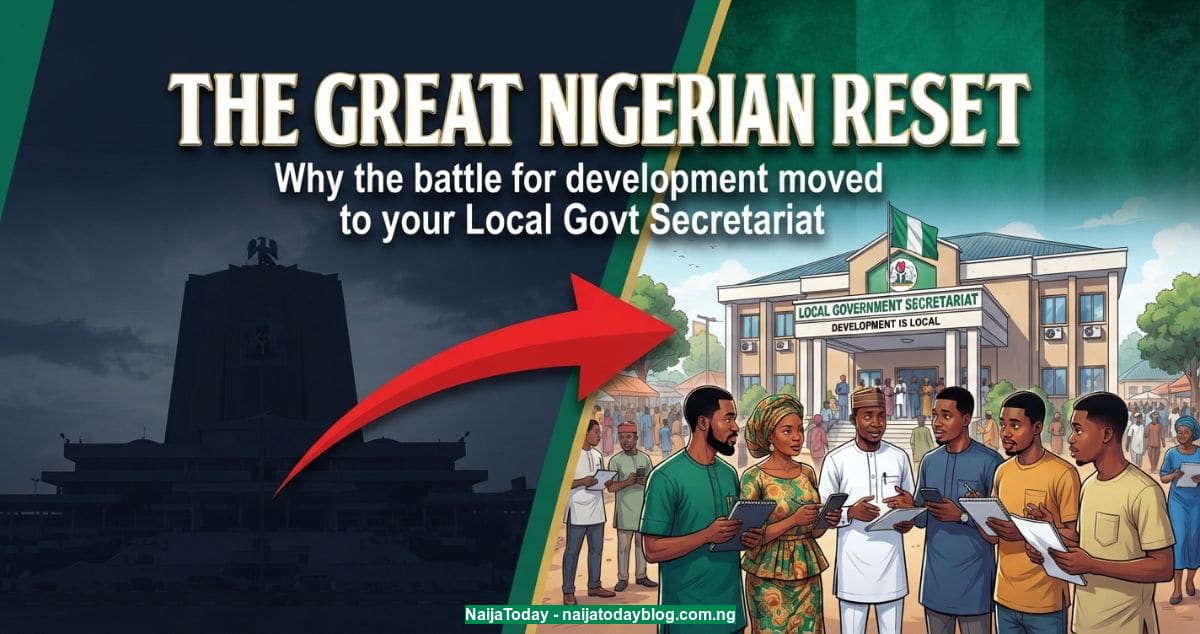
The real battle for Nigeria’s survival, economic sanity, and daily livability is no longer happening in Abuja. It has moved straight to your local government secretariat. And unless we as citizens wake up to this new reality, we will continue to suffer in darkness while the people holding the keys to our immediate relief walk away with billions of Naira unaccounted for.
The Death of the "Governor Ate Our Money" Excuse
To understand where we are today, we must look at the tragic history of Nigeria’s 774 Local Government Areas (LGAs).
For over twenty-five years following the return to democracy in 1999, the third tier of government in Nigeria existed largely on paper. On paper, Nigeria had 774 local governments designed to bring governance close to the grassroots. In reality, what we had was 36 imperial state governors who treated local government allocations as their personal political slush funds.
Through the infamous State Joint Local Government Accounts (SJLGA), monthly allocations meant for local councils were seized at the state capital. State governors would dole out tiny stipends to local government chairmen—just enough to pay basic civil service salaries, buy fuel for official cars, and keep the local political patronage machine running—while swallowing the bulk of the funds meant for grassroots development.
Local government chairmen across the country quickly learned the rules of the game: Do not build roads, do not fix health centers, do not clear drainages.
Just fly to the state capital every month, bow before the governor, collect your operational allowance, and keep quiet.
Whenever angry citizens confronted their local council chairmen about overflowing refuse dumps, abandoned primary schools, or dark streets, the response was always a sad smile and a familiar excuse: "The governor has not released our funds."
That excuse is now officially dead.
With the enforcement of full financial autonomy for all 774 Local Government Councils, following landmark legal victories and direct disbursement frameworks instituted by the Federal Government, allocations from the Federation Account Allocation Committee (FAAC) now land directly into the bank accounts of local government councils. No state governor can legally seize, divert, or tamper with those funds anymore.
Every single month, hundreds of millions—and in some larger urban councils, over a billion Naira—are poured directly into the accounts of your Local Government Chairman.
The money is there. It is landing every 30 days. The question every Nigerian must now ask is: Where is it going?
The Absurdity of Imperial Governors and Forgotten Grassroots
Consider the sheer absurdity of how we have run this country for the last two decades.
We live in a nation where a State Governor organizes a lavish, televised ceremony complete with red carpets, brass bands, and live news coverage just to cut a ribbon for a 800-meter inner-street road, a 10-bed primary healthcare clinic, or a public toilet.
Think about that for a moment. A governor, managing a state with millions of citizens, vast agricultural expanses, higher education systems, state security architectures, and regional industrial policy, is spending his afternoon commissioning a culvert!
Why? Because the local government system was deliberately crippled, forcing citizens to beg the state capital for solutions to problems that should be solved by a local ward councillor.
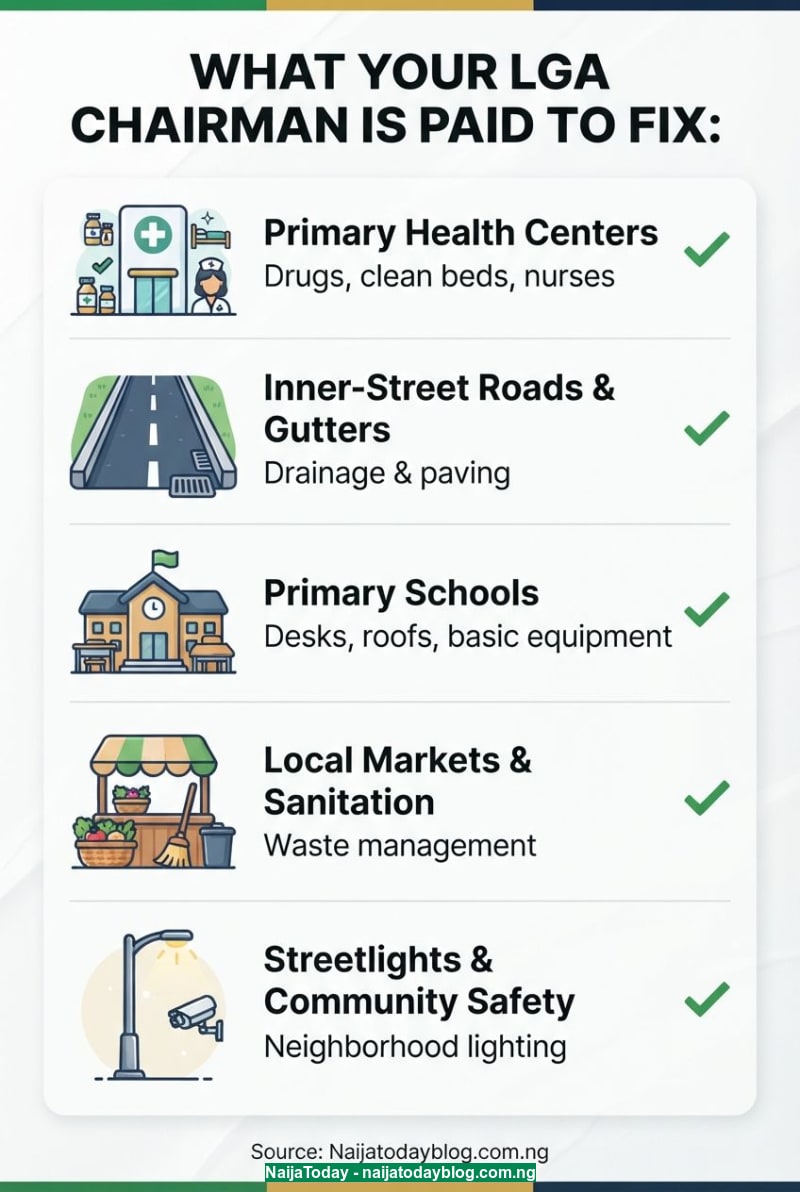
Let us break down what your Local Government Area is constitutionally mandated and financially empowered to do for you right now:
1. Primary Healthcare Delivery
Your local primary healthcare center (PHC) is not the business of the President in Abuja. It is not even primarily the job of the State Governor. It belongs to your Local Government Council.
When a PHC lacks basic vaccines, clean beds, blood pressure monitors, or basic antimalarial drugs, your LGA Chairman is directly responsible.
2. Inner-Community Roads and Drainage Systems
State governments are responsible for inter-state and major intra-city trunk roads. But that broken inner road leading into your estate? That blocked drainage ditch that causes knee-deep flooding every time it rains for twenty minutes? That is 100% the responsibility of your local government council.
3. Primary Education Infrastructure
While state governments oversee secondary schools and universities, the foundation of our educational system—primary schools—falls squarely within the local government domain.
The leaky roofs, broken desks, and unequipped classrooms where millions of Nigerian children sit every morning are a direct reflection of local council leadership.
4. Public Sanitation, Markets, and Street Lighting
Who manages the local markets where your family buys food? Who is supposed to manage municipal waste disposal so that refuse doesn't pile up in front of residential areas? Who is supposed to install solar streetlights to deter night-time street crime? Your Local Government Council.
When you look at this list, you realize something shocking: 80% of the everyday problems that make life frustrating, expensive, and stressful for the average Nigerian fall squarely under the jurisdiction of the Local Government Chairman.
Macroeconomic Gains vs. Pocket-Level Reality
We live in a time of massive economic transitions.
Across Nigeria, we hear daily news about major macroeconomic indicators. We read about the Dangote Petroleum Refinery expanding its output, crude oil exports stabilizing, foreign exchange reserves recovering, and billion-dollar investments flowing into tech, aviation, and infrastructure.
These high-level economic achievements are vital. No country can survive without industrialization, energy security, and foreign investment.
However, there is a dangerous disconnect currently gripping our nation. A country can record a 4% GDP growth rate on paper, but if an ordinary mother in Aba, Kaduna, or Ibadan cannot safely navigate her street to get her sick child to a functional clinic at 2:00 AM, that GDP growth feels like a lie.
Macroeconomic policy creates wealth at the top; local government administration converts that wealth into daily livability at the bottom.
If the Federal Government stabilizes the exchange rate and lowers wholesale petrol prices through domestic refining, but your local government chairman allows the main market road to remain a broken swamp, the food truck coming from the rural farm will still break an axle on the way to the market.
The driver will still double his haulage fee to cover repairs. The market woman will still mark up the price of a bag of garri or a basket of tomatoes to cover her transport costs. And you, the consumer, will still walk out of the market complaining that "things are too expensive."
This is how bad local governance neutralizes good national economic policy. You cannot build a prosperous 21st-century economy on top of collapsed, abandoned local infrastructure.
The New Civic Duty: Moving Beyond Aso Rock Obsession
So, where do we go from here? How do we break this cycle?
The answer lies in a radical shift in citizen engagement.
Nigerian youth, civic organizations, community leaders, and digital influencers must redirect their analytical energy down to the grassroots.
For too long, political activism in Nigeria has been an elite, top-heavy affair. We spend endless hours debating presidential appointments, analyzing cabinet reshuffles, and arguing on social media about national political figures who do not even know our names.
Meanwhile, during local government elections, turnout drops to catastrophic lows. In many states, local council elections are treated like a joke—conducted quietly on a Saturday morning with zero public debate, allowing the ruling party in the state to clear all chairmanship and councillorship seats with fabricated numbers.
We must change the rules of engagement. Here is how we begin the real citizen-led reset:
1. Know Your Leaders
If you ask the average educated Nigerian on the street for the name of their local government area, they will probably tell you. But ask them: "Who is your current LGA Chairman? Who is the Ward Councillor representing the exact street where you sleep every night?" Nine out of ten people will stare at you blankly.
This anonymity is the local politician’s greatest weapon. They thrive in the shadows. They steal in silence because nobody is calling their names in public. Step one of civic duty is simple: Find out who your LGA Chairman is, find out who your Ward Councillor is, and put their names on your radar.
2. Follow the Money
The Federal Ministry of Finance publishes monthly breakdown reports of FAAC disbursements to all three tiers of government.
This information is public. It is open data.
When you see that your local government area received ₦600 million or ₦1.2 billion for the month, take that number to social media. Post it on community WhatsApp groups. Write about it on X (formerly Twitter) and Facebook. Ask simple, polite, but uncompromising questions: "Our LGA received ₦850 Million this month. Where is the budget for our primary health center repair?"
3. Organize at the Ward Level
Real political power in a democracy resides at the ward level.
Every local government is divided into political wards. Join your local Resident Association, Landlords' Association, or Youth Development Council. Attend local ward meetings.
When local politicians realize that the educated, digital-savvy youth in their communities are attending ward meetings and asking hard questions about public expenditure, the atmosphere of impunity will evaporate overnight.
4. Leverage Digital Transparency and Citizen Media
At NaijaTodayBlog, our mission is not just to report the news; it is to illuminate the truth and empower the citizen. Today, every Nigerian carries a powerful tool in their pocket: a smartphone with a camera and an internet connection.
When a local government chairman claims to have spent ₦50 million renovating a community health center, but the facility remains a dilapidated bungalow with no light or water, take pictures. Record video clips. Tag civic tracking organizations like BudgIT, tag news platforms like NaijaTodayBlog, and broadcast the reality to the world. Sunshine is the best disinfectant for corruption.
The Future Starts on Your Street
Nigeria will not be saved by a messiah in Aso Rock. It will not be transformed overnight by a single speech from a President or a grand policy announcement from a Minister.
Nigeria will be saved when 774 Local Government Areas begin to function as clean, secure, efficient, and accountable units of human development.
Nigeria will be transformed when an ordinary citizen in a rural village or a dense urban suburb can walk out of their front door onto a clean, well-lit street, send their child to a decent local primary school, access quick medical attention at a functional neighborhood clinic, and conduct business in a well-managed local market.
The money is now at the local level. The legal framework is in place. The legal excuses have expired.
The ball is no longer in the court of the politicians in Abuja or the state capitals. The ball is in our court—the citizens of Nigeria. It is time to look away from Aso Rock for a moment, turn around, and face your Local Government Secretariat.
It is time to ask your Chairman: "Where is our money, and what have you done for our community today?"
What is the state of governance in your local government area? Do you know your LGA Chairman? Join the conversation in the comments below, share this article with your community groups, and follow NaijaTodayBlog.com.ng for verified news, deep analysis, and citizen-led reporting across Nigeria.