The Nigerians Who Left — and Why They Are Still Nigeria's Most Valuable Asset
Category: Forum | Author: NaijaToday Features Desk | June 21, 2026 | Published: Mon Jun 22 2026
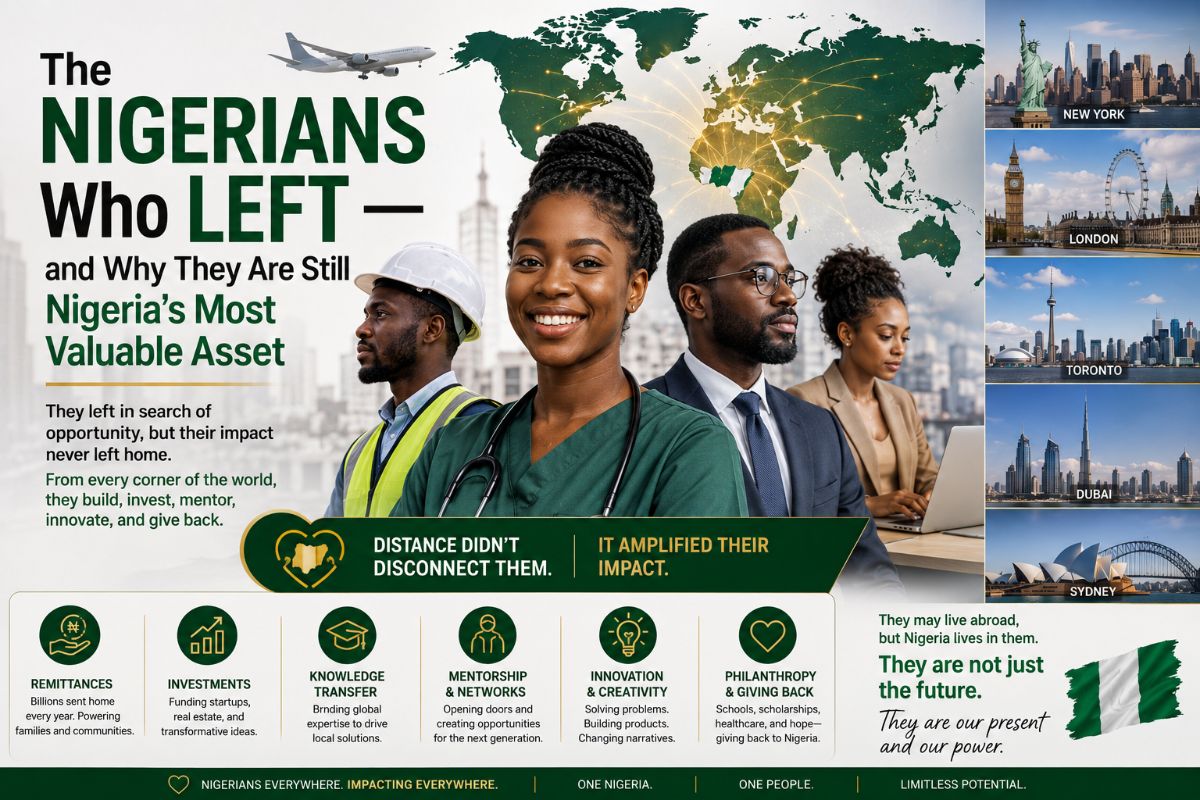
On a Tuesday afternoon in a hospital in Houston, Texas, a Nigerian doctor named Chukwuemeka performs a surgery that will save a life. He trained at the University of Lagos. He completed his residency in Ibadan. He moved to the United States twelve years ago when the gap between what he could earn and what he needed to live a stable life became too large to bridge on a Nigerian public hospital salary.
On a Tuesday afternoon in a hospital in Houston, Texas, a Nigerian doctor named Chukwuemeka performs a surgery that will save a life. He trained at the University of Lagos. He completed his residency in Ibadan. He moved to the United States twelve years ago when the gap between what he could earn and what he needed to live a stable life became too large to bridge on a Nigerian public hospital salary. Every month, without fail, he sends money home. To his mother in Enugu. To his sister's children's school fees. To the community development project in his hometown that is building a health centre. Last year, he sent the equivalent of ₦18 million. Multiply him by six million. That is approximately the size of Nigeria's diaspora — Nigerians living outside the country, on every continent, in virtually every country with a functioning economy. And the money they send home — remittances — has become one of the most significant financial flows in the entire Nigerian economy. The Numbers Are Staggering In 2025, Nigeria received approximately $20 billion in remittances from its diaspora. That figure places Nigeria among the top five remittance-receiving countries in the world, and it is the largest single source of foreign exchange inflows into the Nigerian economy — larger than oil revenues in some quarters, larger than all foreign direct investment combined. Twenty billion dollars. Sent home by Nigerians abroad, in amounts ranging from a few hundred dollars to tens of thousands, through bank transfers and mobile money platforms and the informal hawala networks that predate the modern financial system. Sent to pay school fees, to fund medical treatment, to support aging parents, to invest in small businesses, to build houses, to keep families afloat in an economy that has made keeping afloat genuinely difficult. The World Bank ranks Nigeria as the largest remittance recipient in Sub-Saharan Africa and the sixth largest in the world. By some estimates, remittances account for more than five percent of Nigeria's GDP — a contribution that appears in no government budget, is claimed by no ministry, and yet reaches the households that need it most with a directness and efficiency that formal aid flows rarely achieve. Why They Left To understand the diaspora, you have to understand the departures. And the departures tell a story about Nigeria that is, in many ways, more honest than official economic statistics. The doctors left because Nigerian public hospitals could not pay them salaries that reflected the value of their skills, and because working in those hospitals — with their persistent shortages of drugs, equipment, and electricity — had become professionally demoralising as well as financially inadequate. The United Kingdom, Canada, Australia, and the United States have systematically recruited Nigerian medical professionals for decades, offering salaries, working conditions, and career development opportunities that the Nigerian health system cannot mat