Why Nigeria Still Has No Light: The Truth About the Power Crisis Nobody Wants to Tell You
Category: Viral | Author: NaijaToday Investigative Desk | June 21, 2026 | Published: Mon Jun 22 2026
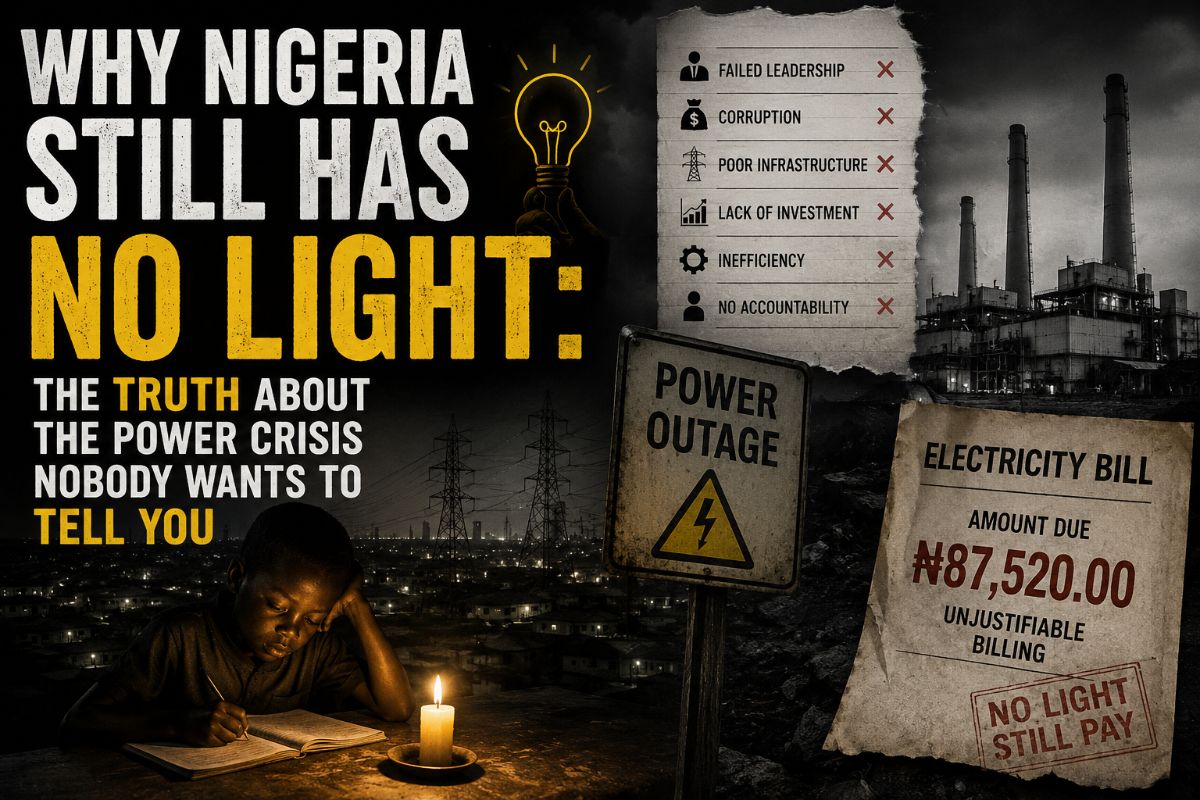
If you are reading this in Lagos, Abuja, Kano, Port Harcourt, Enugu, or virtually any other city in Nigeria, that statement is almost certainly true. The only variable is how long the outage lasted, how many times it happened, and what it cost you — in generator fuel, in spoiled food, in work interrupted, in the particular low-grade exhaustion that comes from living in a country that cannot reliably keep the lights on.
At some point in the last 24 hours, your electricity went out. 🤔 If you are reading this in Lagos, Abuja, Kano, Port Harcourt, Enugu, or virtually any other city in Nigeria, that statement is almost certainly true. The only variable is how long the outage lasted, how many times it happened, and what it cost you — in generator fuel, in spoiled food, in work interrupted, in the particular low-grade exhaustion that comes from living in a country that cannot reliably keep the lights on. Nigeria has been having this conversation for decades. Every administration since independence has promised to fix electricity. Every administration has failed. The country that sits atop some of the world's largest natural gas reserves — gas that could, if properly harnessed, generate electricity for the entire continent — cannot reliably power its own homes. This is not an accident. It is the accumulated result of specific decisions, specific failures, and specific interests that have profited from the dysfunction. The Numbers That Should Shame Us 🤔 Let us start with the facts, because the facts are extraordinary in what they reveal. Nigeria has an installed electricity generation capacity of approximately 13,000 megawatts. On a good day — and good days are rare — the national grid delivers between 3,500 and 5,000 megawatts to consumers. That is less than 40 percent of installed capacity, on the best days. South Africa, with a population roughly one-sixth of Nigeria's, generates over 40,000 megawatts. Egypt generates over 50,000 megawatts. Ghana — a country of 33 million people compared to Nigeria's 220 million — has achieved a level of electricity reliability that Nigerian businesspeople openly envy. The gap between Nigeria's installed capacity and its actual generation is explained by a cascade of failures: gas supply constraints that mean power plants sit idle because they cannot get fuel; transmission infrastructure so old and poorly maintained that it cannot carry power from where it is generated to where it is needed; distribution networks characterised by commercial losses, technical losses, and the theft of electricity on a scale that would be difficult to believe if the evidence were not so well-documented. And at the base of all of this: decades of chronic underinvestment, compounded by subsidy policies that kept electricity prices so low that the companies responsible for generating, transmitting, and distributing it could not recover their costs, let alone invest in expansion or maintenance. The Privatisation That Did Not Work 😀 In 2013, the Nigerian government privatised the electricity sector. The Power Holding Company of Nigeria (PHCN) — the state monopoly that had delivered consistently inadequate power for decades — was broken up and its components sold to private investors. The theory was sound. Private ownership would bring accountability, capital, and the profit motive to an industry that government had shown it could not manage. Competition,