Why Nigerian Men Don't Say "I Love You" — And What They Mean Instead
Category: Relationship | Author: NaijaToday Desk | Published: Sun Jun 28 2026
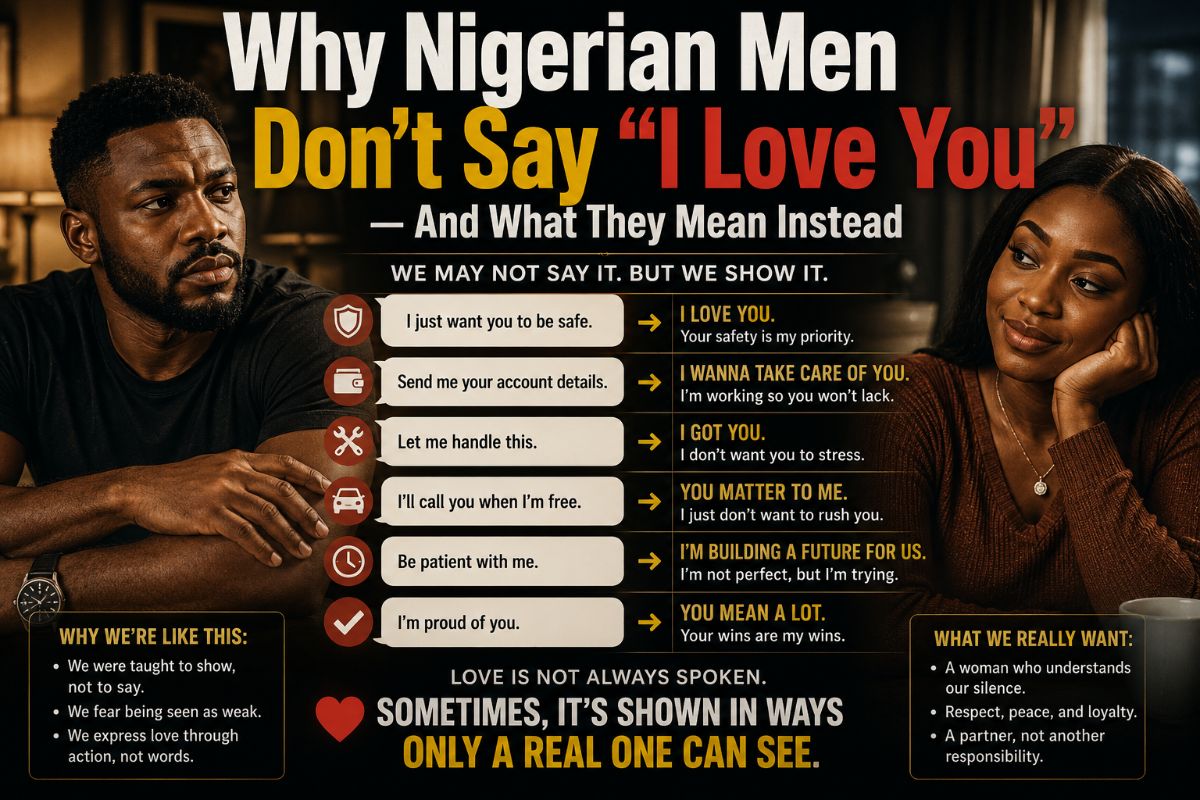
Love in Nigeria doesn't always come with the words. It comes with actions, sacrifices, and a language that was never taught in schools. Here's what we've been missing.
Why Nigerian Men Don't Say "I Love You" — And What They Mean Instead On love, silence, and the unspoken dialects of African affection There is a man somewhere in Nigeria right now who has been married to the same woman for thirty-one years. He has never, not once, looked her in the eyes and said the words. Not on their wedding day. Not when she survived a difficult childbirth. Not even last Christmas when the grandchildren were gathered in the sitting room and the television was playing and the jollof rice was perfect and the moment was, by every possible standard, made for the words. He did not say them. But here is what he did. He woke up every morning for thirty-one years and made sure there was money for food before he left for work. When she was sick in 1999, he sat outside the hospital room on a plastic chair for eleven hours and did not leave even when the nurses told him visiting hours were over. When her mother died, he drove four hours in the rain to the village and carried the coffin on his shoulder and did not complain once. When her business failed, he did not say a single word about it. Just quietly gave her money to start again. He has never said "I love you." But if you asked his wife whether she is loved, she would look at you the way you look at someone who has just asked a question so obvious it is almost offensive. Of course , she would say. Can't you see? The Language We Were Never Taught to Translate The problem with the global conversation about love and relationships is that it was largely written in English, by people whose emotional culture expresses itself in words. And when you grow up watching American movies and reading romance novels where love is always announced, always declared, always verbal — you begin to believe that love which is not spoken is love which does not exist. This is one of the most damaging lies that Western cultural exports have told African people about themselves. Love in Nigeria — in most of Africa — has always had a different grammar. It is a language of action rather than declaration. Of presence rather than proclamation. Of sacrifice rather than statement. And learning to read that language, rather than waiting for a translation that may never come, might be one of the most important things a person can do for their own emotional life. This is not to say that words do not matter. They do. There is something that happens when someone looks at you and says the words — something that no amount of action can fully replace, because human beings need to hear themselves spoken into significance by the people they love. But it is to say that a man who has never said "I love you" in thirty-one years and a man who is not in love are not the same man. And collapsing those two different realities into one is a failure of emotional literacy that costs people — costs women especially — the ability to recognize what they actually have. What They Do Instead So what does Nigerian love actually look like whe