Dangote Refinery Has Cut Petrol Prices Four Times in a Month — Here's What It Means at the Pump
After months of uncertainty in Nigeria's downstream petroleum sector, motorists finally have something positive to watch.
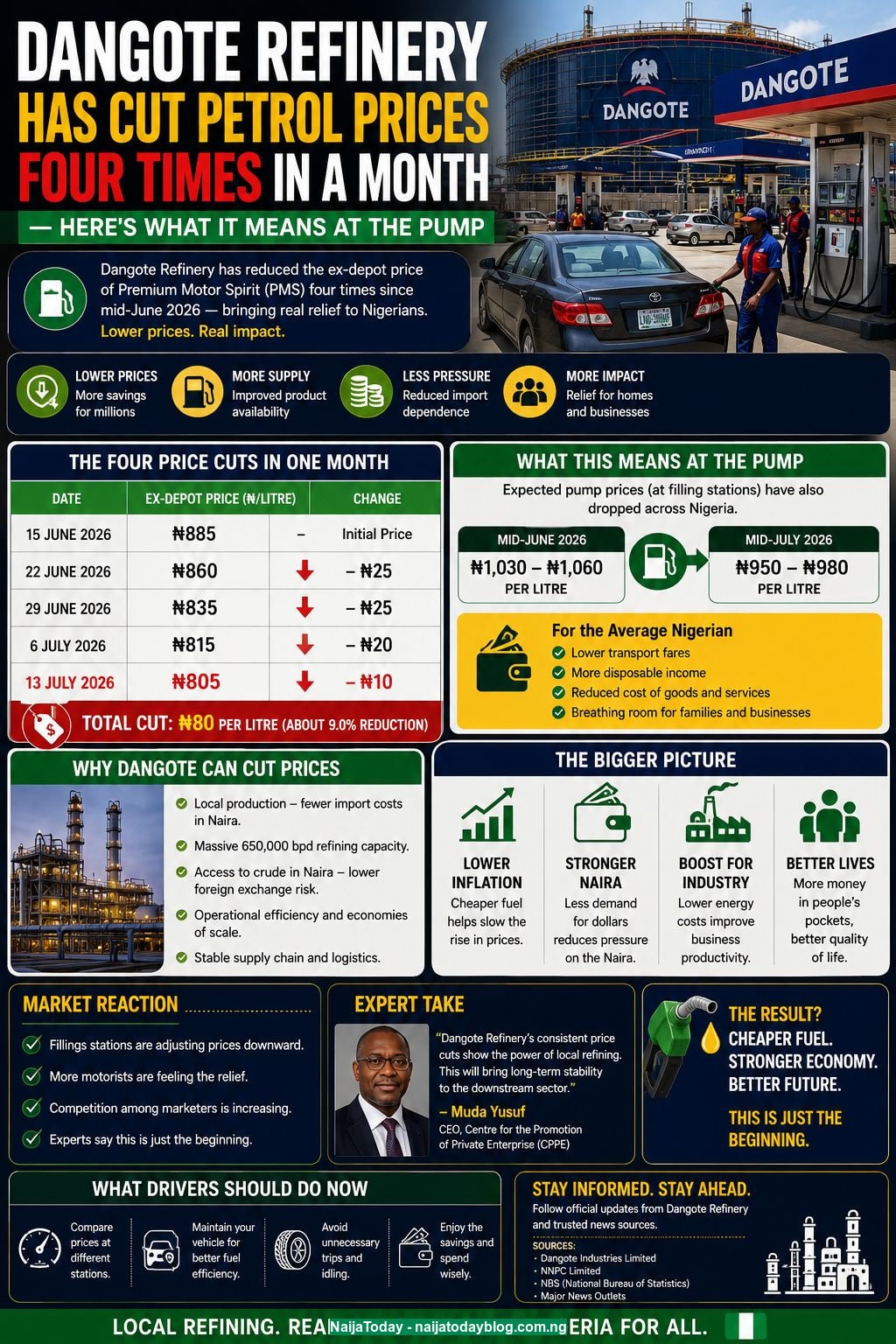
The Dangote Petroleum Refinery has reduced its ex-depot (gantry) price for Premium Motor Spirit (PMS) four times since the end of May 2026, bringing the total reduction to ₦200 per litre in just one month. The latest adjustment lowered the gantry price by ₦50, bringing it down to ₦1,075 per litre.
While many Nigerians are eager to know whether they will immediately pay less at filling stations, the answer is a little more complicated.
The refinery's price reduction is undoubtedly good news, but motorists should understand how fuel pricing works in Nigeria's deregulated market and why pump prices don't always fall overnight.
Still, the recent trend points in a positive direction and could encourage stronger price competition across the country.
Dangote Refinery's Recent Petrol Price Changes
Fuel prices have moved sharply this year, reflecting both global oil market developments and changes within Nigeria's deregulated petroleum sector.
According to available pricing data, Dangote Refinery's petrol prices have followed this timeline:
March 2, 2026: ₦874 per litre
March 7, 2026: ₦995 per litre
March 9–10, 2026: ₦1,175 per litre following a sharp increase in global crude oil prices
Late May through early July 2026: Four consecutive price reductions that brought the gantry price down to ₦1,075 per litre
The latest reduction was confirmed by Anthony Chiejina, Chief Communications Officer of Dangote Group, while refinery officials told local media that the revised pricing took immediate effect.
The speed of these adjustments demonstrates how closely domestic fuel prices are now linked to developments in the international energy market.
Why Petrol Prices Rose So Quickly Earlier This Year
Many Nigerians were surprised when petrol prices increased sharply in March.
However, the rise was not caused by domestic shortages alone.
Global crude oil prices surged after renewed geopolitical tensions in the Middle East disrupted international energy markets.
As uncertainty grew, Brent crude prices climbed significantly, increasing production costs for refiners around the world.
Although Dangote Refinery operates in Nigeria, it purchases crude oil using international pricing benchmarks.
This means the refinery is still affected by global market conditions.
Speaking earlier this year, Dangote Refinery Chief Executive Officer David Bird explained that the company could not completely shield itself from rising crude prices because refining costs are directly linked to international oil markets.
When crude becomes more expensive, producing petrol also becomes more expensive.
Those higher costs eventually influence wholesale fuel prices.
Why Prices Are Falling Again
Fortunately, the situation has improved over recent weeks.
As tensions in the Middle East eased, global oil markets became less volatile.
Brent crude prices retreated from earlier highs, reducing the cost of refining petroleum products.
Lower crude prices have given Dangote Refinery room to gradually reduce its gantry price.
Rather than making one dramatic adjustment, the refinery has implemented four separate reductions within one month.
This gradual approach allows marketers and distributors to adjust inventories while responding to changing market conditions.
It also reflects the reality of a deregulated market where prices respond to supply and demand rather than government directives.
What Exactly Is the Gantry Price?
One of the biggest misconceptions surrounding recent announcements is that the gantry price is the same as the price motorists pay at filling stations.
It is not.
The gantry price, sometimes called the ex-depot price, is the amount petroleum marketers pay when purchasing fuel directly from the refinery.
From that point, several additional costs are added before fuel reaches consumers.
These include:
Transportation and logistics
Storage costs
Retail operating expenses
Dealer margins
Distribution costs
Regulatory charges
As a result, a reduction in the gantry price does not automatically translate into an equal reduction at petrol stations.
Instead, it creates room for marketers to lower retail prices as competition increases.
When Will Motorists Notice Lower Pump Prices?
That is the question on everyone's mind.
The answer depends on several factors.
Many filling stations already have existing fuel stocks purchased at higher prices.
Before reducing retail prices, marketers often need to sell part of their current inventory.
In addition, transportation costs vary across Nigeria.
Petrol transported to Maiduguri, Sokoto, Calabar, or Yola naturally costs more than fuel supplied within Lagos, where the refinery is located.
Distance, logistics, road conditions, and distribution expenses all influence final pump prices.
Nevertheless, as marketers replenish supplies using the lower gantry price, consumers are expected to gradually benefit from lower prices.
Competition among independent marketers may accelerate that process.
Diesel Prices Are Also Falling
The latest adjustments are not limited to petrol alone.
Dangote Refinery has also reduced the price of Automotive Gas Oil (AGO), commonly known as diesel.
According to the refinery's pricing notice, diesel prices have fallen by approximately ₦190 per litre, dropping from around ₦1,620 to ₦1,430.
This reduction could have broader economic implications.
Diesel powers thousands of generators used by businesses across Nigeria.
It also fuels heavy-duty trucks transporting food, cement, building materials, pharmaceuticals, and manufactured goods.
Lower diesel prices can therefore reduce transportation costs and business operating expenses over time.
If sustained, those savings could eventually contribute to slower increases in consumer prices.
Competition Is Beginning to Shape Nigeria's Fuel Market
Perhaps the most significant aspect of these price reductions is what they reveal about Nigeria's evolving downstream petroleum industry.
Since fuel price controls were removed, petroleum companies have been expected to compete based on market conditions.
Instead of government agencies fixing prices, refiners and marketers now respond to actual production costs and competitive pressures.
Dangote Refinery's recent pricing decisions appear to be influencing the wider market.
Reports indicate that NNPC Limited has also adjusted prices downward at several retail outlets in early July.
This growing competition could ultimately benefit consumers by encouraging more efficient pricing throughout the supply chain.
Rather than relying on subsidies, the market itself may increasingly determine fuel prices.
What Regulators Are Saying
The Nigerian Midstream and Downstream Petroleum Regulatory Authority (NMDPRA) has repeatedly maintained that petrol prices should remain cost-reflective.
In practical terms, this means prices should rise when production costs increase and fall when those costs decline.
Officials argue that this creates a healthier and more sustainable fuel market over the long term.
Similarly, the Minister of State for Petroleum Resources (Oil), Heineken Lokpobiri, recently reiterated that Nigeria has moved beyond the era of government-controlled fuel prices.
According to the minister, expanding domestic refining capacity should naturally encourage competition and improve fuel availability.
If multiple refiners compete for customers, motorists are more likely to benefit from better pricing.
Not Everyone Agrees
Despite the optimism, some industry stakeholders remain cautious.
The Independent Petroleum Marketers Association of Nigeria (IPMAN) has argued that fuel prices should be determined entirely by market forces rather than public expectations surrounding one refinery's pricing decisions.
IPMAN maintains that while Dangote Refinery is now a major supplier, retailers still make independent purchasing decisions based on transportation costs, logistics, storage expenses, and commercial considerations.
This means pump prices could differ from one location to another, even if marketers purchase fuel at the same gantry price.
The debate highlights an important reality of Nigeria's deregulated market: lower wholesale prices do not guarantee identical retail prices nationwide.
What This Means for Nigerians
For millions of Nigerians struggling with high transportation costs and rising living expenses, any reduction in petrol prices is welcome news.
Lower fuel prices can influence almost every part of the economy.
Commercial transport operators may eventually reduce fares.
Businesses relying on petrol generators could experience lower operating costs.
Delivery services may spend less on logistics.
Retailers transporting goods across the country could benefit from reduced distribution expenses.
Although these changes often take time, lower energy costs generally support broader economic stability.
Consumers should, however, remain patient.
Price adjustments usually move gradually through the supply chain rather than appearing instantly at every filling station.
What Should Motorists Expect Next?
The direction of petrol prices over the coming months will largely depend on global crude oil markets.
If international oil prices remain stable—or continue declining—there may be room for additional reductions.
However, renewed geopolitical tensions, supply disruptions, or unexpected increases in crude prices could quickly reverse the current trend.
Exchange rate movements will also play an important role.
Since refining inputs and operational costs remain partly linked to international markets, fluctuations in the value of the naira can still affect domestic fuel prices.
For now, however, the overall outlook is considerably more encouraging than it was earlier this year.
Final Thoughts
Dangote Refinery's decision to reduce its petrol gantry price four times within a single month represents one of the most significant developments in Nigeria's downstream petroleum sector this year.
While motorists may not immediately see matching reductions at every filling station, the lower wholesale price is expected to increase competition among marketers and gradually place downward pressure on retail fuel prices.
Combined with falling diesel prices and increasing domestic refining capacity, these developments suggest Nigeria's energy market is becoming more responsive to changing economic conditions.
The coming weeks will reveal how quickly marketers pass these savings on to consumers.
For millions of Nigerians facing rising transportation and living costs, even modest reductions at the pump could provide meaningful financial relief.
As always, motorists are encouraged to compare prices across filling stations and monitor official announcements from marketers and regulators as the market continues to adjust.
Sources: Channels Television, The Telegraph Nigeria, WithinNigeria, and statements from Dangote Petroleum Refinery, NMDPRA, and the Federal Ministry of Petroleum Resources (July 2026).